<?xml version="1.0" encoding="UTF-8"?><feed
	xmlns="http://www.w3.org/2005/Atom"
	xmlns:thr="http://purl.org/syndication/thread/1.0"
	xml:lang="en-US"
	>
	<title type="text">Thoughtful Journalism</title>
	<subtitle type="text">Explaining complex stories for Canadians</subtitle>

	<updated>2026-11-12T01:55:57Z</updated>

	<link rel="alternate" type="text/html" href="https://energi.media/" />
	<id>https://energi.media/feed/atom/</id>
	<link rel="self" type="application/atom+xml" href="https://energi.media/feed/atom/" />

	<generator uri="https://wordpress.org/" version="7.1.4">WordPress</generator>
<icon>https://energi.media/wp-content/uploads/2026/07/cropped-Energi-Media_Simple-Logo-scaled-1-32x32.png</icon>
	<entry>
		<author>
			<name>Markham Hislop</name>
					</author>

		<title type="html"><![CDATA[Canada’s 2026 budget shifts toward investment, but industrial policy remains unfinished: economist]]></title>
		<link rel="alternate" type="text/html" href="https://energi.media/news/canada-budget-2026-karaguesian-industrial-policy-trump-tariffs/" />

		<id>https://energi.media/?p=69169</id>
		<updated>2026-11-12T01:55:57Z</updated>
		<published>2026-11-12T01:55:57Z</published>
		<category scheme="https://energi.media/" term="Economy" /><category scheme="https://energi.media/" term="Canada" /><category scheme="https://energi.media/" term="News" />
		<summary type="html"><![CDATA[<p>Ottawa is combining tariff relief, trade diversification and investment incentives, but economist Julian Karaguesian says Canada still needs a comprehensive industrial strategy.</p>
<p>The post <a href="https://energi.media/news/canada-budget-2026-karaguesian-industrial-policy-trump-tariffs/">Canada’s 2026 budget shifts toward investment, but industrial policy remains unfinished: economist</a> appeared first on <a href="https://energi.media">Thoughtful Journalism</a>.</p>
]]></summary>

					<content type="html" xml:base="https://energi.media/news/canada-budget-2026-karaguesian-industrial-policy-trump-tariffs/"><![CDATA[<p>Canada’s latest federal budget offers an increasingly coherent response to U.S. tariffs and years of economic stagnation, but Ottawa has yet to articulate a fully developed national industrial policy, according to economist Julian Karaguesian.</p>
<p>In an Energi Talks interview with publisher Markham Hislop, Karaguesian said the November 5 budget brings together support for industries affected by Donald Trump’s tariffs, efforts to diversify exports and measures intended to encourage domestic and foreign investment.</p>
<p>Many of the initiatives had been announced before budget day, he said. Their significance lies partly in how they fit together.</p>
<p><iframe title="YouTube video player" src="https://www.youtube.com/embed/0RHDV_uT86g?si=GsDOjW6ZTpST2s2v" width="560" height="315" frameborder="0" allowfullscreen="allowfullscreen"></iframe></p>
<h2>Tariff relief and new trading relationships</h2>
<p>Karaguesian described a collection of programs supporting industries that have lost business because of tariffs, including steel. Individually, some measures are relatively modest, but collectively they represent billions of dollars in assistance, he said.</p>
<p>Ottawa is also reallocating resources to strengthen trade relationships with countries including China, India, Indonesia and Mexico, as well as Europe. The objective is to reduce Canada’s heavy dependence on the U.S. market.</p>
<p>Major infrastructure is another central element. Karaguesian pointed to port expansions, pipelines and LNG projects as examples of investments intended to improve access to markets beyond the United States.</p>
<h2>A tax incentive for investment</h2>
<p>The productivity mega deduction could play an important role in that strategy, Karaguesian said. It allows businesses to deduct eligible capital expenditures, including qualifying equipment and software, up front rather than spreading deductions over many years.</p>
<p>He cautioned that a tax measure alone would have limited impact during economic stagnation. Combined with public infrastructure investment, efforts to attract private capital and expanded market access, however, it could encourage companies to invest.</p>
<h2>Old industries and new technologies</h2>
<p>Asked whether the government is reinforcing established industries or building new ones, Karaguesian said the answer is both.</p>
<p>Western resource exports remain an important focus, particularly LNG and related infrastructure. At the same time, he pointed to federal support for artificial intelligence, research partnerships and discussions with Europe about independent digital infrastructure.</p>
<p>The automotive industry is less certain. Karaguesian said Canada has not yet developed a comprehensive nationwide industrial policy, although he expects the government’s approach to evolve.</p>
<p>He traced the erosion of Canadian manufacturing to several forces, including offshoring, currency appreciation and the restructuring of North American automotive production.</p>
<h2>Growth beyond the headlines</h2>
<p>The interview also addressed Canada’s weak productivity performance and stagnant real income per person. Karaguesian questioned political claims of economic leadership that fail to reflect the pressures many households face.</p>
<p>He characterized the budget as investment-focused rather than consumption-focused, with government resources directed toward infrastructure and productive capacity.</p>
<p>For Canada, the unresolved test is whether those investments translate into more competitive industries, higher productivity and lasting gains in living standards.</p>
<p>The post <a href="https://energi.media/news/canada-budget-2026-karaguesian-industrial-policy-trump-tariffs/">Canada’s 2026 budget shifts toward investment, but industrial policy remains unfinished: economist</a> appeared first on <a href="https://energi.media">Thoughtful Journalism</a>.</p>
]]></content>
		
			</entry>
		<entry>
		<author>
			<name>Markham Hislop</name>
					</author>

		<title type="html"><![CDATA[Battery storage opens evening electricity markets to solar: Ember]]></title>
		<link rel="alternate" type="text/html" href="https://energi.media/news/battery-storage-solar-evening-power-ember/" />

		<id>https://energi.media/?p=69171</id>
		<updated>2026-11-12T01:50:08Z</updated>
		<published>2026-11-12T01:50:08Z</published>
		<category scheme="https://energi.media/" term="Electrification" /><category scheme="https://energi.media/" term="News" />
		<summary type="html"><![CDATA[<p>Battery storage is extending solar power into evening hours, with California and Bulgaria already meeting roughly a quarter of evening demand, Ember finds.</p>
<p>The post <a href="https://energi.media/news/battery-storage-solar-evening-power-ember/">Battery storage opens evening electricity markets to solar: Ember</a> appeared first on <a href="https://energi.media">Thoughtful Journalism</a>.</p>
]]></summary>

					<content type="html" xml:base="https://energi.media/news/battery-storage-solar-evening-power-ember/"><![CDATA[<p>Battery storage is pushing solar power beyond daylight hours and into electricity markets long dominated by fossil fuels, according to a report from energy think tank Ember.</p>
<p><a href="https://ember-energy.org/latest-insights/batteries-have-unlocked-the-era-of-anytime-solar/">The analysis</a>, published August 12, finds solar and batteries already supplied roughly a quarter of evening electricity demand in California and Bulgaria during the first half of 2026.</p>
<p>Globally, batteries expected to be installed this year could shift 34 per cent of new daily solar generation into evening hours, based on solar growth during the first six months. That compares with 18 per cent in 2025 and just 4 per cent in 2021.</p>
<p>Ember cautions that the estimate is a theoretical ceiling. It assumes all the new batteries are used to shift solar electricity. Actual performance depends on how storage is operated and whether electricity market rules allow batteries to earn revenue from multiple services.</p>
<p>The findings point to a new phase of solar expansion.</p>
<p>Solar supplied just over 10 per cent of global electricity in the first half of 2026, nearly double its 5.6 per cent share three years earlier. On an average day, it met more than a quarter of demand between 11 a.m. and 2 p.m., before falling to almost nothing overnight.</p>
<p><iframe loading="lazy" title="YouTube video player" src="https://www.youtube.com/embed/3pS8Z7xuYfs?si=bHEd2NL_hfbHmVhu" width="560" height="315" frameborder="0" allowfullscreen="allowfullscreen"></iframe></p>
<p>That concentration creates problems in markets already producing abundant midday solar electricity. Wholesale prices can turn negative, generators may be forced to curtail output, and returns on additional solar projects weaken.</p>
<p>Batteries can store that electricity for later use, reducing waste and allowing solar to compete during evening demand peaks.</p>
<p>In California, solar and batteries met more than a quarter of demand between 7 p.m. and 9 p.m. in the first half of 2026, up from 6.8 per cent in the same period of 2023.</p>
<p>Bulgaria reached 24 per cent during those evening hours. In Chile, batteries helped solar meet more than 10 per cent of electricity demand through the evening and into midnight.</p>
<p>“Solar’s role in global power systems can be far bigger than previously thought possible,” Ember analyst Kostantsa Rangelova said in the report.</p>
<p>Deployment is accelerating. Ember cites projected global battery additions of 459 gigawatt-hours in 2026, a 50 per cent increase from 307 gigawatt-hours last year.</p>
<p>But installing equipment is only part of the challenge.</p>
<p>Batteries can earn money by shifting electricity between low-price and high-price hours, supporting grid stability and providing capacity when needed. Rules that let operators combine those revenue streams can improve utilisation.</p>
<p>China illustrates the gap. Standalone batteries averaged 299 charge-discharge cycles in 2025, while batteries installed alongside generation averaged just 199. Ember compares that with international best practice of about 350 cycles annually.</p>
<p>Storage also has limits. Today&#8217;s batteries primarily address daily fluctuations, leaving prolonged cloudy weather and seasonal shortages as continuing challenges.</p>
<p>Ember says electricity systems will still need a complementary mix of wind, hydro, nuclear and longer-duration storage.</p>
<p>The next stage of solar growth will depend increasingly on deploying batteries and integrating them into electricity markets, the report concludes. That makes market reform central to further expansion.</p>
<p>The post <a href="https://energi.media/news/battery-storage-solar-evening-power-ember/">Battery storage opens evening electricity markets to solar: Ember</a> appeared first on <a href="https://energi.media">Thoughtful Journalism</a>.</p>
]]></content>
		
			</entry>
		<entry>
		<author>
			<name>Markham Hislop</name>
					</author>

		<title type="html"><![CDATA[Forever Canadian’s Next Chapter: A New Model for Alberta Politics?]]></title>
		<link rel="alternate" type="text/html" href="https://energi.media/news/forever-canadian-next-chapter-alberta-politics/" />

		<id>https://energi.media/?p=69093</id>
		<updated>2026-11-12T01:45:31Z</updated>
		<published>2026-11-12T01:45:31Z</published>
		<category scheme="https://energi.media/" term="Alberta" /><category scheme="https://energi.media/" term="Canada" /><category scheme="https://energi.media/" term="News" /><category scheme="https://energi.media/" term="Politics" />
		<summary type="html"><![CDATA[<p>Thomas Lukaszuk wants Forever Canadian to turn its referendum campaign into a lasting movement, combining personal connections, civic education and technology.</p>
<p>The post <a href="https://energi.media/news/forever-canadian-next-chapter-alberta-politics/">Forever Canadian’s Next Chapter: A New Model for Alberta Politics?</a> appeared first on <a href="https://energi.media">Thoughtful Journalism</a>.</p>
]]></summary>

					<content type="html" xml:base="https://energi.media/news/forever-canadian-next-chapter-alberta-politics/"><![CDATA[<h2>&#8220;Albertans are not right-wing or left-wing. They have both wings. They’re the whole chicken.” &#8211; Thomas Lukaszuk, Forever Canadian</h2>
<p><em>By Bob Weber, freelance journalist</em></p>
<p>It was three days before Alberta’s vote-to-have-a-vote on separation. Outside Edmonton’s Expo Centre, people lined up for nearly a kilometre waiting to enter a pro-Canada rally sponsored by the group Forever Canadian. The mood was upbeat, even celebratory. The crowd was awash in red. Jackets, t-shirts, ball caps and hoodies flew enough maple leaves for a small forest. Inside, floodlights flashed, flags waved and music pumped.</p>
<p>But the din was nothing compared to the roar from 6,000 throats that greeted the headline speakers – Prime Minister Mark Carney and the leader of Forever Canadian, Thomas Lukaszuk.</p>
<p>“Now is the time to send a strong signal to the world that Canada is united, independent, and will never become a 51st state,” orated Lukaszuk to thunderous cheers. “Friends, we are making history over here and I know that 50 or 100 years from now our children and grandchildren will be studying about this moment in their social studies classes. And they will be looking back at us in 2026 and judging us for who we were.”</p>
<p>More cheers. Many, many more.</p>
<p>A few days after that vote decisively repudiated separation, Lukaszuk sat in Forever Canadian’s offices in a northwest Edmonton light industrial zone. He joked about the minimalist décor. Once-teeming rooms are deserted. Tables formerly piled with papers are clear and there isn’t a computer in sight.</p>
<p>The quiet, though, is deceptive. The referendum is over, but Forever Canadian will go on. Lukaszuk is determined not to let the energy from events like the one at the Expo Centre dissipate.</p>
<p>In fact, he hopes what he now calls a movement will offer a new model for politics in Canada, one that combines old-fashioned hand-shaking, beer-sipping, heart-to-hearts with artificial intelligence and social media used to bring people together instead of drive them apart.</p>
<p>“I think Forever Canadian has shown Albertans that politics doesn’t have to be partisan,” he said. “Albertans are not right-wing or left-wing. They have both wings. They’re the whole chicken.”</p>
<p><iframe loading="lazy" title="YouTube video player" src="https://www.youtube.com/embed/1D4Oa5lXU6w?si=4vXP39TQ9lUtmfyS" width="560" height="315" frameborder="0" allowfullscreen="allowfullscreen"></iframe></p>
<h3>A Campaign Built On Conversations</h3>
<p>This, of course, is a familiar observation. University of Alberta research suggests on most issues, opinion in the province doesn’t veer that much from the national average. Pollsters find that on a left-right scale from one to 10, Albertans average a politely conservative six. But when Lukaszuk says it, it carries the weight of experience.</p>
<p>“I think I have met personally more people than any political candidate ever has in running for office,” he said. Over 18 months – perhaps the longest campaign in Canadian political history – Lukaszuk’s Unity Bus racked up 40,000 kilometres, from Peerless Lake First Nation in the north to Coutts on the U.S. border.</p>
<p>That odyssey on the Unity Bus was very different from his experience as a provincial cabinet minister.</p>
<p>“My experience prior to this campaign was very superficial,” Lukazsuk said. “You fly in on a government airplane to a little town, meet with city council, have lunch, fly back to the legislature. When you’re in office, people are not always as open and honest with you as they could be. (The Unity Bus) was a very organic, raw experience. I would drive in, no staffers, and meet with anybody who cared to come up and say hello. People of all political views were coming up. I could spend several hours in each town, go to a local diner, sleep in a local campground, drink beer with people I never met and will probably never meet again. People were very open about their politics because it was a safe space. This wasn’t the conservative bus or the liberal bus. This was the Forever Canadian bus.”</p>
<p>“We had people of all political backgrounds working together, showing that we actually can work together,” Lukaszuk said. From the start, he had help from people as diverse as Ian McClelland, a co-founder of the old Reform Party, former Liberal Deputy Prime Minister Anne McLellan and onetime provincial New Democrat leader Brian Mason. And before long, he had a small army of 18,000 volunteers helping out and hundreds of thousands of dollars to spend. Now, with the referendum done and dusted, that’s a lot of non-partisan money and energy looking for a place to go.</p>
<h3>What Comes Next For Forever Canadian</h3>
<p>Lukaszuk has a few ideas on that. Firstly, the organization will remain vigilant for the return of a second referendum. Although Premier Danielle Smith has promised she won’t start one, Lukaszuk notes her government has lowered the bar for private citizens to initiate such a vote and the separatists haven’t gone away.</p>
<p>“I think the possibility of one is greater than not having one,” Lukaszuk said.</p>
<p>But he has bigger things in mind. The country needs to know itself better, he said.</p>
<p>“Lack of understanding among the provinces of each other and each other’s economies is a problem. When I spoke to the Economic Club of Canada – Bay Street, essentially – I was astonished how little they know about how integrated Alberta’s economy is with Ontario’s.”</p>
<p>Forever Canadian is already talking about that work with think tanks such as the Canada West Foundation. The Pembina Institute has reached out. So has the Manning Centre for Building Democracy. Lukaszuk muses about the need for better civics education to give Canadians a better understanding of Canadian history, governance and its role in the world. He’s pushing for a national curriculum review and has already met with the Alberta Educators Society to that end.</p>
<h3>Using Technology To Bring People Together</h3>
<p>Forever Canadian’s most powerful legacy may flow from how it conducted its voter campaign.</p>
<p>Lukaszuk recalls how difficult it was at first for the group’s volunteers to keep in touch with each. Text messages were secure, but unwieldy for thousands of people. Facebook sites were better, but prone to disruptive infiltration by separatists.</p>
<p>So Forever Canadian created its own Facebook-like site, restricted to members. That site remains active. “Right now there are several thousand of them talking to each other on our private Facebook, because they found each other,” Lukaszuk said. “Especially in rural Alberta. Those are the biggest users of our platform. It’s a safe space.”</p>
<p>It wasn’t Forever Canadian’s only forward-thinking use of technology.</p>
<p>The group trained an artificial intelligence program to answer the thousands of email questions it was getting – which otherwise would have taken dozens of staffers and scarce resources. They used AI demographic analysis to find the best sites for collecting petition signatures. AI told them, for example, to stop going to hockey games but keep attending football.</p>
<p>They used AI to plan the most efficient route for the Unity Bus, one that would not only hit the most communities with the fewest kilometres, but would also line up with community events – say, the Smoky Lake Pumpkin Festival. And to get people to the polls, Forever Canadian stood up its own province-wide ride-sharing service, a sort of bespoke Uber for patriots.</p>
<p>But it’s the online communication that Lukaszuk likes to talk about most. Forever Canadian may have become the antidote to the toxic polarization of today’s Alberta politics.</p>
<p>“We created a community in Alberta,” Lukaszuk said. “It became a movement.”</p>
<h3>A Possible Return To Politics</h3>
<p>For now, Lukaszuk plans to return to his financial business. He doesn’t rule out a return to politics, but he’s clear about what that decision would take.</p>
<p>“Only if the necessity requires,” he said. “I would have to be at a point that is exactly the same as I was in June 2025 when I knew that separatists were going to file a petition. I looked around. Nobody else was stepping up. When I called people around, they said not interested. Then I knew I had to do it. If I am to enter politics, it will probably happen under much the same circumstances.”</p>
<p>Lukasuk acknowledges that he and Carney see eye-to-eye on a lot of things.</p>
<p>“I get along with him exceptionally well,” he said. “I think he is the first Prime Minister in a long time who understands Canada’s role in the world and what a big role Canada can play. I come from a perspective that if the call comes to serve you country, you serve your country. If a prime minister calls you and says, I need you to do this, then you don’t ask why, you just say when.”</p>
<p>Forever Canadian may already be considering a move into electoral politics. A few days after the referendum, Forever Canadian circulated a survey to supporters. It asked what the group should do next, such as producing podcasts, developing educational materials, building an online community or simply planning for next year’s 160th Canada Day.</p>
<p>It asked if respondents would vote for candidates approved by Forever Canadian; it also probed whether the group should get more involved in politics and whether Alberta needs a new political party, asking further if respondents would join it, donate to it or volunteer for it.</p>
<p>But wherever Lukaszuk goes and whatever the movement he created does, the lessons he learned from Forever Canadian will stick.</p>
<p>“Forever Canadian has shown Albertans that politics doesn’t have to be partisan,” Lukaszuk said. He scorns leaders who gin up support by pointing to a bad guy who is the source of all problems. “That’s lazy politics,” he said.</p>
<p>Over and over, said Lukaszuk, people thanked him for his approach. “ ‘Thank you for giving us our voice back’ &#8211; I must have heard that a thousand times. I would always say you always had your voice, you just chose not to use it. They said no, no, no. We needed something like this to bring us together and give us our voice back.”</p>
<p>Forever Canadian’s offices are now closed. The group that arguably saved the country has left its digs in the remote, light-industrial no-man’s-land of northwest Edmonton. Its new headquarters will be in the city’s 124th street area, a lively neighbourhood of cafes, galleries, and small business just off downtown. It will be, appropriately, in the centre.</p>
<h2>Related Energi Media Journalism</h2>
<ul>
<li><a href="https://energi.media/canada/alberta-referendum-forever-canadian-permanent-office/">Forever Canadian Plans Permanent Office After Alberta Referendum</a></li>
<li><a href="https://energi.media/news/thomas-lukaszuk-alberta-separatism-backfires/">Alberta Separatism Is Reviving Canadian Patriotism, Says Thomas Lukaszuk</a></li>
<li><a href="https://energi.media/canada/canada-separatism-foreign-interference-stewart-prest/">Canada Must Draw a Clear Line Against Foreign Support for Separatism</a></li>
</ul>
<p>The post <a href="https://energi.media/news/forever-canadian-next-chapter-alberta-politics/">Forever Canadian’s Next Chapter: A New Model for Alberta Politics?</a> appeared first on <a href="https://energi.media">Thoughtful Journalism</a>.</p>
]]></content>
		
			</entry>
		<entry>
		<author>
			<name>Markham Hislop</name>
					</author>

		<title type="html"><![CDATA[Carney&#8217;s Electrification Budget Is a Breakthrough. Now Triple the Ambition]]></title>
		<link rel="alternate" type="text/html" href="https://energi.media/canada/carney-electrification-budget-2026-needs-bigger-ambition/" />

		<id>https://energi.media/?p=69150</id>
		<updated>2026-11-06T00:38:04Z</updated>
		<published>2026-11-06T00:38:04Z</published>
		<category scheme="https://energi.media/" term="Electrification" /><category scheme="https://energi.media/" term="Canada" /><category scheme="https://energi.media/" term="Markham on Energy" />
		<summary type="html"><![CDATA[<p>Budget 2026 makes electricity and electrification central to Canada's economic future. The vision is excellent, but the scale of the supply buildout and adoption programs must grow.</p>
<p>The post <a href="https://energi.media/canada/carney-electrification-budget-2026-needs-bigger-ambition/">Carney&#8217;s Electrification Budget Is a Breakthrough. Now Triple the Ambition</a> appeared first on <a href="https://energi.media">Thoughtful Journalism</a>.</p>
]]></summary>

					<content type="html" xml:base="https://energi.media/canada/carney-electrification-budget-2026-needs-bigger-ambition/"><![CDATA[<p>Prime Minister Mark Carney has delivered the budget I&#8217;ve been waiting for. Budget 2026 puts electricity and electrification at the centre of Canada&#8217;s economic strategy. The government understands that cheap, abundant, clean electricity is the foundation of industrial competitiveness, energy security and household affordability. It understands that electric cars, heat pumps, and factories are part of one economic transformation. And it&#8217;s prepared to put serious federal money behind that vision.</p>
<p>For someone who&#8217;s spent years arguing that Canada should electrify its economy, this is a terrific budget.</p>
<p>But I&#8217;ve got one big complaint: The ambition isn&#8217;t nearly big enough.</p>
<p>Canada gets about 18 per cent of its end-use energy from electricity. That&#8217;s the starting line. But the math doesn&#8217;t match Carney&#8217;s ambition.</p>
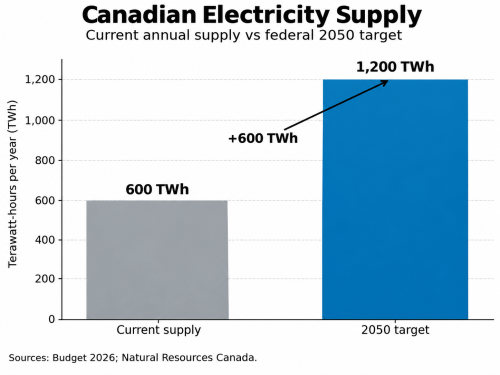
<p>Canada consumes 600 TWh of electricity per year. I&#8217;ve done a rough calculation about how much new industry &#8211; pipelines, LNG&lt; oil sands, mines, smelting and refining, manufacturing, to name the big ones &#8211; could be added by 2050, and the new load could easily be another 600 TWh. That would leave Canada using the same percentage of electricity it does today.</p>
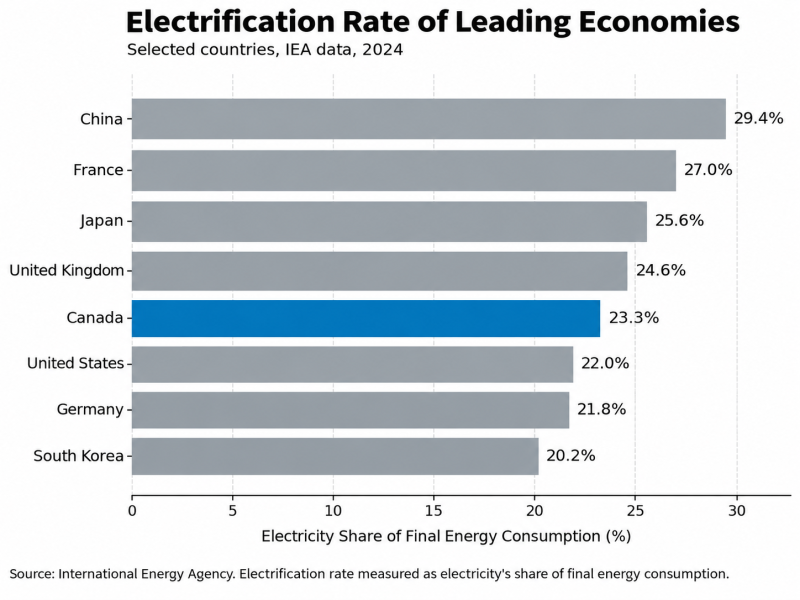
<p>Meanwhile, other advanced economies are advancing at a rapid pace. The electrification rate for China, for example, 30 per cent and it&#8217;s rising by one percentage point per year. China could arrive at mid-century with a rate of 55 to 60 per cent.</p>
<p>The Prime Minister is correct that electrification is more efficient, lower cost, and that electric technologies make Canada more competitive. It follows, then, that Canada should be shooting for a much, much higher degree of electrification than this budget suggests.</p>
<p>An advanced economy that wants to compete in an increasingly electric world should be far more ambitious. The budget finally gets the direction right. Now the federal government needs a plan that matches the scale of the opportunity.</p>
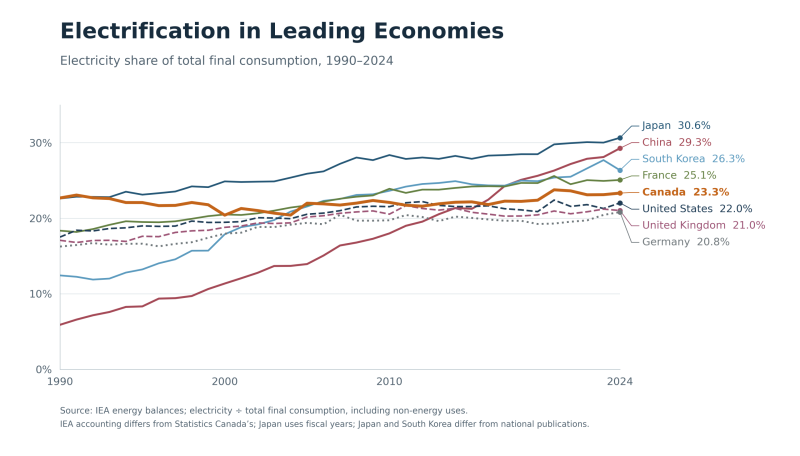
<div id="attachment_69152" style="width: 810px" class="wp-caption aligncenter"><img loading="lazy" decoding="async" aria-describedby="caption-attachment-69152" class="wp-image-69152 size-full" src="https://energi.media/wp-content/uploads/2026/11/Electrification-Rates-of-Leading-Economies-e1793918377421.png" alt="" width="800" height="600" /><p id="caption-attachment-69152" class="wp-caption-text"><strong>There are several methods of calculating electrification rates. This graph uses International Energy Agency data, which gives Canada a higher rate. The 18% referred to in this article uses Canadian Energy Regulator methodology and data. </strong></p></div>
<h3>The Great Electricity Build-Out</h3>
<p><img loading="lazy" decoding="async" class="alignright size-full wp-image-69155" src="https://energi.media/wp-content/uploads/2026/11/Canadian-Electricity-Supply_-2050-Target-1-e1793919136188.png" alt="" width="500" height="375" />Ottawa&#8217;s National Electricity Strategy, first released last spring, aims to double the country&#8217;s electricity system by 2050. Natural Resources Canada says federal support for electrification totals $115 billion through 2041–42, including $52 billion in new Budget 2026 commitments.</p>
<p>Those aren&#8217;t all cheques for new power plants: a large share consists of tax incentives spread over many years.</p>
<p>Still, the program is substantial. The government proposes extending the 30 per cent Clean Technology and 15 per cent Clean Electricity investment tax credits to 2040, at an estimated cost of $38.5 billion. High-voltage transmission lines within provinces would become eligible for the electricity credit. Another $4 billion would support electricity infrastructure, renewable energy and priority grid projects.</p>
<p>Nuclear power, hydroelectricity, offshore wind, northern energy systems, and interprovincial transmission are all in the mix. Projects already receiving federal backing include Darlington nuclear in Ontario, the North Coast Transmission Line in British Columbia, and Churchill Falls and Gull Island in Labrador.</p>
<p>And here&#8217;s where the arithmetic becomes uncomfortable.</p>
<p>Canada produces roughly 600 terawatt-hours of electricity annually. Doubling that would take us to about 1,200 TWh by mid-century, an additional 600 TWh. But expanding industries—everything from critical minerals processing and steel to hydrogen and data centres—could claim a staggering share of that new supply.</p>
<p>Consider a plausible scenario in which new industrial demand alone adds 600 TWh a year. The entire increase in generation would be spoken for before we dramatically electrified the rest of the economy. That&#8217;s a stress test, not a verified federal demand forecast, and we must avoid counting industrial demand twice.</p>
<p>But it exposes a crucial question: is doubling supply sufficient for both industrial expansion and mass electrification?</p>
<p>Ottawa needs to publish an integrated electricity-demand plan, sector by sector, that shows how much power its economic ambitions actually require. If the answer is more than twice today&#8217;s supply, the national target should rise.</p>
<h3>Connecting the Country—and Making the Equipment</h3>
<p>The budget recognizes that generation is only half the battle. Electricity has to get from dams, reactors, and wind farms to the communities and industries that need it.</p>
<p>Canada&#8217;s provincial grids are fragmented</p>
<p>Transmission links could allow provinces to share clean electricity, reduce the need for duplicate capacity and protect customers against disruptions. Ottawa proposes additional transmission support, planning work and new financing arrangements to avoid loading the entire cost of long-lived infrastructure onto today&#8217;s ratepayers.</p>
<p>The most encouraging part might be the industrial logic. Federal tax-credit bonuses of up to 10 percentage points for clean technology and five points for clean electricity are being considered for projects using Canadian-made components. Transformers, cables, batteries, turbines and digital controls could become major Canadian manufacturing opportunities.</p>
<p>That&#8217;s economic sovereignty in concrete form: building the infrastructure and building the industries that supply it. But these domestic-content bonuses are still subject to consultation. Ottawa will have to translate its intentions into orders, factories and jobs.</p>
<h3>Heat Pumps: A Good Start, Not a Mass Transition</h3>
<p><img loading="lazy" decoding="async" class="aligncenter size-full wp-image-69158" src="https://energi.media/wp-content/uploads/2026/11/Screenshot-2026-11-05-at-5.05.49-pm-e1793923586671.png" alt="" width="800" height="304" /></p>
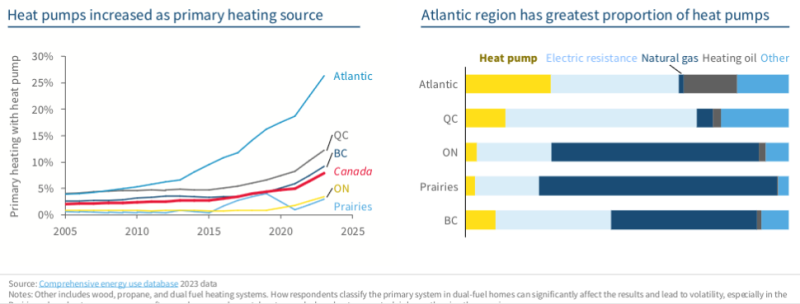
<p>The government is also spending more than $2 billion on one million home retrofits. Its National Heat Pump Rebate is intended to support up to 820,000 households, helping them replace costly heating systems and lower energy bills. The government estimates annual savings exceeding $1 billion across its retrofit effort.</p>
<p>Excellent policy. Modest scale.</p>
<p>Using a working estimate of 17.4 million homes, 820,000 installations would represent about 5.7 per cent of the housing stock over eight years. And not every supported installation necessarily replaces a fossil-fuel heating system. The actual additional electrification would be smaller.</p>
<p>We replace furnaces and other heating equipment every year. That&#8217;s the opportunity: make the electric option easy and affordable whenever a household needs a new system. A serious national electrification program would move beyond a limited rebate pool toward sustained, mass-market adoption, supported by provincial utilities and installers.</p>
<h3>Electric Vehicles Need the Same Ambition</h3>
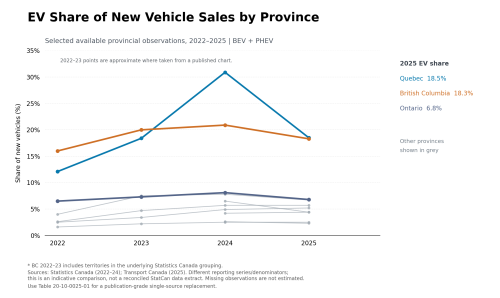
<p><img loading="lazy" decoding="async" class="alignright size-full wp-image-69160" src="https://energi.media/wp-content/uploads/2026/11/Canada-EV-sales-by-province-e1793924416765.png" alt="" width="500" height="298" />Budget 2026 promises more charging infrastructure: over 55,000 additional federally supported chargers, backed by $587 million over five years, alongside support for EV affordability and Canadian automotive manufacturing.</p>
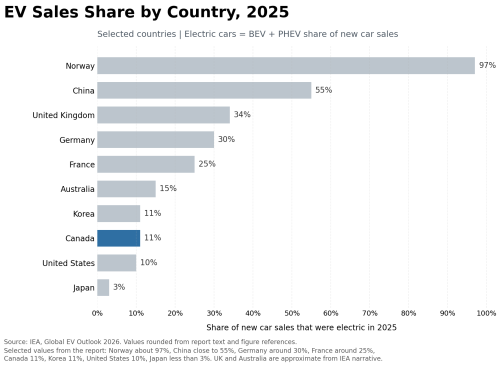
<p><img loading="lazy" decoding="async" class="alignleft size-full wp-image-69161" src="https://energi.media/wp-content/uploads/2026/11/EV-sales-by-country-2025-e1793924812432.png" alt="" width="500" height="372" />Good. Range anxiety is real, especially in rural Canada, and dependable public charging matters. But chargers are only one part of the transition. Canadians also need affordable vehicles, straightforward home and workplace charging, and electricity prices that make switching attractive.</p>
<p>The government&#8217;s own action plan sees electric vehicles and heat pumps as the means of shrinking the household &#8216;energy wallet&#8217;—the combined bill for gasoline, natural gas, heating oil, propane and electricity.</p>
<p>As electricity takes a larger share, overall energy spending can fall because electric technologies use energy more efficiently.</p>
<p>That&#8217;s a compelling affordability argument. Ottawa should make it much more central to public policy.</p>
<p>&nbsp;</p>
<h3>Make the Vision Bigger</h3>
<p><img loading="lazy" decoding="async" class="aligncenter size-full wp-image-69157" src="https://energi.media/wp-content/uploads/2026/11/Canada-electrification-rate-1990-2025-scaled-e1793923036614.png" alt="" width="800" height="456" /></p>
<p>This graph sums up a big problem for Canada: The electrification of the national economy hasn&#8217;t changed for 35 years. Sure, we have a clean power supply, but the majority of Canada&#8217;s energy comes from gasoline and diesel for transportation and natural gas for heating.</p>
<p>Mark Carney&#8217;s electricity budget is unlikely to significantly change the country&#8217;s trajectory.</p>
<p>The Canadian Climate Institute is right to welcome this budget&#8217;s direction. Electricity investment can drive growth, lower emissions, and improve competitiveness. The federal government has finally connected those dots in a way that reaches far beyond climate policy.</p>
<p>But we shouldn&#8217;t confuse a breakthrough in thinking with a complete plan. Doubling electricity generation by 2050 is a major undertaking. It may also be too conservative. Electrifying a relatively small fraction of homes over eight years won&#8217;t transform the residential sector. And charging stations won&#8217;t electrify transportation by themselves.</p>
<p>Carney has given Canada a convincing economic destination. Now he needs to show the country what it will take to get there—and raise the ambition if the math demands it.</p>
<p>That&#8217;s my verdict on Budget 2026: a remarkable start, and a challenge to think much bigger.</p>
<h3>Related Energi Media Journalism</h3>
<ul>
<li><a href="https://energi.media/canada/canada-electrification-grid-growth-mcpherson/">Canada Must Electrify Its Economy Faster or Risk Falling Further and Further Behind</a></li>
<li><a href="https://energi.media/electrification/canada-electrostate-electrification-jan-rosenow/">Canada Needs Affordable Power and Practical Policies to Become an Electrostate</a></li>
<li><a href="https://energi.media/electrification/canada-electricity-strategy-utility-reform/">Electrifying Canada’s Economy Requires Provincial Coordination and Utility Reform</a></li>
<li><a href="https://energi.media/electrification/canada-heat-pump-strategy-installation-quality/">Canada Heat Pump Strategy Needs Stronger Standards</a></li>
<li><a href="https://energi.media/markham-on-energy/battery-storage-gas-peakers-canada-energy-transition/">Battery Storage Beats Gas Peakers. Is Canada Backing the Wrong Horse?</a></li>
<li><a href="https://energi.media/news/carney-ford-8-7-billion-ontario-steel-auto-ev-plan/">Carney and Ford Unveil $8.7 Billion Plan to Defend Ontario Steel, Auto Jobs and EV Manufacturing</a></li>
<li><a href="https://energi.media/canada/china-rooftop-solar-lessons-canada/">China’s Rooftop Solar Boom Offers Lessons for Canada</a></li>
<li><a href="https://energi.media/electrification/china-electric-trucks-battery-costs-anders-hove/">China’s Electric Truck Boom Challenges Long-Haul Assumptions</a></li>
<li><a href="https://energi.media/ontario/ontario-local-electricity-grid-innovation-winfield/">Ontario Local Electricity Grid Report Misses Innovation Opportunity, Says Winfield</a></li>
<li><a href="https://energi.media/markham-on-energy/canada-eu-partnership-electrification-industrial-strategy/">New Canada-EU Partnership a Good Start With One Big Question Mark</a></li>
</ul>
<h3>End Notes</h3>
<ol>
<li><a href="https://budget.canada.ca/">Budget 2026, Masters of Our Destiny (November 5, 2026).</a></li>
<li><a href="https://natural-resources.canada.ca/energy-sources/electricity-infrastructure/powering-canada-strong-strategy-action">Natural Resources Canada, Powering Canada Strong: From Strategy to Action (November 2026).</a></li>
<li><a href="https://cer-rec.gc.ca/en/data-analysis/canada-energy-future/2026/executive-summary/">Canada Energy Regulator, Canada&#8217;s Energy Future 2026, Executive Summary.</a></li>
<li><a href="https://climateinstitute.ca/news/budget-2026-maps-new-milestones-for-clean-power-electrification-and-climate-competitiveness/">Canadian Climate Institute, Budget 2026 maps new milestones for clean power, electrification and climate competitiveness.</a></li>
</ol>
<p>The post <a href="https://energi.media/canada/carney-electrification-budget-2026-needs-bigger-ambition/">Carney&#8217;s Electrification Budget Is a Breakthrough. Now Triple the Ambition</a> appeared first on <a href="https://energi.media">Thoughtful Journalism</a>.</p>
]]></content>
		
			</entry>
		<entry>
		<author>
			<name>Markham Hislop</name>
					</author>

		<title type="html"><![CDATA[Canada’s Oil, Metals Export Boom Masks Manufacturing Weakness Under Trump]]></title>
		<link rel="alternate" type="text/html" href="https://energi.media/economy/canada-exports-manufacturing-weakness-trump-2026/" />

		<id>https://energi.media/?p=69113</id>
		<updated>2026-11-05T13:48:07Z</updated>
		<published>2026-11-05T13:48:07Z</published>
		<category scheme="https://energi.media/" term="Economy" />
		<summary type="html"><![CDATA[<p>Canadian exports surged 15.5 per cent in the first nine months of 2026, but energy and precious metals drove 82 per cent of the increase as automotive and forestry exports fell.</p>
<p>The post <a href="https://energi.media/economy/canada-exports-manufacturing-weakness-trump-2026/">Canada’s Oil, Metals Export Boom Masks Manufacturing Weakness Under Trump</a> appeared first on <a href="https://energi.media">Thoughtful Journalism</a>.</p>
]]></summary>

					<content type="html" xml:base="https://energi.media/economy/canada-exports-manufacturing-weakness-trump-2026/"><![CDATA[<h2>Auto manufacturing, forestry decline 7% year over year</h2>
<p>Canada&#8217;s latest merchandise trade data hints at more resilient exports than was imagined when Donald Trump assumed the Oval Office last year. But the apparent boom is hiding a much weaker performance across major manufacturing industries, according to a new Energi Media analysis of Statistics Canada data.</p>
<p>Exports totalled $670.1 billion from January through September 2026, up 15.5 per cent from $580.2 billion in the same period last year. Yet energy and unwrought precious metals accounted for more than four-fifths of that increase. A group of seven manufacturing-heavy export categories fell marginally.</p>
<p>The figures come as the November 3 U.S. midterm election results shift the political landscape in Washington. They suggest that Canada’s trade position is more complicated than either a story of economic defeat or a victory over Trump’s trade policies.</p>
<h3>Canada’s Resource Economy Is Carrying Export Growth</h3>
<p>Energy exports rose to $165.2 billion in the first nine months of 2026, up $43.2 billion, or 35.4 per cent, from the previous year. Exports of unwrought precious metals and alloys, a category dominated by gold, increased by $30.9 billion to $77.8 billion, a gain of 65.8 per cent.</p>
<p>Combined, the two categories supplied $74.1 billion of Canada’s $89.9 billion increase in merchandise exports. That’s 82.4 per cent of the growth.</p>
<figure class="wp-block-group" style="border: 1px solid #dce2e8; padding: 18px; margin: 20px 0; background: #f8fafc;">
<div style="font-weight: bold; font-size: 18px; margin-bottom: 6px;">Where Canada&#8217;s $89.9B export increase came from</div>
<div style="font-size: 13px; color: #4b5563; margin-bottom: 15px;">January–September 2026 vs. 2025; additional export value, C$ billions</div>
<div style="margin: 11px 0;">
<div style="display: flex; justify-content: space-between; font-size: 14px;">Energy products<strong>+$43.2B</strong></div>
<div style="width: 100%; height: 15px; background: #e5e7eb;">
<div style="height: 15px; width: 100.0%; background: #256a8a;"></div>
</div>
</div>
<div style="margin: 11px 0;">
<div style="display: flex; justify-content: space-between; font-size: 14px;">Unwrought precious metals<strong>+$30.9B</strong></div>
<div style="width: 100%; height: 15px; background: #e5e7eb;">
<div style="height: 15px; width: 71.5%; background: #b48935;"></div>
</div>
</div>
<div style="margin: 11px 0;">
<div style="display: flex; justify-content: space-between; font-size: 14px;">All other goods<strong>+$15.8B</strong></div>
<div style="width: 100%; height: 15px; background: #e5e7eb;">
<div style="height: 15px; width: 36.6%; background: #758394;"></div>
</div>
</div><figcaption style="font-size: 12px; color: #4b5563; margin-top: 13px;">Source: Statistics Canada, Table 12-10-0163-01. The categories are non-overlapping.</figcaption></figure>
<p>Exports excluding energy and this precious-metals category increased just 3.8 per cent, from $411.3 billion to $427.1 billion. The contrast is substantial: the headline export figure suggests rapid expansion, while the rest of the merchandise economy is advancing far more slowly.</p>
<p>These are export values measured in current Canadian dollars. They reflect changes in prices as well as shipments. Stronger crude oil or gold prices can lift export receipts without a comparable increase in physical goods sold. The tables used here don&#8217;t isolate how much of the increase is price-driven.</p>
<p>Economist Jim Stanford told Energi Media<sup><a href="#note-1">1</a></sup> that Canada&#8217;s export strategy needs to address the kinds of goods the country sells as well as its trading partners.</p>
<blockquote><p>“It&#8217;s important to also diversify what we sell, not just where we sell it. And in this regard, the news is not encouraging because since the turn of the century, we have seen a significant reduction in the share of our merchandise exports &#8230; [that] constitute value added products, high technology, manufactured things &#8230; and instead we&#8217;ve been becoming more and more focused on the extraction and export of raw resource &#8230; products.”</p></blockquote>
<p>Stanford was speaking about a long-term structural shift, rather than attributing the latest monthly trade changes to any single cause. His argument is developed further in Energi Media&#8217;s <a href="https://energi.media/economy/canada-manufacturing-decline-jim-stanford/">report on Canada&#8217;s manufacturing decline and economic sovereignty</a>.</p>
<p>September underlined the trend. Total exports reached $78.6 billion, up 21.7 per cent from September 2025. Energy exports alone were 50.8 per cent higher.</p>
<h3>Canadian Manufacturing Is Under Pressure, Particularly Automotive and Forestry</h3>
<p>The seven manufacturing-heavy categories in the analysis exported $291.9 billion from January to September 2026, compared with $292.5 billion a year earlier. That’s a decline of 0.2 per cent despite the strong national export total. Energi Media previously examined the longer-term <a href="https://energi.media/economy/alberta-referendum-ontario-quebec-manufacturing-decline/">manufacturing losses in Ontario and Quebec</a>.</p>
<p>Automobiles and parts suffered the largest dollar setback among those categories. Exports fell $5.3 billion, or 7.6 per cent, to $64.9 billion. Forestry products and building materials lost another $2.6 billion, declining 7.5 per cent to $32.2 billion.</p>
<figure class="wp-block-group" style="border: 1px solid #dce2e8; padding: 18px; margin: 20px 0; background: #f8fafc;">
<div style="font-weight: bold; font-size: 18px; margin-bottom: 6px;">Uneven performance across major industrial exports</div>
<div style="font-size: 13px; color: #4b5563; margin-bottom: 15px;">Jan.–Sept. 2026 versus 2025, per cent change in nominal export value</div>
<div style="margin: 11px 0;">
<div style="display: flex; justify-content: space-between; font-size: 14px;">Chemicals, plastics and rubber<strong>+11.5%</strong></div>
<div style="width: 100%; height: 15px; background: #e5e7eb;">
<div style="position: relative; height: 15px; width: 100%;">
<div style="position: absolute; left: 50%; top: 0; bottom: 0; border-left: 2px solid #4b5563;"></div>
<div style="position: absolute; left: 50%; width: 49%; height: 15px; background: #256a8a;"></div>
</div>
</div>
</div>
<div style="margin: 11px 0;">
<div style="display: flex; justify-content: space-between; font-size: 14px;">Electronics and electrical equipment<strong>+7.3%</strong></div>
<div style="width: 100%; height: 15px; background: #e5e7eb;">
<div style="position: relative; height: 15px; width: 100%;">
<div style="position: absolute; left: 50%; top: 0; bottom: 0; border-left: 2px solid #4b5563;"></div>
<div style="position: absolute; left: 50.0%; width: 31.1%; height: 15px; background: #256a8a;"></div>
</div>
</div>
</div>
<div style="margin: 11px 0;">
<div style="display: flex; justify-content: space-between; font-size: 14px;">Industrial machinery<strong>+3.6%</strong></div>
<div style="width: 100%; height: 15px; background: #e5e7eb;">
<div style="position: relative; height: 15px; width: 100%;">
<div style="position: absolute; left: 50%; top: 0; bottom: 0; border-left: 2px solid #4b5563;"></div>
<div style="position: absolute; left: 50.0%; width: 15.3%; height: 15px; background: #256a8a;"></div>
</div>
</div>
</div>
<div style="margin: 11px 0;">
<div style="display: flex; justify-content: space-between; font-size: 14px;">Motor vehicles and parts<strong>−7.6%</strong></div>
<div style="width: 100%; height: 15px; background: #e5e7eb;">
<div style="position: relative; height: 15px; width: 100%;">
<div style="position: absolute; left: 50%; top: 0; bottom: 0; border-left: 2px solid #4b5563;"></div>
<div style="position: absolute; left: 17.6%; width: 32.4%; height: 15px; background: #a45e48;"></div>
</div>
</div>
</div>
<div style="margin: 11px 0;">
<div style="display: flex; justify-content: space-between; font-size: 14px;">Forestry and building materials<strong>−7.5%</strong></div>
<div style="width: 100%; height: 15px; background: #e5e7eb;">
<div style="position: relative; height: 15px; width: 100%;">
<div style="position: absolute; left: 50%; top: 0; bottom: 0; border-left: 2px solid #4b5563;"></div>
<div style="position: absolute; left: 18.0%; width: 32.0%; height: 15px; background: #a45e48;"></div>
</div>
</div>
</div><figcaption style="font-size: 12px; color: #4b5563; margin-top: 13px;">Source: Statistics Canada, Table 12-10-0163-01. Bars show size of percentage change; signed labels show its direction.</figcaption></figure>
<p>Those two sectors together recorded almost $8 billion in reduced export sales. They have faced particular uncertainty from U.S. trade measures, but the trade figures alone can&#8217;t assign the losses to tariffs. Vehicle production decisions, demand conditions, exchange rates and other factors also influence sales.</p>
<p>Automotive historian Dimitry Anastakis told Energi Media<sup><a href="#note-2">2</a></sup> that Trump&#8217;s trade measures have worsened conditions for Canadian vehicle producers.</p>
<blockquote><p>“They&#8217;ve had a pretty tremendously negative impact. Last couple of months, exports to the United States, particularly around automotive, have been amongst the lowest in the last few years, because of the cost of these tariffs and &#8230; the rejigging of how the automotive market &#8230; is exporting towards the United States. We&#8217;ve also got 50% tariffs on steel and aluminum, which in some ways are a bigger problem in terms of the total automotive market.”</p></blockquote>
<p>His comments address industry-wide pressures; the new export figures alone don&#8217;t isolate the effect of tariffs. The governments&#8217; response was detailed in Energi Media&#8217;s report on the <a href="https://energi.media/news/carney-ford-8-7-billion-ontario-steel-auto-ev-plan/">$8.7-billion Carney–Ford plan for Ontario steel, auto jobs and EV manufacturing</a>.</p>
<p>Not every industrial category is contracting. Chemicals, plastics and rubber exports increased 11.5 per cent, electronics and electrical equipment rose 7.3 per cent, and industrial machinery gained 3.6 per cent. Consumer goods were also modestly higher.</p>
<h3>Canada Is Reducing Its Dependence on the U.S. Export Market</h3>
<p>The other important change is where Canadian goods are going. Exports to the United States increased 8.5 per cent, reaching $458.9 billion in the first nine months of 2026. Exports to all other countries grew much faster: 34.3 per cent, to $211.2 billion.</p>
<figure class="wp-block-group" style="border: 1px solid #dce2e8; padding: 18px; margin: 20px 0; background: #f8fafc;">
<div style="font-weight: bold; font-size: 18px; margin-bottom: 6px;">Canada&#8217;s export markets: U.S. versus elsewhere</div>
<div style="font-size: 13px; color: #4b5563; margin-bottom: 15px;">Jan.–Sept. merchandise exports, C$ billions, 2025 and 2026</div>
<div style="margin: 11px 0;">
<div style="display: flex; justify-content: space-between; font-size: 14px;">U.S. exports, 2025<strong>$423.0B</strong></div>
<div style="width: 100%; height: 15px; background: #e5e7eb;">
<div style="height: 15px; width: 92.2%; background: #9aabb9;"></div>
</div>
</div>
<div style="margin: 11px 0;">
<div style="display: flex; justify-content: space-between; font-size: 14px;">U.S. exports, 2026<strong>$458.9B</strong></div>
<div style="width: 100%; height: 15px; background: #e5e7eb;">
<div style="height: 15px; width: 100.0%; background: #256a8a;"></div>
</div>
</div>
<div style="margin: 11px 0;">
<div style="display: flex; justify-content: space-between; font-size: 14px;">Rest of world, 2025<strong>$157.2B</strong></div>
<div style="width: 100%; height: 15px; background: #e5e7eb;">
<div style="height: 15px; width: 34.3%; background: #b9ac89;"></div>
</div>
</div>
<div style="margin: 11px 0;">
<div style="display: flex; justify-content: space-between; font-size: 14px;">Rest of world, 2026<strong>$211.2B</strong></div>
<div style="width: 100%; height: 15px; background: #e5e7eb;">
<div style="height: 15px; width: 46.0%; background: #b48935;"></div>
</div>
</div><figcaption style="font-size: 12px; color: #4b5563; margin-top: 13px;">Source: Statistics Canada, Table 12-10-0011-01. Cumulative January–September nominal values.</figcaption></figure>
<p>The American share of Canada’s merchandise exports declined from 72.9 per cent in January–September 2025 to 68.5 per cent in the equivalent 2026 period, a drop of 4.4 percentage points. That&#8217;s meaningful diversification in the value of trade, although the United States remains by far Canada&#8217;s largest export market. A recent <a href="https://energi.media/news/canada-eu-trade-diversification-td-report/">Energi Media report on TD Economics&#8217; Canada–Europe trade analysis</a> also examined how much of the potential export opportunity is concentrated in energy.</p>
<p>These particular tables report trading partners and commodity categories separately. They don&#8217;t establish how much of the growth in non-U.S. sales comes from manufactured goods finding new customers.</p>
<p>Trade economist Dan Ciuriak cautioned in an Energi Media interview<sup><a href="#note-3">3</a></sup> that integrated production and corporate supply chains limit how quickly tariffs can reorganize North American trade.</p>
<blockquote><p>“It does bite into company profits. They don&#8217;t like it. And they will, in the fullness of time, rearrange their supply chains to &#8230; avoid paying those particular tariffs.”</p></blockquote>
<p>Ciuriak was discussing automotive tariffs and the persistence of cross-border trade, a useful qualification to the broader diversification figures. Economist Joseph Steinberg made a related argument about the constraints of geography and supply chains in <a href="https://energi.media/news/trump-zero-sum-trade-canada-joseph-steinberg/">an earlier Energi Media interview on Trump&#8217;s trade strategy</a>.</p>
<p>The new trade data sharpen the central question for Canadian policymakers: Can Canada turn diversification in export value into stronger, broader manufacturing performance, or will the country&#8217;s apparent resilience continue to depend disproportionately on resources and precious metals?</p>
<h3>End Notes</h3>
<ol>
<li id="note-1">Jim Stanford, <a href="https://www.youtube.com/watch?v=_TAgVSqdexE"><em>Canada De-Industrialized</em></a>, Energi Media.</li>
<li id="note-2">Dimitry Anastakis, <a href="https://www.youtube.com/watch?v=w7fQxIvzHCs"><em>Canada’s Automakers Hanging On Despite Trump Tariffs</em></a>, Energi Media.</li>
<li id="note-3">Dan Ciuriak, <em>Canada and US Trade</em>, Energi Media.</li>
</ol>
<p>The post <a href="https://energi.media/economy/canada-exports-manufacturing-weakness-trump-2026/">Canada’s Oil, Metals Export Boom Masks Manufacturing Weakness Under Trump</a> appeared first on <a href="https://energi.media">Thoughtful Journalism</a>.</p>
]]></content>
		
			</entry>
		<entry>
		<author>
			<name>Markham Hislop</name>
					</author>

		<title type="html"><![CDATA[Danielle Smith&#8217;s Gerrymandered Electoral Map Undermines Democratic Norms]]></title>
		<link rel="alternate" type="text/html" href="https://energi.media/alberta/alberta-electoral-boundaries-duane-bratt-gerrymandering/" />

		<id>https://energi.media/?p=69109</id>
		<updated>2026-11-04T02:51:02Z</updated>
		<published>2026-11-04T02:51:02Z</published>
		<category scheme="https://energi.media/" term="Alberta" />
		<summary type="html"><![CDATA[<p>Political scientist Duane Bratt argues Alberta’s proposed electoral map favours the UCP, undermines independent boundary reviews and may face a legal challenge.</p>
<p>The post <a href="https://energi.media/alberta/alberta-electoral-boundaries-duane-bratt-gerrymandering/">Danielle Smith&#8217;s Gerrymandered Electoral Map Undermines Democratic Norms</a> appeared first on <a href="https://energi.media">Thoughtful Journalism</a>.</p>
]]></summary>

					<content type="html" xml:base="https://energi.media/alberta/alberta-electoral-boundaries-duane-bratt-gerrymandering/"><![CDATA[<p>Alberta’s latest electoral boundaries proposal threatens the independence of the province’s election rules, political scientist Duane Bratt argues, pointing to riding changes he says favour Premier Danielle Smith’s United Conservative Party.</p>
<p>In an Energi Talks interview with Markham Hislop, Bratt said his principal concern was the process used to produce the proposed map. He described the departure from decades of largely accepted independent boundary reviews as a serious breach of democratic norms.</p>
<p>“The biggest concern I actually have is the entire process,” Bratt said.</p>
<p>The commission process broke down after an earlier panel produced a unanimous interim report, followed by sharply divergent final recommendations, Bratt explained. The government then initiated a new review. According to Bratt, the replacement process did not require new public submissions, hearings or an interim report.</p>
<p><iframe loading="lazy" title="YouTube video player" src="https://www.youtube.com/embed/zTVBeqBqLnI?si=cO5TgRCIHoBTYxFz" width="560" height="315" frameborder="0" allowfullscreen="allowfullscreen"></iframe></p>
<h3>Changes South of Airdrie Draw Scrutiny</h3>
<p>Bratt said adding two seats and making related adjustments around Edmonton and northern Alberta were not the centre of the dispute. He focused instead on changes south of Airdrie, which he said departed from the limitations recommended by Justice Dallas Miller in the earlier process.</p>
<p>One change would divide Springbank, a reliably conservative community outside Calgary, between two Calgary-area ridings held by UCP ministers who won narrowly in 2023, Bratt said. He believes the additional conservative voters could improve those ministers’ electoral prospects.</p>
<p>A second would move Diamond Valley into Banff–Canmore, a competitive riding that has been won by both the UCP and NDP. Bratt argued the transfer could shift the partisan balance there.</p>
<p>In Lethbridge, he said, the proposed boundaries would create one largely urban NDP-friendly seat while dividing other parts of the city among several ridings extending into rural areas. Bratt described the arrangement as “pack and crack,” a form of gerrymandering that concentrates some voters while dispersing others.</p>
<h3>Legal Challenge Could Complicate 2027 Election</h3>
<p>Bratt also raised concerns about effective representation and communities of interest. He argued that large differences between urban and rural riding populations would weaken the political voice of some urban voters.</p>
<p>He expects lawsuits challenging the map and predicts a court could reject the review process. But that remains his assessment: no judicial finding about the proposal is established in the interview.</p>
<p>With Alberta scheduled to vote in October 2027, Bratt suggested a successful challenge could force a return to the 2023 electoral map if there were insufficient time for another review. That outcome, too, is speculative.</p>
<p>His concern reaches beyond Alberta. Bratt warned that allowing governments to influence electoral maps for partisan advantage could encourage similar tactics across Canada. He pointed to the United States, where safe districts can reduce electoral competition and reward candidates at the ideological edges of their parties.</p>
<p>For Bratt, the central issue is trust. Independent boundaries are intended to keep politicians from choosing their voters. He believes Alberta is moving in the opposite direction.</p>
<p>Related: <a href="https://energi.media/alberta-electoral-boundary-changes-jared-wesley/">Energi Media’s interview on Alberta electoral-boundary changes with Jared Wesley</a>.</p>
<p>The post <a href="https://energi.media/alberta/alberta-electoral-boundaries-duane-bratt-gerrymandering/">Danielle Smith&#8217;s Gerrymandered Electoral Map Undermines Democratic Norms</a> appeared first on <a href="https://energi.media">Thoughtful Journalism</a>.</p>
]]></content>
		
			</entry>
		<entry>
		<author>
			<name>Markham Hislop</name>
					</author>

		<title type="html"><![CDATA[Stewart Prest Warns US Dependence Threatens Canadian Sovereignty]]></title>
		<link rel="alternate" type="text/html" href="https://energi.media/news/stewart-prest-us-dependence-canadian-sovereignty/" />

		<id>https://energi.media/?p=69098</id>
		<updated>2026-11-03T02:57:48Z</updated>
		<published>2026-11-03T02:57:48Z</published>
		<category scheme="https://energi.media/" term="Canada" /><category scheme="https://energi.media/" term="News" /><category scheme="https://energi.media/" term="USA" /><category scheme="https://energi.media/" term="Video interviews" />
		<summary type="html"><![CDATA[<p>Political scientist Stewart Prest tells Energi Talks that dependence on American systems and investment exposes Canada to coercion — and calls for stronger domestic capacity.</p>
<p>The post <a href="https://energi.media/news/stewart-prest-us-dependence-canadian-sovereignty/">Stewart Prest Warns US Dependence Threatens Canadian Sovereignty</a> appeared first on <a href="https://energi.media">Thoughtful Journalism</a>.</p>
]]></summary>

					<content type="html" xml:base="https://energi.media/news/stewart-prest-us-dependence-canadian-sovereignty/"><![CDATA[<p>Canada’s dependence on American technology, finance, military equipment and corporate investment has left the country vulnerable to pressure from Washington, political scientist Stewart Prest argues in a new Energi Talks interview.</p>
<p>Prest, author of a <a href="https://thewalrus.ca/trump-has-his-finger-on-canadas-kill-switch/">Walrus essay titled “Trump Has His Finger on Canada’s Kill Switch”</a>, told host Markham Hislop that the problem goes well beyond President Donald Trump’s trade threats. Canadian systems are so closely integrated with those of the United States that decisions made south of the border can disrupt daily life and limit Ottawa’s options.</p>
<p>“On issue after issue, Canadian systems run through the United States,” Prest said.</p>
<p>The F-35 fighter is one example. Although Prest described the “kill switch” as metaphorical, he said the aircraft’s reliance on American software updates and technical support creates a serious vulnerability if relations deteriorate.</p>
<p><iframe loading="lazy" title="YouTube video player" src="https://www.youtube.com/embed/YKjsbj8Zmdo?si=AE18KiNrwgEMCgmY" width="560" height="315" frameborder="0" allowfullscreen="allowfullscreen"></iframe></p>
<h3>Digital Platforms and Corporate Control</h3>
<p>Prest pointed to US sanctions against a Canadian International Criminal Court judge that affected her banking and online services. He also criticized Meta’s decision to block Canadian news on its platforms, arguing that a foreign corporation had restricted an important forum for Canadians to discuss their own affairs.</p>
<p>Hislop raised the layoffs at Stelco and the difficulty of holding American-owned businesses to commitments made in Canada. Prest said contractual rights mean little when enforcement depends on international arrangements or leverage that Ottawa may lack.</p>
<p>The discussion also examined the erosion of Canada’s industrial base. Hislop cited substantial manufacturing job losses in Ontario and Quebec. Prest argued that foreign ownership can shift more than production: head-office positions, research capacity, tax revenue and major investment decisions can migrate abroad as well.</p>
<p>Alberta’s north–south integration provided another case study. Prest said American capital helped develop the province’s resources but also created economic and political relationships that can compete with national priorities.</p>
<h3>Building Alternatives, Not Isolation</h3>
<p>Prest said Canada should deepen ties with European countries and other democracies to develop alternatives in defence procurement, digital infrastructure and financial services. He welcomed elements of Prime Minister Mark Carney’s effort to diversify international partnerships, while questioning the continued emphasis on attracting large American investors.</p>
<p>He also called for renewed investment in Canadian diplomacy and greater attention to the conditions attached to foreign investment.</p>
<p>The interview explored a potentially larger role for government in financing strategic industries. Prest argued that public capital can support Canadian development without making essential capabilities dependent on foreign owners. Such an approach, he suggested, revives an older understanding of the state’s economic responsibilities.</p>
<p>For Prest, the central challenge is structural rather than personal. Even a change of administration in Washington would not undo decades of integration or erase the possibility of future coercion.</p>
<p>Canada cannot sever its relationship with the United States, he said. But it can create alternatives, preserve more decision-making power at home and become willing to bear the costs of genuine sovereignty.</p>
<h3>Related Energi Media Journalism</h3>
<ul>
<li><a href="https://energi.media/markham-on-energy/canada-eu-partnership-electrification-industrial-strategy/">New Canada–EU Partnership a Good Start With One Big Question Mark</a></li>
<li><a href="https://energi.media/news/carney-ford-8-7-billion-ontario-steel-auto-ev-plan/">Carney and Ford Unveil $8.7 Billion Plan to Defend Ontario Steel, Auto Jobs and EV Manufacturing</a></li>
<li><a href="https://energi.media/news/canada-eu-trade-diversification-td-report/">Europe Offers Canada $57 Billion Export Opportunity, but Energy Dominates: TD Economics</a></li>
</ul>
<p>The post <a href="https://energi.media/news/stewart-prest-us-dependence-canadian-sovereignty/">Stewart Prest Warns US Dependence Threatens Canadian Sovereignty</a> appeared first on <a href="https://energi.media">Thoughtful Journalism</a>.</p>
]]></content>
		
			</entry>
		<entry>
		<author>
			<name>Markham Hislop</name>
					</author>

		<title type="html"><![CDATA[Alberta Solar Farm Combines Hay, Sheep and Honey Production]]></title>
		<link rel="alternate" type="text/html" href="https://energi.media/news/alberta-agrivoltaics-solar-hay-sheep-honey/" />

		<id>https://energi.media/?p=69094</id>
		<updated>2026-11-03T02:52:46Z</updated>
		<published>2026-11-03T02:52:46Z</published>
		<category scheme="https://energi.media/" term="Electrification" /><category scheme="https://energi.media/" term="Alberta" /><category scheme="https://energi.media/" term="News" />
		<summary type="html"><![CDATA[<p>A 75 MW solar development near Airdrie is producing electricity alongside hay, sheep grazing and honey—offering a test case for Alberta agrivoltaics.</p>
<p>The post <a href="https://energi.media/news/alberta-agrivoltaics-solar-hay-sheep-honey/">Alberta Solar Farm Combines Hay, Sheep and Honey Production</a> appeared first on <a href="https://energi.media">Thoughtful Journalism</a>.</p>
]]></summary>

					<content type="html" xml:base="https://energi.media/news/alberta-agrivoltaics-solar-hay-sheep-honey/"><![CDATA[<p class="standfirst">A 75-megawatt project near Airdrie is testing whether utility-scale solar can coexist with agriculture on the same land.</p>
<p>A 75-megawatt solar farm near Airdrie, Alberta, is continuing to produce hay, support sheep grazing and host honeybees, offering a working example of how electricity generation can coexist with agriculture.</p>
<p>Mark Owerko, whose company owns the 448-acre property, told Energi Talks that preserving the site&#8217;s agricultural value was central to the project&#8217;s design. The company had owned the land since 2008 and identified an opportunity for solar development because of a nearby 138-kilovolt transmission line.</p>
<p>“We wanted to continue to be good stewards of the land,” Owerko said.</p>
<p><iframe loading="lazy" title="YouTube video player" src="https://www.youtube.com/embed/lovVFRJ4uGM?si=f9hs34Vp1bQ0xPU6" width="560" height="315" frameborder="0" allowfullscreen="allowfullscreen"></iframe></p>
<h3>Agrivoltaics Keeps Hay Production Going</h3>
<p>The company designed the solar project to retain hay harvesting rather than convert the entire property exclusively to electricity production. Owerko said about 20 per cent of the soil was disturbed during construction, an approach intended to protect agricultural productivity and limit future weed problems.</p>
<p>The installation uses single-axis tracking equipment, with panels moving from east to west as sunlight changes. The layout permits machinery to operate between the solar structures.</p>
<p>Owerko described the farm as an unusual undertaking for a solar developer because the company owns the land rather than leasing it from another landowner. That ownership gave it a particular incentive to preserve the property&#8217;s long-term value.</p>
<h3>Sheep Reduce the Cost of Vegetation Control</h3>
<p>About 260 sheep graze in a roughly 60-acre fenced paddock on the northern side of the property. Owerko said grazing began with approximately 60 animals after the company found that some terrain and setbacks made hay harvesting difficult.</p>
<p>The sheep eat weeds and grass that otherwise require mowing or other management. While the grazing lease is not especially lucrative, Owerko said the arrangement offsets labour, equipment and fuel costs associated with vegetation control.</p>
<p>He also said the flock benefits from shade provided by the panels, although the interview did not provide independent measurements of animal health or productivity.</p>
<h3>Solar Economics and a Model for Other Developers</h3>
<p>Owerko described the solar project as financially viable despite what he called historically low Alberta power prices. Its first-year returns were modest, he said, but acceptable to shareholders.</p>
<p>The company also worked with an agronomist and engaged regulators and local stakeholders on its land-management commitments. Owerko said other developers have visited the site and that the company is willing to share its experience without treating the methods as proprietary.</p>
<p>The experiment extends beyond hay and sheep. According to Owerko, more than two million honeybees are now on the property, and the operation produced more than 1,000 pounds of honey last year. The company is also considering greenhouses or vertical farming on an unused eight-acre construction yard.</p>
<p>Alberta&#8217;s regulatory debate has often framed renewable electricity and agricultural land as competing priorities. Owerko&#8217;s project does not prove agrivoltaics will work everywhere, but it demonstrates that the relationship between farming and solar development can be more flexible than that argument suggests.</p>
<h3>Related Energi Media Journalism</h3>
<ul>
<li><a href="https://energi.media/news/ontario-bars-solar-on-prime-farmland-misses-middle-ground-in-agrivoltaics/">Ontario Bars Solar on Prime Farmland, Misses Middle Ground in Agrivoltaics</a></li>
<li><a href="https://energi.media/opinion/how-ideology-is-darkening-the-future-of-renewables-in-alberta/">How Ideology Is Darkening the Future of Renewables in Alberta</a></li>
</ul>
<p>The post <a href="https://energi.media/news/alberta-agrivoltaics-solar-hay-sheep-honey/">Alberta Solar Farm Combines Hay, Sheep and Honey Production</a> appeared first on <a href="https://energi.media">Thoughtful Journalism</a>.</p>
]]></content>
		
			</entry>
		<entry>
		<author>
			<name>Markham Hislop</name>
					</author>

		<title type="html"><![CDATA[New Canada-EU Partnership a Good Start With One Big Question Mark]]></title>
		<link rel="alternate" type="text/html" href="https://energi.media/markham-on-energy/canada-eu-partnership-electrification-industrial-strategy/" />

		<id>https://energi.media/?p=69051</id>
		<updated>2026-11-01T14:37:54Z</updated>
		<published>2026-11-01T14:37:54Z</published>
		<category scheme="https://energi.media/" term="Economy" /><category scheme="https://energi.media/" term="Electrification" /><category scheme="https://energi.media/" term="Canada" /><category scheme="https://energi.media/" term="Markham on Energy" />
		<summary type="html"><![CDATA[<p>Canada’s new European partnership opens doors for investment and industry. Markham Hislop asks whether electrification will guide the results.</p>
<p>The post <a href="https://energi.media/markham-on-energy/canada-eu-partnership-electrification-industrial-strategy/">New Canada-EU Partnership a Good Start With One Big Question Mark</a> appeared first on <a href="https://energi.media">Thoughtful Journalism</a>.</p>
]]></summary>

					<content type="html" xml:base="https://energi.media/markham-on-energy/canada-eu-partnership-electrification-industrial-strategy/"><![CDATA[<h2>“Because the path to affordability is electrification. The path to competitiveness is electrification. The path to net-zero is electrification.” &#8211; Mark Carney, May 14, 2026</h2>
<p>Friday’s <a href="https://www.pm.gc.ca/en/news/statements/2026/10/30/joint-statement-canada-and-european-union-building-together-alliance">Canada–European Union announcement</a> of a stronger alliance is an important step toward diversifying away from the United States. Building bridges to a significant bloc with similar values is smart. &#8220;Ours is an Alliance that delivers now and for the future,&#8221; is how Prime Minister Mark Carney described the &#8220;new partnership of nations.&#8221; A more accurate take might be that the new partnership has delivered some small successes and laid the groundwork for bigger ones down the road.</p>
<p>And that&#8217;s about as much as could be asked for in the 19 months since Carney became PM. He has done a great deal during his short tenure, but the proof of the pudding really is in the tasting. For Carney, that proof is closely tied to electrification.</p>
<p>Yet, the new alliance with Europe says little about electrification, which in turn is linked with Ottawa&#8217;s efforts to stem a quarter century of de-industrialization.</p>
<h3 data-pm-slice="1 1 []">Make Electrification the Organizing Principle</h3>
<p>Canada should approach this alliance with a clear idea of the economy it wants to build. Start with the work businesses and households need done: moving goods, heating and cooling buildings, running factories. Then identify where electric technologies can do that work more cheaply and efficiently, what Canadian companies could manufacture, and how European partners could help with technology, investment and customers.</p>
<p>That would give the partnership an industrial purpose that would advance electrification of the Canadian economy. Last spring&#8217;s national electricity strategy promised to double the supply of electricity by 2050 while growing demand.</p>
<p data-pm-slice="1 1 []">Canada has spent the past 25 years undoing much of its industrial progress. As economist Jim Stanford explained in a <a href="https://energi.media/economy/canada-manufacturing-decline-jim-stanford/">recent Energi Media interview</a>, decades of deliberate industrial policy helped build Canadian capabilities in autos, aerospace, telecommunications and other industries.</p>
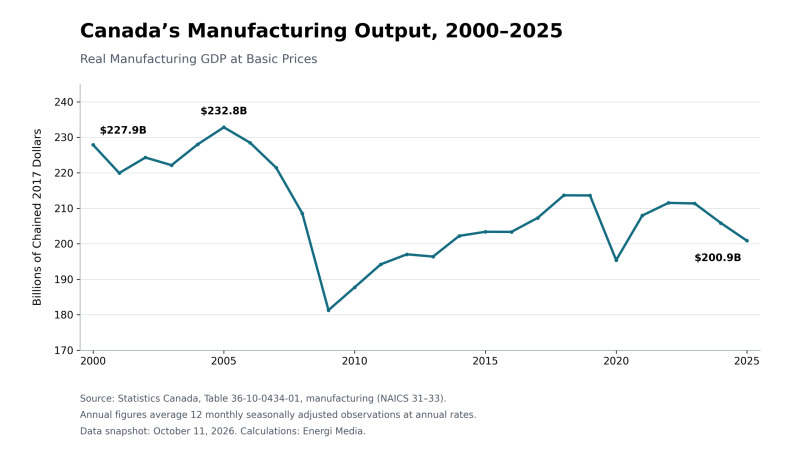
<p data-pm-slice="1 1 []">“But since the turn of the century, we’ve been going backwards,” he said. <a href="https://energi.media/economy/alberta-referendum-ontario-quebec-manufacturing-decline/">Manufacturing has retreated</a> (down 19% in Ontario, with 250,000 jobs lost) while extracting and exporting resources, particularly oil and gas, has become more central to our economy. Stanford’s warning should guide the European partnership: “It’s important to also diversify what we sell, not just where we sell it.”</p>
<p data-pm-slice="1 1 []"><img loading="lazy" decoding="async" class="aligncenter size-full wp-image-69076" src="https://energi.media/wp-content/uploads/2026/11/canada-manufacturing-output-2000-2025-scaled-e1793535639358.png" alt="Canada’s annual real manufacturing output from 2000 to 2025." width="800" height="467" /></p>
<p data-pm-slice="1 1 []"><a href="https://cleanenergycanada.org/canada-eu-summit-a-step-forward-on-critical-minerals-with-a-lack-of-focus-on-the-end-goal-electrification/">Clean Energy Canada spotted a big hole</a> in Friday’s announcement. Joanna Kyriazis, its director of policy and strategy, called the lack of focus on electrification “a major shortcoming of this agreement.”</p>
<p data-pm-slice="1 1 []">She welcomed progress on critical minerals and investment, but argued that electrifying transportation, buildings and industry should guide the partnership.</p>
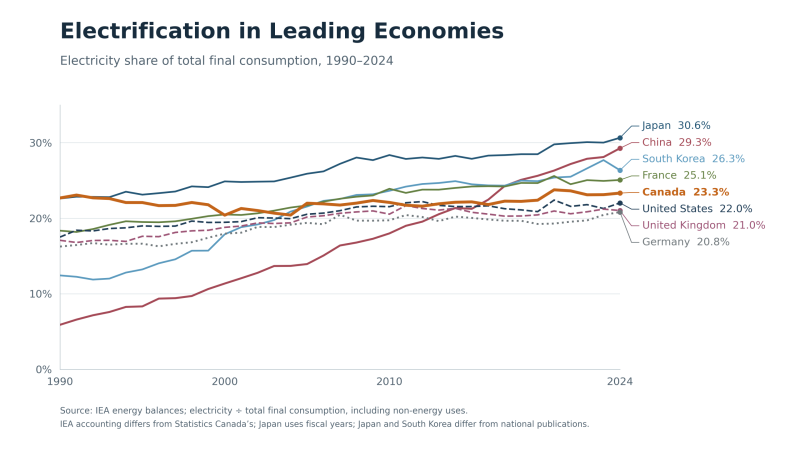
<p data-pm-slice="1 1 []">Exactly. And the reason shows up in the electrification rates of Canada&#8217;s competitors, as illustrated in the graph below. Based on the rate alone (23% in 2024), Canada is in the middle of the pack. The problem is that its rate has stagnated for 35 years while rates in other economies have risen.</p>
<p data-pm-slice="1 1 []">Asian economies have electrified to a greater degree than Europe or North America. China has become the world&#8217;s first electro-state by developing, deploying, and manufacturing electric technologies on a massive scale. Its electrification rate is rising by one per cent a year while Canada’s rate is falling slightly; other Western economies are stagnating.</p>
<p data-pm-slice="1 1 []">This is the reason for Kyriazis&#8217; pointed criticism of the Canada-EU pact:</p>
<p class="wp-block-paragraph">&#8220;[T]he lack of focus on electrification is surprising given both jurisdictions’ domestic emphasis on building out their electricity systems—and is thus a major shortcoming of this agreement. As the EU and Canada seek to advance a partnership anchored in ensuring mutual security and navigating an uncertain world, it is essential that electrification remains a north star. The electrification of vehicles, buildings, and industries is one of the greatest ways we can advance both short- and long-term affordability, competitiveness, and energy security. It underpins the build-out of critical mineral and electricity supply chains. And it needs a greater focus at this stage of discussions.”</p>
<p data-pm-slice="1 1 []"><img loading="lazy" decoding="async" class="aligncenter wp-image-69077 size-full" src="https://energi.media/wp-content/uploads/2026/11/G7_electrification_1990_2024-scaled-e1793537600583.png" alt="Electrification rates in leading economies from 1990 to 2024, comparing electricity’s share of final energy consumption." width="800" height="456" /></p>
<h3 data-pm-slice="1 1 []">Turn European Financing Into Canadian Industry</h3>
<p>The <a href="https://www.eib.org/en/press/all/2026-398-eib-and-canada-open-new-chapter-for-investment-at-eu-canada-summit">European Investment Bank agreement</a> opens a financing door. Now comes the harder work of getting Canadian projects through it. A mineral refinery needs customers willing to sign long-term purchase agreements, electricity at a competitive price, skilled workers and infrastructure. Governments have to help put those pieces together.</p>
<p>European financing could be particularly useful if it comes alongside commitments from European manufacturers to buy the output. That would give Canadian projects both capital to build and customers to serve, the beginnings of an industrial strategy with something concrete to show for it.</p>
<p data-pm-slice="1 1 []">There is substance to work with here.</p>
<p data-pm-slice="1 1 []">The agreement allows the EIB to consider loans, guarantees, equity investments, and technical assistance for Canadian projects, with critical minerals an early priority. Processing, refining and recycling are explicitly included, and the bank plans to establish a presence in Ottawa.</p>
<p data-pm-slice="1 1 []">These tools could help Canadian companies finance the expensive steps between a mineral deposit and a product manufacturers can use. Friday established the financing framework; the test now is which projects get funded, where they are built and how much industrial capability Canada gains.</p>
<p data-pm-slice="1 1 []">Economist Aaron Cosbey laid out the ingredients in an <a href="https://energi.media/economy/canada-eu-summit-green-iron-mineral-refining/">Energi Media interview before the summit</a>. “Canada has plenty of those minerals. We don’t have the refining capacity,” he said.</p>
<p data-pm-slice="1 1 []">His proposal would combine Canadian and European equity investment with long-term purchase commitments and either stockpiling or minimum prices to protect projects against market volatility. That package could support Canadian refineries supplying manufacturers on both sides of the Atlantic. “There’s a beautiful possibility for a partnership here,” he said.</p>
<p data-pm-slice="1 1 []">The EIB agreement gives governments one tool to pursue it.</p>
<div>
<h3>Make LNG Pass the Commercial Test</h3>
<p>Friday’s announcement commits Canada and the EU to <a href="https://www.pm.gc.ca/en/news/backgrounders/2026/10/30/canada-and-european-union-announce-new-alliance-future-create-greater">studying whether increased LNG exports are viable</a>. Good. Let’s see the numbers.</p>
<p>Energy analyst <a href="https://energi.media/news/canadian-lng-europe-us-gas-dependence/">Seb Kennedy told Energi Media</a> that his modelling strongly favours shipping Western Canadian LNG to Asia, where shorter voyages and avoided Panama Canal fees improve returns. European companies buying Canadian LNG therefore does not mean those cargoes will reach Europe.</p>
<p>Additional Pacific supply could ease global gas markets, he acknowledged, while leaving Europe dependent on American LNG. The study needs to establish what Canadian projects can realistically deliver for European energy security and whether the commercial returns justify building them.</p>
<p><iframe loading="lazy" title="YouTube video player" src="https://www.youtube.com/embed/QCvqNTg7W-U?si=idO7xUSIq-Nzo9y6" width="560" height="315" frameborder="0" allowfullscreen="allowfullscreen"></iframe></p>
<div>
<h3>Beyond Energy, Plenty Worth Building On</h3>
<p>The alliance reaches well beyond energy, with several initiatives that could strengthen Canadian research, manufacturing and technological independence.</p>
<ul>
<li><strong>Supercomputing:</strong> Canada’s membership in the <a href="https://www.eurohpc-ju.europa.eu/canada-becomes-39th-participating-state-eurohpc-joint-undertaking-2026-10-30_en">European High Performance Computing Joint Undertaking</a> opens access to powerful computers, including JUPITER, for research and AI development.</li>
<li><strong>Digital trade:</strong> Negotiations have concluded on <a href="https://policy.trade.ec.europa.eu/news/eu-and-canada-conclude-negotiations-digital-trade-agreement-2026-10-30_en">an agreement to simplify online trade</a>, including electronic contracts and cross-border transactions for Canadian businesses serving European customers.</li>
<li><strong>Skills and research:</strong> Planned negotiations on <a href="https://www.pm.gc.ca/en/news/backgrounders/2026/10/30/canada-and-european-union-announce-new-alliance-future-create-greater">expanded Erasmus+ participation</a> and <a href="https://www.pm.gc.ca/en/news/news-releases/2026/10/30/canada-and-european-union-announce-new-alliance-future-create-greater">the next Horizon Europe program</a> could give Canadians more opportunities for study, skills exchanges and joint research.</li>
<li><strong>Defence manufacturing:</strong> Montréal’s Galvion secured a <a href="https://www.galvion.com/newsroom/galvion-awarded-five-year-latvian-helmet-framework-contract-under-eu-safe-program">five-year framework contract worth up to €27.8 million</a> to supply military helmets to Latvia, following <a href="https://www.prnewswire.com/news-releases/marconi-technologies-selected-to-deliver-orion-x650-tactical-radios-to-polish-military-302801874.html">Marconi’s earlier contract to build radios for Poland</a>.</li>
<li><strong>Waterbombers:</strong> Up to <a href="https://dehavilland.com/production/de-havilland-canada-announces-agreement-and-de-havilland-canadair-515-production-increase/">$2.5 billion in financing</a> would help De Havilland expand Canadian aircraft production, serving Canadian and European firefighting needs while supporting manufacturing jobs in Alberta.</li>
<li><strong>Satellite services:</strong> Cooperation on Europe’s <a href="https://www.pm.gc.ca/en/news/backgrounders/2026/10/30/canada-and-european-union-announce-new-alliance-future-create-greater">IRIS² communications network</a> and <a href="https://www.pm.gc.ca/en/news/backgrounders/2026/10/30/canada-and-european-union-announce-new-alliance-future-create-greater">Galileo navigation system</a> could strengthen secure connectivity, emergency response and navigation, including in the Arctic. MDA Space also announced an <a href="https://mda-en.investorroom.com/2026-10-30-IRIS2-CONSTELLATION-MDA-SPACE-TO-PROVIDE-THALES-ALENIA-SPACE-WITH-DIGITAL-ANTENNA-SUBSYSTEMS-FOR-66-EARLY-DELIVERY-SATELLITES">initial agreement worth more than $100 million</a> with Thales Alenia Space for antenna systems for 66 IRIS² satellites, manufactured in Montréal.</li>
<li><strong>Digital infrastructure:</strong> Canada and Europe will examine <a href="https://www.pm.gc.ca/en/news/statements/2026/10/30/joint-statement-canada-and-european-union-building-together-alliance">a direct transatlantic data cable</a> to strengthen the security and independence of their digital connections.</li>
</ul>
<div>
<h3>A Good Start. Now Build on It.</h3>
<p>Carney deserves credit for opening doors while Donald Trump tries to slam them in our face. The Prime Minister inherited a Canadian economy that has been shedding industries and manufacturing jobs for 25 years, and is now under attack from the United States. His stated goal is to reverse those trends by doubling the country’s exports to countries other than the United States by 2035.</p>
<p>Viewed through that lens, the fortified alliance with Europe is significant progress. The aircraft, satellite equipment and defence contracts show what closer ties with Europe can deliver: Canadian expertise turned into products that customers need and will pay for.</p>
<p>Ottawa should apply that same discipline to the electric economy. The minimal progress on this front is a red flag. That said, the federal budget will be tabled Thursday and it will provide more details about how the more robust economic relationship with the EU will proceed.</p>
</div>
</div>
</div>
<p>The post <a href="https://energi.media/markham-on-energy/canada-eu-partnership-electrification-industrial-strategy/">New Canada-EU Partnership a Good Start With One Big Question Mark</a> appeared first on <a href="https://energi.media">Thoughtful Journalism</a>.</p>
]]></content>
		
			</entry>
		<entry>
		<author>
			<name>Markham Hislop</name>
					</author>

		<title type="html"><![CDATA[Danielle Smith&#8217;s gerrymandering of electoral boundaries threaten Alberta democracy]]></title>
		<link rel="alternate" type="text/html" href="https://energi.media/news/alberta-electoral-boundary-changes-jared-wesley/" />

		<id>https://energi.media/?p=69025</id>
		<updated>2026-10-30T04:34:38Z</updated>
		<published>2026-10-30T04:34:38Z</published>
		<category scheme="https://energi.media/" term="Alberta" /><category scheme="https://energi.media/" term="News" /><category scheme="https://energi.media/" term="Politics" />
		<summary type="html"><![CDATA[<p>Political scientist Jared Wesley warns Alberta’s electoral boundary process could weaken accountability and outlines how to test the proposed map for partisan advantage.</p>
<p>The post <a href="https://energi.media/news/alberta-electoral-boundary-changes-jared-wesley/">Danielle Smith&#8217;s gerrymandering of electoral boundaries threaten Alberta democracy</a> appeared first on <a href="https://energi.media">Thoughtful Journalism</a>.</p>
]]></summary>

					<content type="html" xml:base="https://energi.media/news/alberta-electoral-boundary-changes-jared-wesley/"><![CDATA[<h2><em>Political scientist says proposed map must be tested for independence, effective representation and partisan advantage.</em></h2>
<p>Alberta’s electoral boundary changes could weaken voters’ ability to hold their government accountable, political scientist Jared Wesley warns, arguing that the United Conservative government’s handling of redistribution raises concerns about partisan interference.</p>
<p>In an interview with Energi Media, Wesley said the dispute reaches beyond individual constituencies to the fairness of elections themselves. The final map had not been released when the interview took place, leaving its electoral effects to be assessed once the boundaries become public.</p>
<p>“It’s important that we prevent politicians from picking their voters rather than voters picking governments,” he said.</p>
<p><iframe loading="lazy" title="YouTube video player" src="https://www.youtube.com/embed/NG8NTpEgy7Q?si=MLUkkLUBPohKR1Nr" width="560" height="315" frameborder="0" allowfullscreen="allowfullscreen"></iframe></p>
<h3>Three tests for the new map</h3>
<p>Wesley proposed three tests: whether the process was open and independent, whether the boundaries provide effective representation for communities, and whether they favour the governing party over its opponents.</p>
<p>He said communities can be connected by geography, history, culture, language or economic interests. Preserving those connections helps residents obtain meaningful representation, while breaking them apart for partisan purposes can diminish their influence.</p>
<p>Wesley, who said he previously chaired a boundary commission in Edmonton, described public consultation as essential. Commissioners should publish proposed maps, hear from affected residents and revisit boundaries where communities identify problems.</p>
<p>His warning concerns both the process already followed and the outcomes he expects. Those expectations remain distinct from findings based on a completed, publicly available map.</p>
<h3>Commission report replaced by new process</h3>
<p>According to Wesley, an independent commission conducted the usual redistribution exercise and proposed adding two seats. Two UCP-appointed members dissented and produced an alternative map in a minority report, he said.</p>
<p>The government subsequently rejected the commission’s report and appointed a new panel, whose work Wesley said was based on that minority proposal. He characterized the intervention as an unprecedented departure from the province’s established approach.</p>
<p>Wesley argued that accepting an independent process sometimes requires governments to tolerate boundaries they dislike. He said previous Progressive Conservative governments and former NDP premier Rachel Notley had faced unwelcome redistribution outcomes without replacing the process to secure a preferred result.</p>
<p>In an earlier Energi Media interview, Wesley argued for <a href="https://energi.media/news/jared-wesley-alberta-canada-separatism-federalism/">renewing Canada’s institutions from within Confederation</a> rather than pursuing Alberta separation.</p>
<h3>Court challenges and public pressure</h3>
<p>Wesley linked the dispute to the Charter right to vote and the principle of effective representation. He said exact population equality is not always practical, particularly where geography makes rural or northern constituencies difficult to represent.</p>
<p>His argument is that departures must serve legitimate representational needs rather than partisan advantage. He anticipated a court challenge if the new boundaries proceed, while warning that Albertans should not assume litigation will resolve the issue.</p>
<p>He urged residents to contact their MLAs, discuss the implications with others and support organizations preparing potential legal challenges.</p>
<p>He also called for opposition across party lines, saying the NDP cannot be the only voice defending the integrity of the process.</p>
<p>Author Patrick Lennox has similarly called for <a href="https://energi.media/politics/alberta-separatism-patrick-lennox-democracy/">civic participation to defend democratic institutions</a> in Energi Media’s coverage of Alberta separatism.</p>
<p>“There’s no more important check and balance on a premier’s power than elections,” Wesley said, warning that safer seats can also encourage candidates to appeal to narrower, more polarized constituencies.</p>
<p>The province’s political direction also has economic consequences: Senator Paula Simons has warned that <a href="https://energi.media/alberta/paula-simons-alberta-referendum-economic-risks/">Alberta’s referendum campaign risks driving away workers, entrepreneurs and researchers</a>.</p>
<p>Wesley also argued that the controversy risks being overshadowed by the busy fall legislative agenda. Protecting fair elections, he said, underpins voters’ ability to demand action on affordability, health care, education and the economy from their government.</p>
<h3>End Note — Related Energi Media Videos</h3>
<p>For more context on Alberta politics, democratic accountability and the pressures facing the UCP, watch these Energi Media interviews:</p>
<ul>
<li><a href="https://www.youtube.com/watch?v=pNz_ShbluBw">Danielle Smith Faces Separatist Revolt Within Caucus, UCP Members</a> — Duane Bratt examines the separatist revolt, constituency association pressure and Smith’s leadership challenges.</li>
<li><a href="https://www.youtube.com/watch?v=g_BL-Ayqm9Y">Separatists’ Trump Treason MUST Be Denounced by Danielle Smith</a> — Stewart Prest discusses foreign involvement in separatist politics and the need for a clear political response.</li>
<li><a href="https://www.youtube.com/watch?v=hC8an8Y0dSg">Paula Simons Blasts Alberta’s Referendum Campaign With a Bazooka</a> — Senator Paula Simons explains her concerns about the referendum campaign, immigration and Alberta’s economic future.</li>
<li><a href="https://www.youtube.com/watch?v=eOW2bmSZRJ8">MAGA Premier Danielle Smith Won’t Criticize Trump or Side 100% With Canada</a> — Duane Bratt explores Smith’s political balancing act involving Trump, separatism and Canadian unity.</li>
</ul>
<p>The post <a href="https://energi.media/news/alberta-electoral-boundary-changes-jared-wesley/">Danielle Smith&#8217;s gerrymandering of electoral boundaries threaten Alberta democracy</a> appeared first on <a href="https://energi.media">Thoughtful Journalism</a>.</p>
]]></content>
		
			</entry>
	</feed>