
This article was published by The Energy Mix on Dec. 8, 2025.
By Chris Bonasia
In Australia, a major battery energy storage project and a new requirement for data centres to invest in renewable energy show some ways the country is preparing for the energy transition.
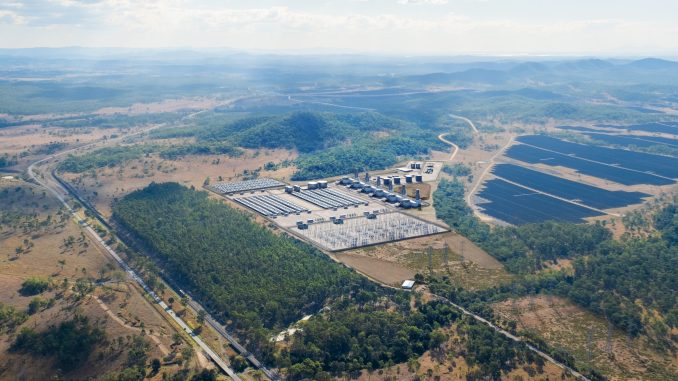
Australia’s largest energy storage battery will be paired with gas turbines, with past statements by one of the project’s partners hinting the move is part of a plan to set up battery infrastructure in anticipation of future clean energy supply.
“When you look at the technology improvement curve of batteries, even over the next two to three years, it’s nothing short of breathtaking,” said David Scaysbrook, co-founder and managing partner for Quinbrook Infrastructure Partners, as reported in Renew Economy. Scaysbrook explained that surplus solar energy can be stored in batteries as a reliable source of cheap energy, “and if you’ve got 320 sunny days a year, that is a very, very powerful combination.”
“Forget subsidies,” he added. “I’m not talking about subsidies. I’m talking about Quinbrook, or someone else, building a large-scale solar-battery hybrid with an eight-hour battery,” capable of “delivering incredibly competitive energy cost without government handouts.”
Quinbrook offshoot Private Energy Partners is currently building the Gladstone State Development Area Energy Hub Project in Queensland, where it proposes to combine a 780-megawatt, eight-hour battery energy storage system with up to 1,080 MW of open-cycle gas turbines. The firm recently signed a memorandum of understanding with Stanwell, a state-owned regional energy generator, which gave Stanwell exclusivity over the project.
The agreement is part of Stanwell’s efforts to move away from burning coal, Renew Economy says. For Quinbrook, the project is part of a strategy to set up long-duration “infrastructure batteries” in Australia that are poised to help soak up cheap renewables and power big industrial loads.
Meanwhile, Australia’s recently-released National AI Plan is requiring that data centre developers pair projects with their own renewable energy generation. Australia’s data centres already consume roughly four terawatt hours of electricity each year—around 2 per cent of the country’s total electricity demand—and that number is expected to triple by 2030 and eventually make up more than 10 per cent of grid demand by 2035, says Renew Economy.
The National AI Plan, broadly, is an attempt by the Australian government to chart out a course for the country to manage the proliferation of AI throughout the economy. But according to The Conversation Canada, the plan’s requirement for renewable energy—and what that could mean for building out infrastructure that will be needed for an energy transition—is a major selling point.
“The government is working with the states and territories, energy market bodies, network service providers, and the data centre industry to harness opportunities from the growth of data centres to promote investment in renewable energy and maintain affordable energy for households and businesses,” the National AI Plan states.
“Australia has the opportunity to take advantage of ambitious AI infrastructure initiatives in ways that accelerate our renewables transition and drive investment in skills, research, and sustainable technologies.”

Be the first to comment