Trudeau Govt should rethink message on downstream GHG emissions and Energy East before serious damage is done
September 16, 2017 | Markham on Energy

Jim Carr, Canadian minister of natural resources. Photo: JimCarrMP.ca.
Trudeau Liberals appear to be willing to sacrifice Energy East for Quebec seats in 2019…a dangerous message to investors in Canadian resource development
One of the things I like most about the Trudeau Liberals is that they are treacherous bastards. Like every Liberal government of my lifetime, they play to win. That bred-in-the-bone treachery will absolutely ensure construction of the Trans Mountain Expansion pipeline to the West Coast, which will cheer the flinty hearts of Calgary-based oil executives. But it will probably sink Energy East. It turns out the Liberals need Quebec far more than they need British Columbia or Alberta.
 The stark reality of Canadian regional political calculations was rammed home – once again – several weeks ago when the National Energy Board decided to include upstream and downstream emissions as part of the Energy East review, which has been underway for several years in fits and spurts, and has cost the company about $800 million, according to former TransCanada executive Dennis McConaghy.
The pipeline giant requested a 30-day suspension of its application to ponder going forward under the new review parameters.
On Thursday, Natural Resources Minister defended the NEB’s decision, pointing to the Liberal’s five interim principles for pipeline reviews announced in Jan. 2016 as proof Ottawa has been planning this all along.
“Carr says the government is not bending on including emissions as a factor to be considered when deciding if a project is in the national interest,” reported the Canadian Press.
Let’s have a look at principle number five: “Direct and upstream greenhouse gas emissions linked to the projects under review will be assessed.” Direct emissions are caused during construction and operation of the pipeline. Upstream emissions are created during extraction.
Where is mention of downstream emissions (which including refining and burning fuel in automobiles)?
In April of 2016, the federal Major Projects Management Office announced that Environment and Climate Change Canada would undertake the upstream assessment of emissions, but no mention of downstream.
Carr and the Trudeau cabinet appear to have caved under pressure from environmental groups, which have been aggressively lobbying for the move.
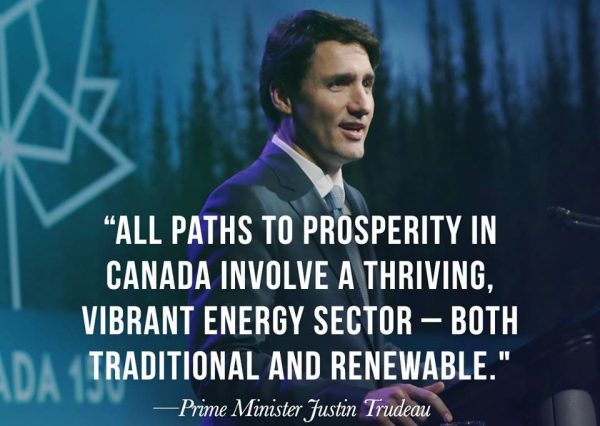
Prime Justin Trudeau delivering a keynote address at CERAWeek 2017. Photo: Justin Trudeau/Facebook.
This is still not the biggest issue of this story.
When the NEB released the list of issues to be considering during the Energy East review, it acknowledged that downstream emissions “are not within the care and control of the Applicants, and the Applicants will not direct or influence the carrying out of the activities.”
No kidding.
And let’s not forget that some of those downstream emissions will be within the control of the very government insisting they be part of the review.
If the Liberals lag on clean fuel standards, will that be counted against TransCanada?
If Eastern Canadian refineries pollute too much because Quebec or New Brunswick governments have been lax enforcing provincial regulations, will that be a black mark against Energy East?
Ah, Quebec.
Where the Liberals currently hold 40 out of the province’s 78 seats. Not only will Energy East run through Quebec, but so to will the re-election hopes of Trudeau and company.
“There is pretty intense opposition [to Energy East] in some quarters in Quebec,” pollster David Coletto told me in the Sept. 12 podcast. “Even if they [Liberals] lose three seats in Alberta but gain 20 in Quebec, that’s probably a trade-off they’re willing to make.”
Add into the calculation the approval of controversial TransCanada project Keystone XL, an 890,000 b/d pipeline from Alberta to refineries on the Gulf Coast, and changing economics for natural gas vs. oil transport, and suddenly Energy East may not look as rosy as it once did.
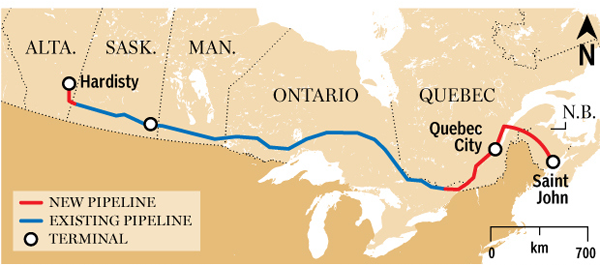
Proposed route for the Energy East pipeline.
Why burn up political capital in Ontario – much of which isn’t happy about Energy East, either – and Quebec that may not even be needed?
What’s to be lost by throwing a bone to eco-activists and talking tough to Albertans, which always plays well in Eastern Canada?
Well, investor confidence, for one.
I’ve argued in several columns against the commonly held idea in Alberta that capital is fleeing the oil and gas industry because of excessive regulation and far too much uncertainty over pipeline reviews.
But Carr’s about face on GHG emissions and TransCanada’s decision to suspend the review has to put a chill on investors’ wallets.
And more important than Carr’s defence of the NEB on this issue is his tone.
The Winnipeg MP and former journalist has been a vocal defender of “sustainably” getting Canada’s resources – including oil and gas – to market. He’s talked tough in Vancouver about calling in the RCMP if Trans Mountain Expansion protesters break the law.
Now he’s doubling down on an issue that at the very least implicitly violates the interim principles he uses to defend the NEB, an issue that is a big win for Energy East opponents.
That tone sends the wrong message to the Alberta government (a political ally which quickly roundly condemned including downstream emissions), an industry just emerging from a very tough three years, and the keepers of capital Canada relies upon to finance resource development.
Including downstream GHG emissions in the Energy East review will likely turn out to be a tempest in a teapot, a factor that wouldn’t influence the NEB panel a whit.
But the political messages Carr sent Alberta are troubling. They suggest that the bridges the Trudeau Government built over Trans Mountain Expansion are about to burnt over Quebec as part of the Liberal re-election strategy.
That would be a mistake. And Minister Carr may want to consider re-calibrating his message on this issue.
If he doesn’t, Alberta will know exactly where it stands: a victim of the unquenchable Liberal need to win in 2019.