Canada’s Low Electrification Rate Threatens Its Future Prosperity
September 23, 2026 | Markham on Energy
Canada’s Electrification On Par With Third-World Economies
The Canadian economy is in trouble. Or, more accurately, it will be in the not-too-distant future, perhaps the mid-2030s or thereabouts. The cause of the impending crisis? The world’s most competitive economies are rapidly electrifying, while Canada’s rate of electrification is low, stagnant, and unlikely to budge much over the next 25 years.
Since electric technologies (e.g., EVs, heat pumps) are now more efficient and lower cost than combustion technologies (e.g., gasoline cars, natural gas furnaces), competitiveness is the difference between Canada’s current affluence and a lower standard of living in the future.
The source of this insight is a new report, Electrification, from the International Energy Agency, supplemented by recent data from the Canadian Energy Regulator.
The IEA says that Prime Minister Mark Carney’s government has embarked on a new “electrification strategy,” but acknowledges that little has been accomplished thus far. Fair comment. The strategy is only a few months old. But the IEA misses an important feature of that strategy: it focuses on doubling the supply of electricity, but provides little detail about demand.
Supply is all about generation (hydro, nuclear, gas, wind, solar, batteries, geothermal). Demand is all about electric transportation, heat pumps for building heating and cooling, industrial heat, and a slew of related technologies like AI and data centres, and power electronics.
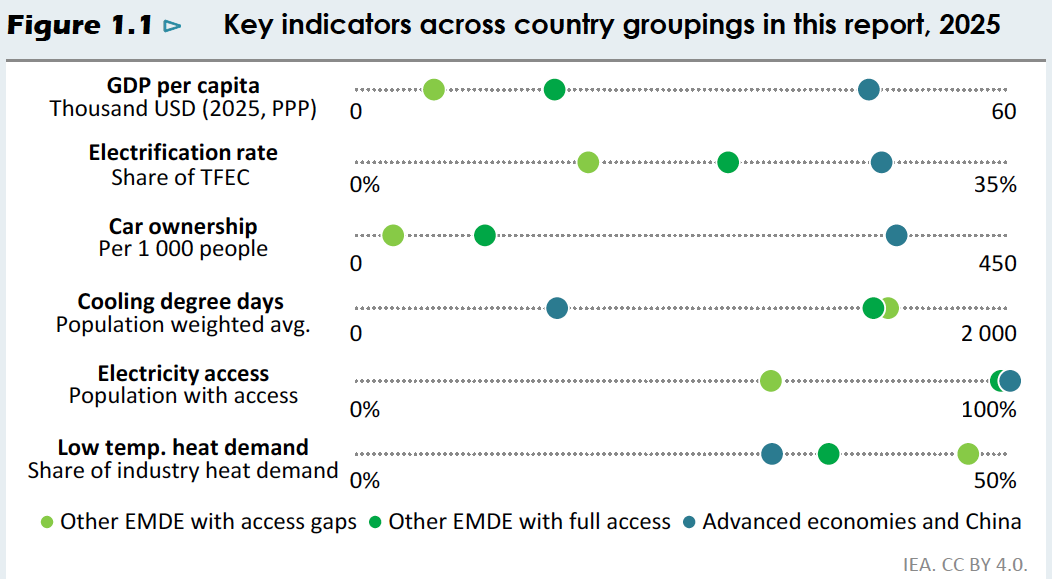
The IEA chart shows how much room emerging economies have to electrify. In 2025, electricity supplied roughly 12 per cent of final energy use in emerging and developing economies with electricity access gaps, and about 20 per cent in those with full access. The rate was roughly 28 per cent for the group combining advanced economies and China.
Getting households connected is only the first step; replacing combustion in transport, buildings and industry is the larger task. China’s low-cost electric technologies are helping other emerging economies make that shift. China advanced supply and demand together, combined with industrial policies to scale up clean energy industries.
What China developed and manufactured it also deployed. Last month, 65 per cent of new vehicles were EVs and 50 per cent of heavy truck sales were electric.
That’s the direction of travel in the global economy.
Advanced economies have higher electrification rates and the switch from molecules (oil, natural gas) to electrons is accelerating. But Asia already leads. China, Japan, and South Korea are out in front, while Indonesia and Thailand are ramping up. A few emerging economies in Latin America and Africa are in the thick of the race.
Canada lags. It is at the bottom of the chart for advanced economies. And its electrification rate hasn’t changed much in decades.
Related news articles from the Energi Media website:
- The Canadian energy conversation is stuck in the wrong century
- China’s New Energy Plan Outlines Ambitious Plan to Build World’s First Clean Power Grid
Related Energi Media expert interviews from our YouTube channel:
- An Electrified Canadian Economy is a More Competitive Economy
- Industry, Not Consumers, Driving Electrification of Canada
- Canada’s Power Islands Are Holding Back Electrification
- Canada at an Energy Crossroads — with Michael Liebreich
Canada Built an Economy to Burn Molecules, Not Convert Electrons
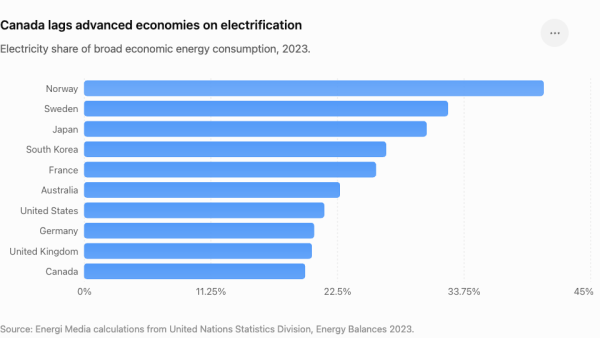
Canada sits at the bottom of the pack for a simple reason: we built an economy around burning fossil fuels and have done remarkably little to change it.
Oil and gas production itself consumes enormous quantities of natural gas, while transportation remains overwhelmingly dependent on gasoline and diesel, and natural gas still heats millions of buildings. Even abundant supplies of relatively clean electricity have not translated into an electrified economy.
Quebec shows that Canada can do much better, but nationally the transition from molecules to electrons has barely begun. That matters because the countries higher up the graph—particularly Japan and South Korea—are major industrial competitors. Canada is behind on the fundamental energy technology increasingly powering the world’s advanced economies.
China’s Electro State Is Exporting Electrification
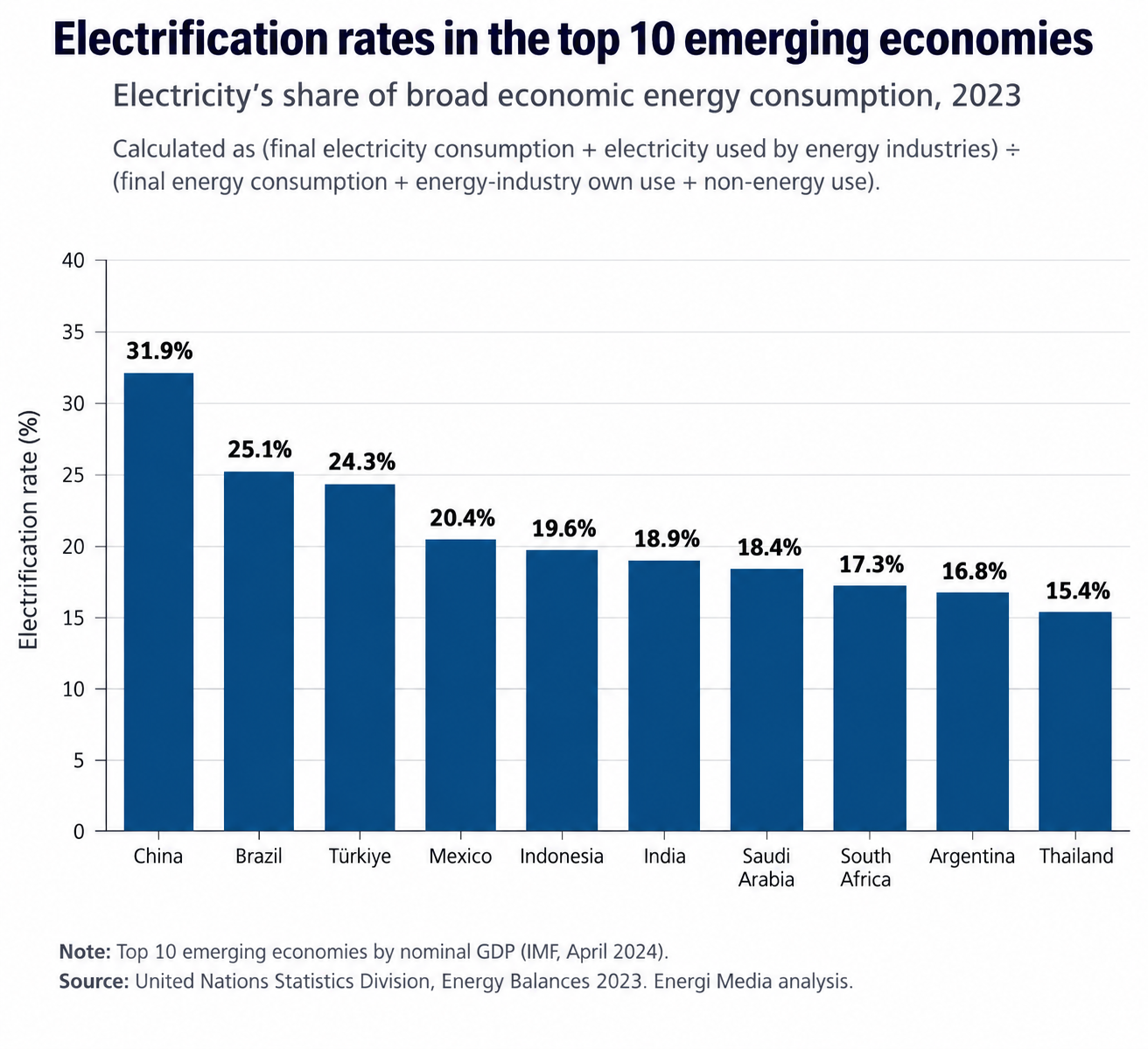
China has become the world’s first electro state. It built enormous capacity to manufacture solar panels, batteries and electric vehicles, drove down their costs, and continues to improve the technology.
That changes the choice facing emerging economies. Many can now expand electricity supply and put electric vehicles on the road using equipment that is increasingly competitive with combustion alternatives. They are adopting different parts of the Chinese model at different speeds, while Chinese exports make the shift faster and cheaper.
Electrification is no longer a transition that rich countries must finance for everyone else. China has turned it into an industrial system that other countries can buy.
Canada’s Competitiveness Clock Is Running
Canada can double the power grid and still fail to electrify. More power plants will do little for competitiveness if cars keep burning gasoline, furnaces keep burning natural gas, and factories keep burning fuel for heat.
Ottawa needs policies that move electricity into those uses. So do the provinces.
By the mid-2030s, Canada will compete against economies that have spent years driving down the cost of electric technology and putting it to work. Our electrification rate has barely moved in decades. If that continues, Canadian businesses will face higher costs while their competitors pull ahead. And Canadians will pay for that failure through fewer opportunities and a lower standard of living.
Endnotes
- International Energy Agency (IEA), Electrification (Paris: IEA, September 22, 2026). Source for the international electrification comparisons, the country-group chart, and the assessment of cost-competitive electric technologies.
- Natural Resources Canada, Powering Canada Strong: A National Strategy for an Electrified Canadian Economy (2026). Source for the federal government’s electricity strategy.
- Canada Energy Regulator, Canada’s Energy Future 2026: Energy Supply and Demand Projections to 2050 (March 2026); see also its Current Measures Scenario fact sheet. The latter puts electricity at 18 per cent of Canadian end-use energy today and nearly 23 per cent in 2050 under current measures. The scenario is a baseline, not a prediction.
- China Passenger Car Association, “August 2026 Manufacturer Sales Bulletin” (September 9, 2026). New-energy vehicles accounted for 65.2 per cent of domestic passenger-car retail sales in August; the category includes battery-electric and plug-in hybrid vehicles.
- Commercial Vehicle World, “New-Energy Heavy-Truck Sales in the First Eight Months of 2026” (September 2026). Its August figure is 47.43 per cent of domestic heavy-truck retail sales, based on vehicle-insurance registrations. The essay should say “nearly half of heavy-truck sales were new-energy vehicles” rather than “50 per cent were electric.”
- International Energy Agency, Energy Technology Perspectives 2026, “Energy Technology Manufacturing and Trade” (Paris: IEA, 2026). Source for China’s clean-energy manufacturing, falling solar and battery prices, and its role in global technology exports.
- Organisation for Economic Co-operation and Development (OECD), “Figure 2.12. Share of Electricity in Final Energy Consumption,” in “From Energy Shocks to Stronger Resilience,” OECD Economic Outlook, Volume 2026 Issue 1 (Paris: OECD, 2026). Download the figure data. The chart reports 2023 shares using IEA World Energy Balances 2025 data.