Building Canada’s electrification industry one building at a time
October 2, 2026 | Economy, Electrification, Canada, Markham on Energy
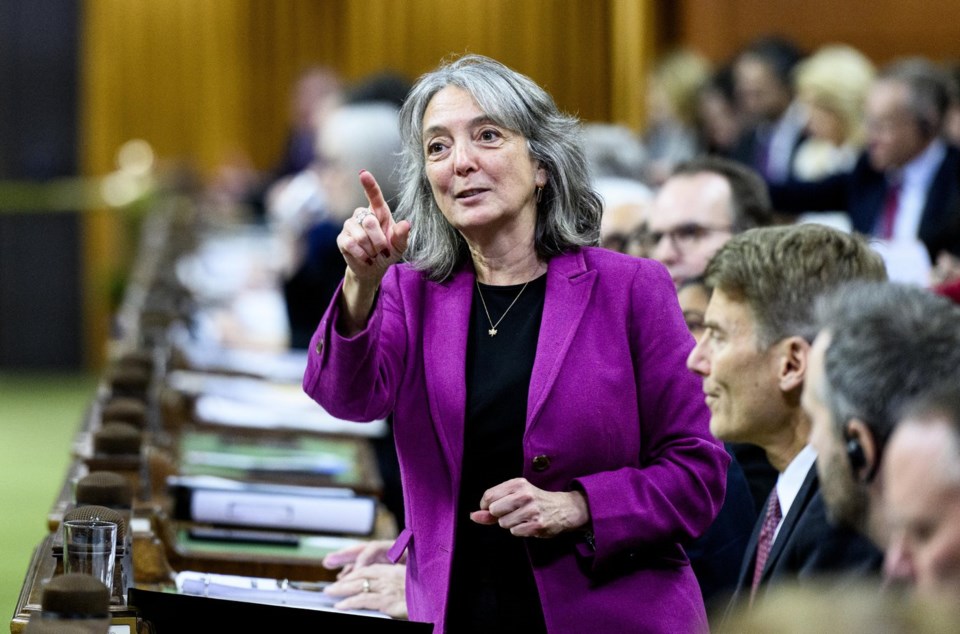
Environment Minister Julie Dabrusin. The Canadian Press photo by Spencer Colby.
This is a pipeline of work, not 162 completed building makeovers.[1]
Canada needs to change how it thinks about buildings.
Canada has a largely unelectrified economy. Electricity supplies just 17 per cent of our energy use. Alberta sits at about seven per cent, British Columbia at 17 per cent and Ontario at 21 per cent. Quebec leads at roughly 40 per cent.
These figures measure how much we use electricity to power the economy, not how clean our electricity supply is. The distinction matters. Clean power delivers its full economic value when it replaces fuel in our vehicles, buildings and factories. Quebec shows how much further the other big provinces could go.
Buildings are electricity infrastructure
Kevin Lockhart, the Pembina Institute’s buildings director, makes that argument across three recent articles. His starting point is straightforward: buildings belong inside electricity planning. Their equipment and operation affect how much grid infrastructure we need and how hard it has to work.[3]
Consider an apartment building. Insulation and air sealing reduce its heating requirements. Efficient electric equipment can replace fossil-fuel heating. Controls and thermal storage can shift some electricity use away from the hours when everyone else needs power.
That makes the building a resource for the utility. Lower demand during those expensive hours can defer some investments in additional infrastructure. Lockhart wants whole-building retrofits, clear performance standards and a defined role for utilities in making this happen.[3]
The implication for public spending is obvious. If a building upgrade delivers value to the electricity system, the investment should be evaluated on that basis. Counting only the owner’s energy savings misses part of the return.
Show us the electrification results
We should also stop confusing more electricity production with electrification.
Electricity can serve new demand while existing furnaces keep burning gas and existing vehicles keep burning gasoline. Generation growth alone tells us very little about how quickly fossil fuels are being displaced.
Lockhart proposes two companion goals for 2050: double electricity’s share of final energy consumption and double energy productivity, the economic value produced per unit of energy. He also argues that retrofits need a durable market, supported by financing that recognizes benefits beyond energy savings.[4]
That is a better framework for judging progress than counting announcements.
Where is the annual scoreboard? How many homes switched fuels? How much gas and heating oil did they stop consuming? How much winter peak demand did better building performance avoid? What happened to household bills after financing costs?
Show your math.
A credible program would publish both its expected savings and its measured results. It would explain the gap. That is how we learn which approaches deserve expansion and which need fixing before taxpayers finance the next round.
The international context makes those questions urgent. The International Energy Agency’s new Electrification report says electricity demand grew more than twice as fast as overall energy use from 2015 to 2025. Electricity now supplies about 23 per cent of global final energy consumption.[5]
That global figure is not Canada’s electrification rate. Nor is the percentage of our electricity generated from clean sources. One measures how much of the economy runs on electricity. The other measures how that electricity is made. Confusing them flatters our performance and obscures the work ahead.
In our interview, the Transition Accelerator’s Moe Kabbara put his finger on the implementation problem. Canada treats market transformation as something that happens through scattered programs. Instead, he argued, we should identify where electrification offers the strongest business case and deliberately build the conditions for adoption.[6]
Replacing oil heating in Nova Scotia presents different economics from replacing gas heating in Edmonton. A serious strategy starts with those differences. It builds experience and scale where the opportunity is strongest, then uses that experience to expand.
Build an industry that lasts
Pembina’s third argument deserves particular attention in Ottawa: electrification is industrial strategy. Demand for better buildings creates work for construction firms, manufacturers and suppliers of grid equipment. Housing policy also determines energy costs for decades. Cheap construction can leave occupants paying higher bills long after the ribbon-cutting.[7]
Workforce planning belongs in that strategy. So do building standards and investment decisions that give businesses a reason to expand. A contractor cannot train tomorrow’s workforce on the strength of today’s ministerial appearance.
This is hardly a new insight. The retrofit mission report in our research archive calls for grouping similar buildings into larger projects, prefabricating components and improving delivery through repeated experience. Its ambition is to make renovations faster and cheaper by changing how the industry operates.[8]
That is the opportunity in these municipal programs: a steady pipeline of work that helps firms get better at delivering it.
Make the pieces work together
But somebody must connect the pieces.
Energy systems researcher Madeleine McPherson made a related point in our interview about electricity planning. Provincial expertise remains essential. What Canada lacks, she argued, is coordination that brings those provincial plans together.[9]
The same discipline should apply to buildings. Retrofit schedules, electricity forecasts and workforce development need to inform one another. Otherwise, one department encourages heat pumps while another plans the grid without a credible picture of their adoption.
Nor should a national strategy assume every household can borrow its way into the transition. Affordable housing providers and low-income residents need support designed around their circumstances. Public money should buy lasting affordability, with results that can be checked.
Dabrusin’s announcement deserves credit for funding useful work. The next test is whether that work produces a larger, more capable industry and measurable reductions in fossil-fuel dependence.
Canada’s energy future is being built inside ordinary homes and apartment buildings. We should give that work the ambition, continuity and scrutiny we routinely reserve for megaprojects.
Otherwise, we will keep celebrating the cheques while Canadians keep paying for the energy we failed to save.
Endnotes