Canada and China deepen clean-tech ties as Ottawa rebuilds economic relationship
October 3, 2026 | Economy, Canada, Innovation
Canada and China are expanding cooperation on clean energy technologies as Ottawa tries to build a larger economic relationship with the world’s biggest clean-tech market.

Julie Aviva Dabrusin.
Environment and Climate Change Minister Julie Dabrusin travelled to Beijing Sept. 27–29 for meetings with Chinese officials, environmental organizations and businesses. The visit included discussions about clean technology, carbon markets and climate policy, while Canadian companies prepare for a clean-tech trade mission to China in November.
The initiative builds on the strategic partnership announced during Prime Minister Mark Carney’s January visit to China and adds another layer to a bilateral relationship Ottawa has been steadily rebuilding.
For Canadian companies, the opportunity extends across technologies where Canada already has industrial, research or engineering expertise. The sectors identified in the Canada-China relationship and related clean-tech initiatives include:
- Energy storage and batteries — explicitly identified as an area for cooperation in the Canada-China strategic partnership. Energi Media has also examined what China’s battery industrial policy could teach Canada.
- Hydrogen and fuel cells — Canada has an established sector, particularly in B.C., with expertise in hydrogen production, electrolyzers and fuel cells.
- Carbon management and CCUS — Canadian companies and research centres work on carbon capture, direct-air capture and carbon utilization.
- Renewable-energy technology — including wind and solar technologies, both specifically identified as areas for Canada-China cooperation.
- Smart grids and electricity technologies — including energy storage, grid management and technologies for integrating renewable electricity.
- Waste-to-energy, remediation and circular-economy technologies — specifically identified as target industries for the Canadian clean-tech trade mission to China in November.
- Clean fuels and industrial decarbonization technologies — including low-carbon fuels and technologies for reducing emissions from industries such as steel and cement.
China is already the world’s largest clean-technology market. Its latest electricity strategy is built around renewables, storage, grid flexibility and electrification. Dabrusin met with the Canada China Business Council and Canadian companies in Beijing to discuss how Canadian firms could capture a larger share of it.
Clean-tech trade heavily favours China
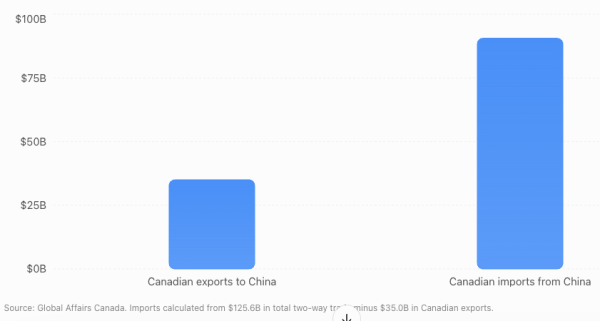
 Canada and China already have a large economic relationship.
Two-way merchandise trade reached $125.6 billion in 2025, according to Global Affairs Canada. Canadian exports to China totalled about $35 billion, making China Canada’s second-largest single-country trading partner.
Clean technology tells a different story.
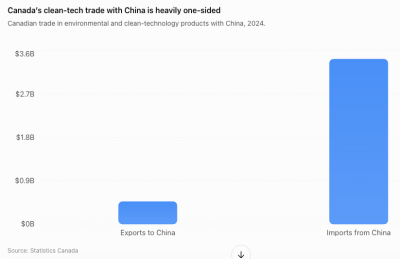
Statistics Canada reported that Canada exported just $464.5 million of environmental and clean-technology products to China in 2024 while importing $3.42 billion.
That is roughly $7.40 of imports for every dollar Canada exported.
Still, China accounted for about one-quarter of Canadian environmental and clean-tech exports to Asia. That suggests an established market exists even if Canadian companies currently capture only a small share of it.
Ottawa’s challenge is to turn diplomatic engagement into more opportunities for Canadian companies without simply increasing Canada’s dependence on Chinese clean-tech imports.
That question has become more important as Canada looks beyond the United States for trade opportunities. University of Toronto economist Joseph Steinberg told Energi Media earlier this year that diversification will be difficult because geography, infrastructure and deeply integrated supply chains strongly favour trade with the United States. New relationships in Europe and Asia can nevertheless produce incremental gains.
Climate cooperation supports the economic relationship
 Clean technology is also connected to a broader effort to renew Canada-China climate cooperation.
Dabrusin and Chinese Ecology and Environment Minister Huang Runqiu agreed to relaunch the Canada-China Ministerial Dialogue on the Environment.
Existing agreements between the countries cover greenhouse-gas mitigation, carbon pricing, clean energy, carbon capture, utilization and storage, low-carbon technologies and international climate negotiations.
Canada also has more than three decades of experience working with China through the China Council for International Cooperation on Environment and Development. The council conducts research and makes policy recommendations to the Chinese government on issues including climate change, pollution, biodiversity and sustainable development.
The climate relationship matters because China’s enormous economy makes its energy transition consequential well beyond its borders. China sits at the centre of a global electrotech manufacturing revolution spanning solar, batteries and electric vehicles. China is simultaneously the world’s largest greenhouse-gas emitter and the dominant producer and deployer of many technologies needed to reduce emissions.
Building the institutional sinew
The succession of ministerial dialogues, memorandums, working groups and trade missions can sound like diplomatic bureaucracy. But those institutions may be precisely the point.
University of Toronto trade economist Daniel Trefler discussed the issue with Energi Media in January while assessing the broader Canada-China strategic partnership.
Trefler cautioned against interpreting the new relationship as a dramatic geopolitical realignment. Much of what Canada and China were establishing was ordinary institutional machinery governments use to manage economic relationships.
But ordinary does not mean unimportant.
Trefler argued that governments need established channels through which officials can communicate when disputes and crises occur.
“When it’s a crisis time, you need open channels,” he said.
Those channels need to be built before they are needed. “Let’s build them,” Trefler said. “Let’s not expect too much of them until there is a crisis.”
That provides a useful way to understand Dabrusin’s Beijing visit.
No single ministerial dialogue, memorandum or trade mission will transform Canada-China commerce. Nor does closer engagement eliminate the political and economic risks of dealing with an authoritarian government that has previously used trade restrictions against Canada.
Instead, Ottawa is gradually constructing the institutional sinew required for a larger relationship.
The first test for Energi Media will be practical: whether Canadian clean-energy companies gain greater access to the enormous Chinese market, whether investment and technology relationships develop, and whether Canadian clean-tech exports begin to close a trade imbalance that currently runs overwhelmingly in China’s favour.
If that happens, the bureaucratic architecture being assembled today will have produced something Canadians can measure.
Endnotes
- Environment and Climate Change Canada, “Minister Dabrusin advances Canada–China cooperation on climate, clean growth, and the environment,” Oct. 1, 2026.
- Prime Minister of Canada, “Prime Minister Carney forges new strategic partnership with the People’s Republic of China focused on energy, agri-food, and trade,” Jan. 16, 2026.
- Global Affairs Canada, “Canada-China relations.”
- Statistics Canada, “Canadian trade in environmental and clean technology products by selected regions and countries, 2024.”
- Prime Minister of Canada, “Canada-China Economic and Trade Cooperation Roadmap,” Jan. 16, 2026.
- Energi Media, interview with University of Toronto trade economist Daniel Trefler, YouTube.