Danielle Smith’s Claim That Ottawa Tried to “Kill” Alberta’s Oil Industry Disproved by Latest Data
October 6, 2026 | Economy, Canada, News
Unlike their Premier, Albertans have shifted from Ottawa is trying to stop us to Ottawa needs to build faster
“Our economy has been under attack for most of the last 10 years, and frankly, off and on for decades, long before that. Not by a foreign country or by world economic forces. No, Alberta’s biggest threat to our prosperity and growth has come from our own nation’s capital. Alberta has an Ottawa problem.” – Alberta Premier Danielle Smith, June, 2025
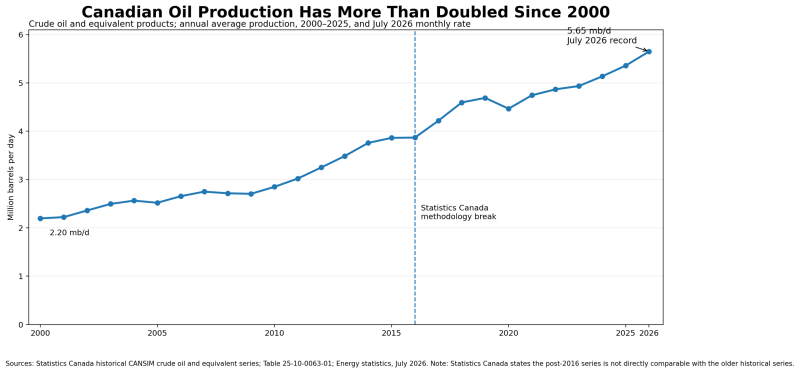
Data tells a very different story than Danielle Smith. Over the last 10 years, by which the Premier means the Justin Trudeau government, Canadian oil production increased by 1.5 million barrels per day. Almost all of that increase occurred in Alberta.
If only Smith believed her patently false narrative, the political fallout might be a problem. But a large swath of the Alberta public believes some version of it, too. The idea that hostile governments in Ottawa spent a decade trying to strangle Alberta’s most important industry has become part of the province’s political conventional wisdom.
Except the industry Ottawa was supposedly trying to kill kept producing more oil.
Canadian crude production averaged a record 5.65 million b/d in July, up 2.7 per cent from a year earlier. Oil sands production drove much of the increase. Synthetic crude alone reached 1.44 million b/d, also a record.
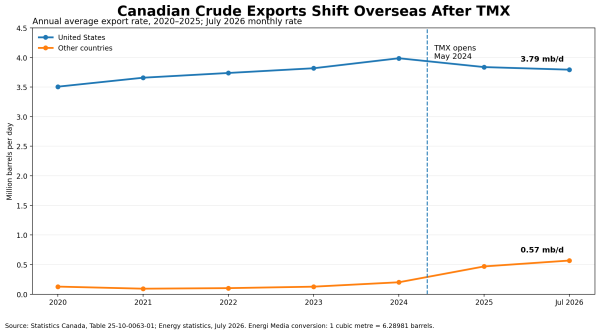
And Alberta producers aren’t merely producing more oil. They are gaining access to markets they spent decades demanding. Canada’s overseas oil exports jumped 45 per cent in July, accounting for all the growth in crude shipments as sales to the United States declined. Asian and European customers bought about 569,000 b/d of Canadian crude, according to Statistics Canada’s latest energy report. Almost three-quarters of that volume left through Vancouver.
The shift is significant. Canada is selling more oil outside its dominant market. But the United States still bought 87 per cent of exported crude, calculated from the agency’s reported volumes.
Total crude exports rose three per cent from July 2025 to 4.37 million b/d. Shipments to the U.S. fell 1.3 per cent to 3.80 million b/d.
Overseas sales are growing quickly, even though they remain a small part of the overall trade. But the direction is unmistakable: record production, record oil sands output and rapidly growing access to overseas customers.
That is a strange way to kill an industry, as the data below makes abundantly clear.
Record oil production
Canadian crude production averaged 5.65 million b/d, up 2.7 per cent from a year earlier. July’s total output was the highest monthly volume in Statistics Canada’s series, which began in 2016, narrowly surpassing December 2025.
Oil sands production drove the increase. Synthetic crude output averaged 1.44 million b/d, up 5.7 per cent, while bitumen production slipped 0.5 per cent. July set a record for total monthly synthetic crude output.
The record therefore reflects different movements within the oil sands: more upgraded crude, slightly less bitumen.
A Sustained Shift Toward Overseas Buyers
July’s increase is part of a broader change in Canada’s oil trade. Calculations using Statistics Canada’s monthly export dataset show overseas customers bought 12.7 per cent of exported crude in the first seven months of 2026. That compares with 9.4 per cent in the same period of 2025 and 3.0 per cent in 2024.
Exports outside the United States averaged about 564,000 b/d from January through July, up 39.7 per cent from a year earlier. Total exports increased just 4.2 per cent. Overseas sales are growing much faster than the overall trade.
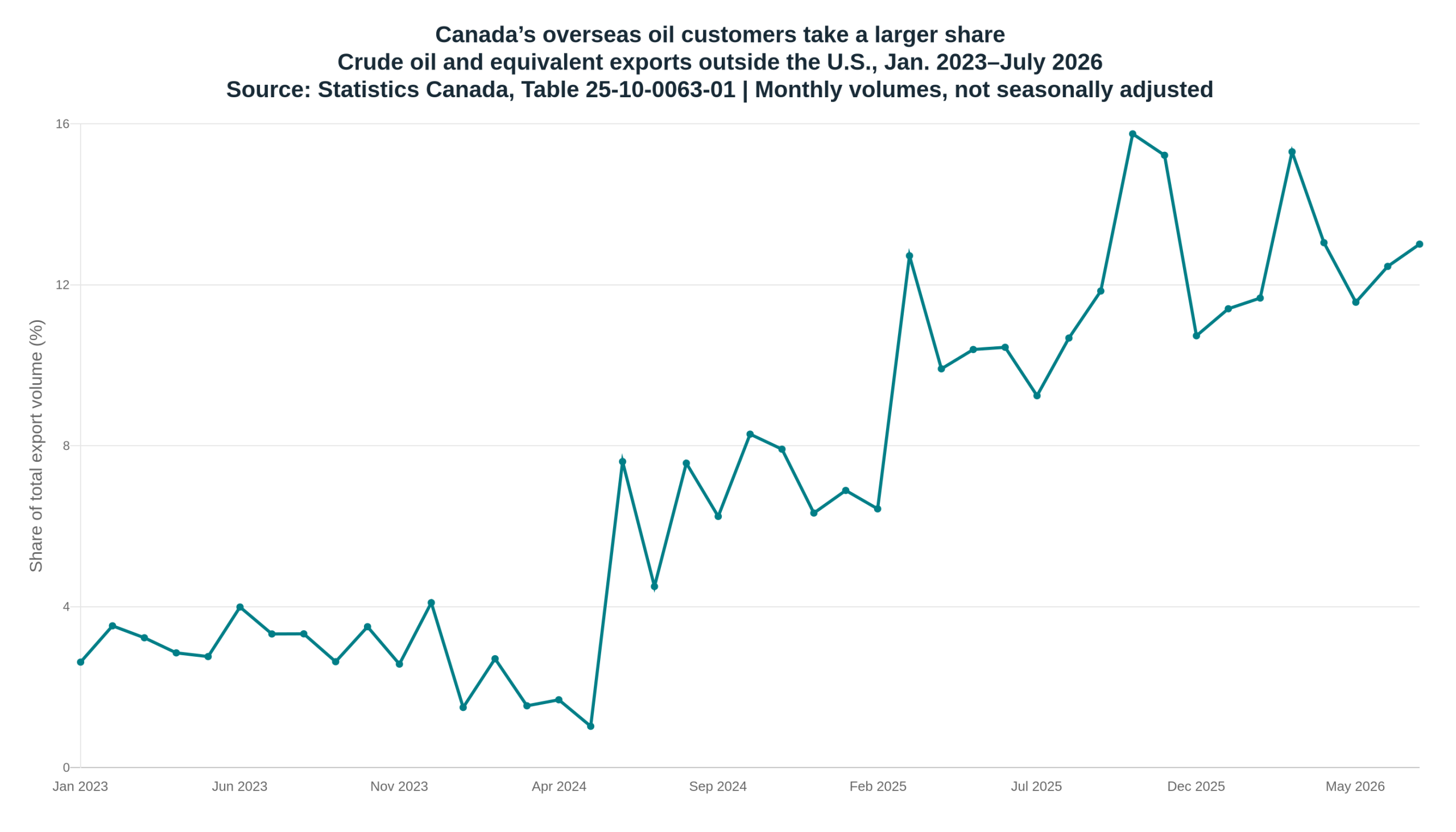
The monthly figures fluctuate, but the direction is clear: overseas buyers are taking a larger share. In July, their share reached 13.0 per cent, compared with 9.2 per cent a year earlier and 3.3 per cent in July 2023.
Canada is diversifying its oil customers. It still sells nearly seven out of every eight exported barrels to the United States.
Domestic Petroleum Consumption Falls
At home, consumption of finished petroleum products declined 3.9 per cent. Gasoline consumption fell 1.5 per cent, while distillate fuels and jet fuel recorded larger decreases.
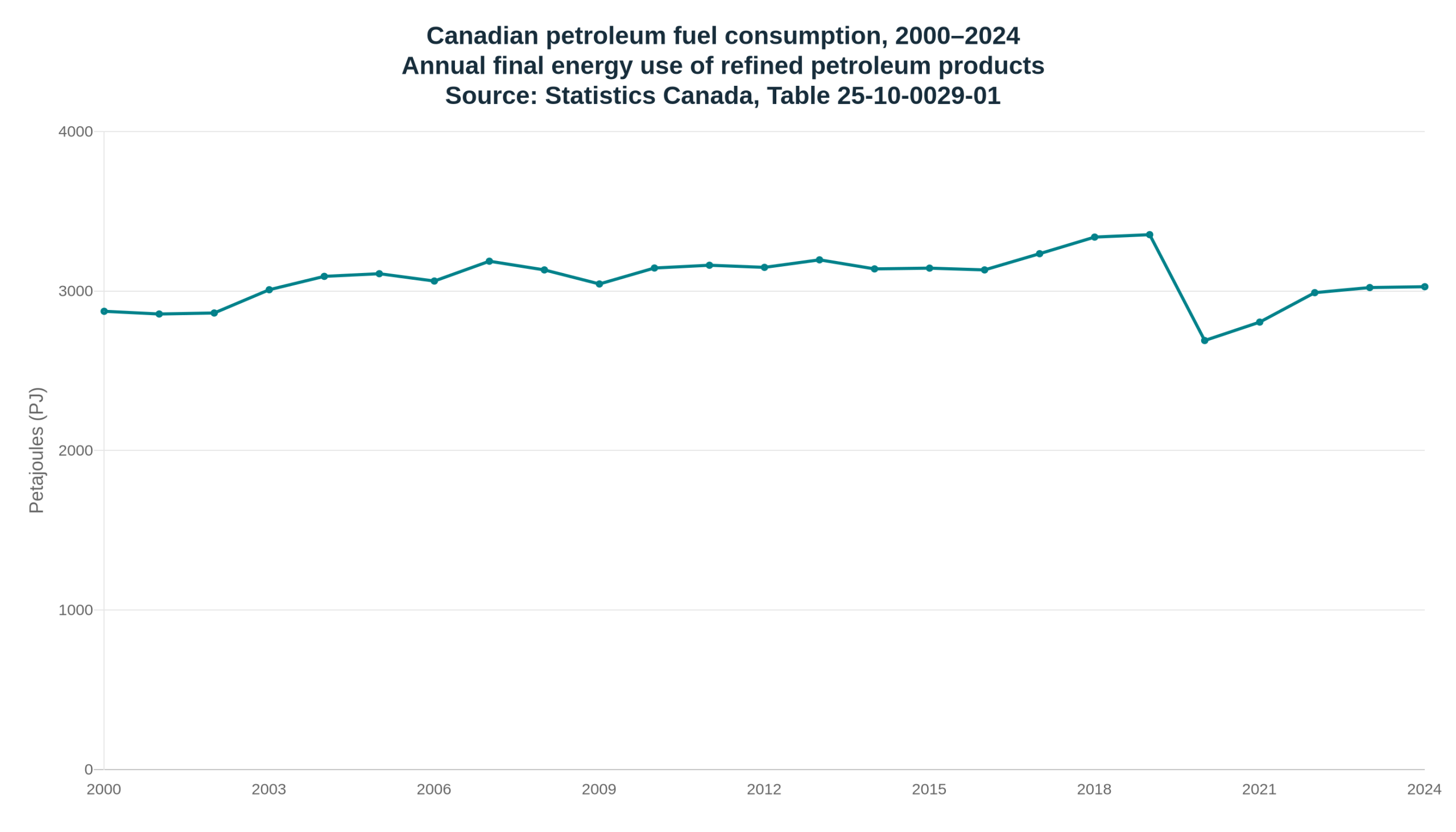
The longer view shows how slowly Canadian petroleum fuel consumption has changed. Statistics Canada’s annual energy dataset puts consumption in 2024 at 3,026 petajoules, just 5.4 per cent above its 2000 level. The series covers 2000–2024, the latest 25 annual observations available.
Consumption peaked at 3,353 petajoules in 2019, then fell sharply in 2020. It has since recovered, but remained 9.7 per cent below that peak in 2024.
Polling shows most Albertans no longer believe Smith’s narrative
Recent polling suggests Smith’s decade-old Alberta-versus-Ottawa narrative is losing its grip. A September Abacus Data survey found 49 per cent of Albertans approve of the Carney government’s handling of major projects, while just 20 per cent disapprove.
That hardly describes a province convinced Ottawa is still determined to suppress its resource economy. At the same time, 73 per cent of Albertans agree that quickly building major projects is now a question of Canadian sovereignty, the highest support of any region in the country.
Albertans remain impatient and overwhelmingly pro-development. Sixty-three per cent want oil and gas pipelines among the projects built first and fastest, compared with 41 per cent nationally, while 70 per cent expect construction on Ottawa’s fast-tracked projects within a year. That looks less like a public convinced the federal government is trying to kill its oil industry than one demanding that Ottawa get on with expanding the infrastructure needed to support it.
The grievance hasn’t disappeared. But the polling suggests the argument has shifted from Ottawa is trying to stop us to Ottawa needs to build faster.
Endnotes
- Statistics Canada, Energy statistics, July 2026, released September 29, 2026.
- Statistics Canada, Table 25-10-0063-01: Supply and disposition of crude oil and equivalent. Export shares and growth rates calculated by Energi Media. Seven-month shares use summed volumes rather than averages of monthly percentages.
- Statistics Canada, Table 25-10-0029-01: Supply and demand of primary and secondary energy in terajoules, annual. Canada; total refined petroleum products; energy use—final demand; 2000–2024. Terajoules converted to petajoules; percentage changes calculated by Energi Media.
- Vantage and Abacus Data, Building in a Hurry: What Canadians Will Trade for Speed on Major Projects, September 2026. National survey of 2,278 Canadian adults conducted September 18–22, 2026.
- Energi Media, CER Market Snapshot: Annual Trade Summary – Crude Oil, June 24, 2025.
- Energi Media, TMX eases pipeline constraints and increases exports to overseas markets, September 4, 2025.
- Energi Media, How oil became Alberta’s identity, power and grievance, August 2026.
- Energi Media interview with S&P Global energy economist Kevin Birn, Oil sands costs low, production growing past 2030 – new report, June 25, 2025.
- Energi Media interview with S&P Global’s Kevin Birn, A Heavy Dose of Reality for Smith and Alberta’s Oil Industry, August 31, 2026.