BREAKING: Ottawa Delivers on Electrification With $2 Billion for Home Retrofits
October 8, 2026 | Economy, Electrification, Canada, News
Ottawa is delivering on its electrification strategy. On Thursday, Prime Minister Mark Carney announced $2 billion over eight years to help up to 820,000 households adopt heat pumps, alongside financing to retrofit 280,000 apartments. The announcement fulfils a major commitment in last spring’s ambitious national electricity strategy.
There are still plenty of questions Carney’s government needs to answer. Will Canada manufacture the heat pumps? Will enough installers be trained to meet demand? Is the program sufficiently ambitious to keep up with other advanced economies in Asia and Europe? Will provincial governments and electricity utilities match Ottawa’s ambition with the power and infrastructure needed to support it?
The next federal budget should explain how these consumer incentives connect to Canadian manufacturing, workforce development, and electricity infrastructure. Helping Canadians buy heat pumps is a welcome step. Building the industrial capacity and electricity system to support widespread adoption is the next test.
Heat-Pump Rebates of up to $10,000 Will Help Canadians Lower Their Energy Bills
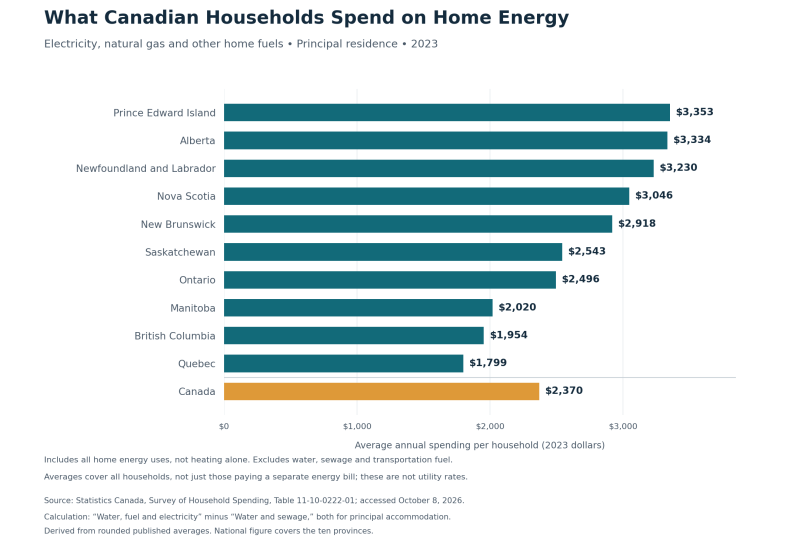
Eligible households below median income will receive up to $10,000 to install a heat pump, while other eligible homeowners will receive $2,000. Both rebates can be combined with provincial incentives to further reduce upfront costs.
Ottawa promises approvals within 24 hours, with no energy audits required before or after installation. The intent is to make it easier for homeowners to choose a heat pump when their existing heating system breaks down.
For households switching from oil, propane, or electric resistance heating, the government estimates average energy savings of more than $1,400 a year. An additional benefit is that heat pumps provide air conditioning during increasingly hot summers.
The program targets a crucial moment in a household’s energy decisions.
According to Ottawa, about one million Canadian homes replace their heating systems each year, more than 80 per cent of them after an unexpected breakdown. Fast approvals could help homeowners choose a heat pump when the immediate priority is getting the heat back on. Households can also apply before their equipment fails, giving them time to plan the switch.
Apartment Retrofits Extend the Benefits of Electrification to Renters
Ottawa’s retrofit push also includes financing to improve 280,000 rental apartments over eight years.
The Canada Mortgage and Housing Corporation will help building owners access private financing on more favourable terms to upgrade up to 250,000 units. The Canada Infrastructure Bank will support another 30,000 through its existing funding.
The investments are intended to improve building quality and energy performance, extending the benefits of the initiative beyond homeowners.
The approach uses public financial institutions to draw private capital into building improvements.
CMHC will insure loans made by approved lenders, while the Canada Infrastructure Bank will finance retrofits through its existing allocation.
Ottawa is also committing nearly $110 million over three years, beginning in 2027–28, to renew the Deep Retrofit Accelerator Initiative. The program helps owners move projects from planning to construction and supports training in the retrofit sector.
Heat Pumps Have a Foothold in Canada, But Plenty of Room to Grow
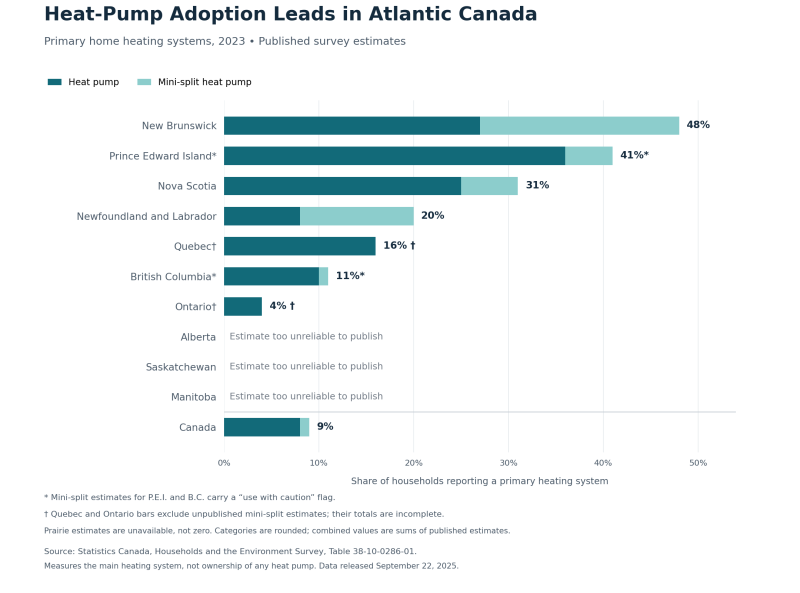
Heat pumps already provide the main source of warmth for a substantial share of Atlantic Canadian households.
Statistics Canada’s 2023 figures show adoption reaching 48% in New Brunswick, about 41% in Prince Edward Island, and 31% in Nova Scotia, compared with 9% nationally. British Columbia stood at about 11%, while Quebec reported 16% and Ontario 4% in the survey’s main heat-pump category, with separate mini-split estimates too unreliable to publish.
Alberta’s estimates for both categories were also too unreliable to publish, preventing a precise comparison.
These figures measure primary heating systems, rather than every home with a heat pump, but they illustrate both the technology’s established role and the considerable opportunity to expand its use.
Carney’s announcement connects that household opportunity to Ottawa’s larger electricity strategy. Expanding the grid matters to Canadians when it translates into something tangible: an affordable way to heat their homes in winter and cool them in summer.
By reducing the upfront cost of heat pumps and simplifying applications, the federal government is taking a practical step toward making electrification an everyday purchasing decision for more families.
Where Is the Industrial Strategy Behind the Heat-Pump Push?
Ottawa’s national electricity strategy explicitly includes industrial policy: manufacturing the technologies needed for electrification and building the Canadian supply chains to support that industry. How does the heat-pump program deliver on that commitment?
Thursday’s announcement includes consultations with heating and cooling contractors and work with technical colleges and industry associations on training and certification. That leaves unanswered whether Ottawa will encourage domestic heat-pump production and expand Canadian component manufacturing.
Consumer rebates will create demand; the question is how much of that spending will support Canadian factories, suppliers, and skilled jobs.
Provincial governments and electricity utilities also have questions to answer.
Do their integrated resource plans account for the adoption Ottawa hopes to encourage? What additional generation, transmission, and neighbourhood infrastructure will be needed, particularly during winter peaks?
Heat pumps replacing electric baseboards can reduce electricity demand, while those replacing fossil-fuel heating add electrical load. The net effect will depend on where installations occur, what equipment they replace, and how they perform during cold snaps.
Ottawa needs to show how its incentives fit with provincial electricity planning.
Good Start on Carney’s Electricity Strategy. What’s Next?
Thursday’s announcement is a welcome, practical step toward delivering the benefits of electrification to Canadian households. Lower energy bills, more comfortable homes, and less pollution are good reasons to get moving. The next federal budget should show how Ottawa intends to turn that household investment into Canadian manufacturing and skilled jobs, backed by coordinated electricity planning with the provinces.
Carney has put money behind the promise. Now Canadians need to see the rest of the plan.
Sources and Further Viewing
- Statistics Canada — Heat-Pump Adoption: Primary Heating Systems and Type of Energy, Table 38-10-0286-01. The article and graph use 2023 data, combining heat-pump and mini-split categories where available. Quebec and Ontario have unpublished mini-split estimates; Alberta’s estimates for both categories are too unreliable to publish.
- Statistics Canada — Home Energy Spending: Household Spending, Canada, Regions and Provinces, Table 11-10-0222-01. The graph subtracts water and sewage from the combined utility total for principal residences. Figures represent average annual spending across households on all home energy uses—not heating-only bills or potential heat-pump savings.
- Statistics Canada — Survey Methodology: User Guide for the Survey of Household Spending, 2023. Definitions, methods, and data-quality guidance for interpreting household expenditures.
- Energi Media — Chris Bataille: Canada Is Betting Billions on the Wrong Energy Future. Carney’s industrial strategy, lessons from East Asia, and whether public investment is building the industries of the future.
- Energi Media — David Victor: Lessons From America: Canada Needs Industrial Policy That Takes Risks. How governments support innovation, finance commercialization, and help domestic industries compete globally.