Canada’s Manufacturing Decline Threatens Economic Sovereignty, Stanford Says
October 15, 2026 | Economy, Canada
Canada must rebuild its industrial capabilities alongside diversifying export markets if it wants to strengthen economic sovereignty, economist Jim Stanford says. Selling more resources outside the United States will leave major vulnerabilities unresolved, he argues.
In an interview with Energi Media’s Markham Hislop, Stanford said Canada’s response to American trade pressure needs to address the composition of exports as well as their destination. His argument builds on his chapter in Bob Rae’s anthology, Reclaiming Canadian Sovereignty in a Ruptured World.
Canada must “diversify what we sell, not just where we sell it,” he said.
Manufacturing Has Lost Ground
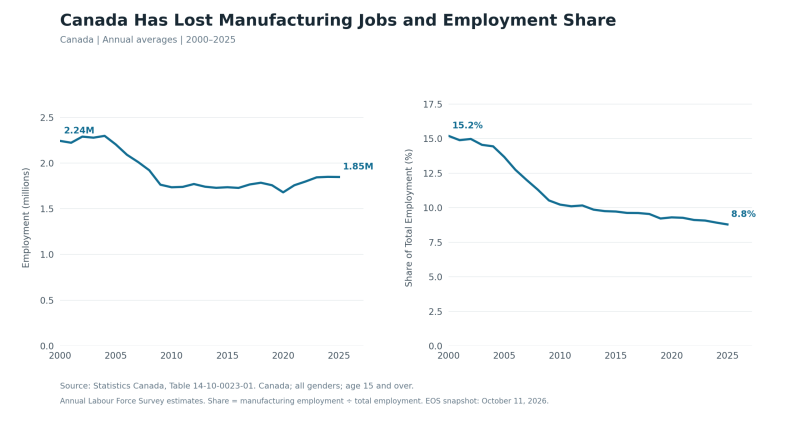
Energi Media’s analysis of Statistics Canada data shows manufacturing employment declined from approximately 2.24 million in 2000 to 1.85 million in 2025, a net loss of 395,100 jobs. Ontario lost 250,200 jobs and Quebec lost 125,700, together accounting for about 95 per cent of Canada’s net decline.
Real manufacturing output fell approximately 11.8 per cent over the same period, while real output across all industries increased 65.3 per cent. Manufacturing’s performance varied: food and machinery production expanded, while motor vehicle manufacturing and aerospace declined.
Business machinery and equipment investment also fell relative to the economy, from approximately 6.3 per cent of GDP in 2000 to 3.2 per cent in 2025.
Resource Dependence Carries Risks
Stanford argues that Canada has moved back toward the “staples trap,” supplying resources that other countries transform into more valuable products. He attributes part of manufacturing’s difficulties to the petroleum investment boom and the resulting appreciation of the Canadian dollar, which weakened exporters’ competitiveness.
Diversifying oil and gas customers does not eliminate exposure to commodity prices, geopolitical disruption or the energy transition, he said. New pipelines therefore cannot substitute for a broader industrial strategy.
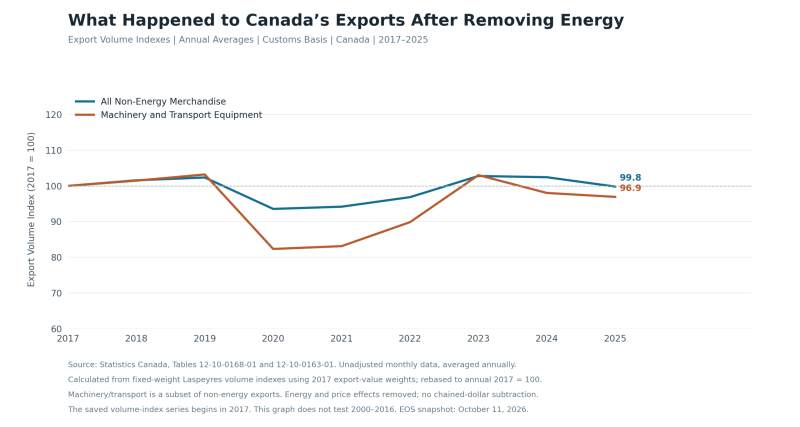
The export data require careful interpretation. Energy prices influence current-dollar export shares. A separate Energi Media calculation removing energy and price changes found non-energy merchandise export volumes were essentially unchanged between 2017 and 2025. That shorter series does not establish the trend since 2000.
Building More Value in Canada
Critical minerals illustrate the choice, Stanford said. Exporting lithium for processing and battery manufacturing elsewhere repeats the resource-export model. Policies supporting domestic processing and manufacturing would retain more industrial activity in Canada.
He called for active use of public investment, procurement, research support, regulation and, where appropriate, public ownership. Canada’s automotive, aerospace and telecommunications industries developed with government support, he said, as did the oil sands.
Stanford welcomed renewed federal interest in industrial policy but said implementation requires more resources, political commitment and public servants with detailed industry expertise.
Governments must also understand what businesses genuinely need without allowing policy to be captured by corporate demands, he said.
Public ownership belongs in that discussion, Stanford said. He argued that retaining the capacity to manufacture steel serves a national purpose, and that governments should be willing to consider ownership when private companies will not maintain strategically important production needed for Canada’s future.
For Stanford, the test of Canada’s response to Trump is whether it builds the productive capabilities needed for an independent economy, rather than deepening dependence on extraction.
End Notes
Related Energi Media Stories
- Only Targeted Industrial Policy Will Fulfil Canada’s Value-Adding Potential — Jim Stanford on rebuilding industries that add value to Canadian resources.
- New Book by Bob Rae: Reclaiming Canadian Sovereignty in a Ruptured World — Industrial capacity, export diversification and Canadian independence.
- US ARPA-E a Model for Carney’s Industrial Ambitions — David Victor on public investment, expertise and technological risk.
Related Energi Media YouTube Interviews
- David Victor on ARPA-E and Canadian Industrial Policy — How governments build technological capability and competitive industries.
- Max Fawcett on Canada’s Energy Superpower Strategy — Commodity exports, clean technology and the case for new pipelines.
- Madeleine McPherson on Electrification and Canada’s Economic Growth — Electricity investment, industrial electrification and competitiveness.