Global Oil Crisis Shifts From Production to Tanker Shipping Costs
October 16, 2026 | News
The global oil crisis is entering a new phase as record tanker freight rates threaten fuel supplies even while crude oil exports from the Middle East recover, according to the International Energy Agency’s October oil market report.
The disruption is exposing a weakness in the international petroleum trade: producing more crude does not necessarily mean refiners can obtain it economically. Or that diesel and other fuels can reach customers. Shipping costs, security threats, and damaged refining infrastructure are keeping fuel markets under pressure despite a substantial rebound in Gulf oil production.
In September, Gulf crude exports rose by 4.4 million barrels per day (b/d) to 13.9 million b/d, more than 75 per cent of their pre-war level. Global oil production climbed by 2.5 million b/d to 102.3 million b/d. Yet the IEA warned that renewed attacks on shipping and energy infrastructure could reverse the recovery.
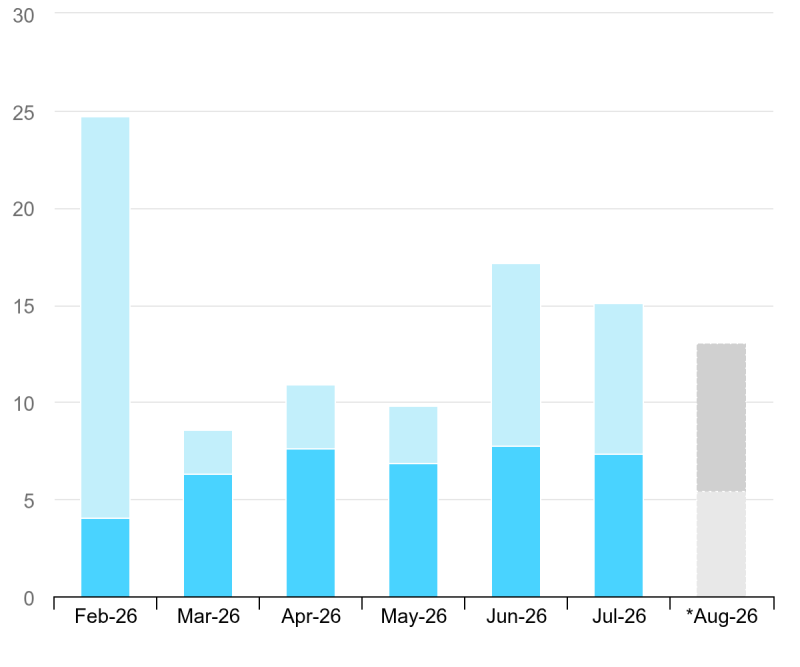
IEA (2026), Gulf Producers Oil Exports, February–August 2026, International Energy Agency, Paris, September 17, 2026
More Crude, But Expensive Deliveries
The problem is no longer confined to the volume of oil available at the wellhead. Tankers must navigate threatened shipping lanes, longer voyages and costly transfers. The IEA says record freight rates have sharply increased the delivered cost of crude and eroded refinery margins outside North America.
Shipping oil from the Persian Gulf to Asian markets has become exceptionally expensive.
Business Insider reported that freight costs on some Gulf-to-Far East journeys exceeded $30 a barrel, while tanker rates for very large crude carriers had quadrupled over the previous year. Those charges come on top of the price of crude itself.
In its October 14 report, the IEA said ship-to-ship transfers in the Gulf of Oman helped increase oil flows through the Strait of Hormuz to 10.9 million b/d in September. Pipeline routes bypassing the strait handled 5.6 million b/d.
Both measures have helped producers restore exports, but neither eliminates the costs and risks of moving oil through a war zone.
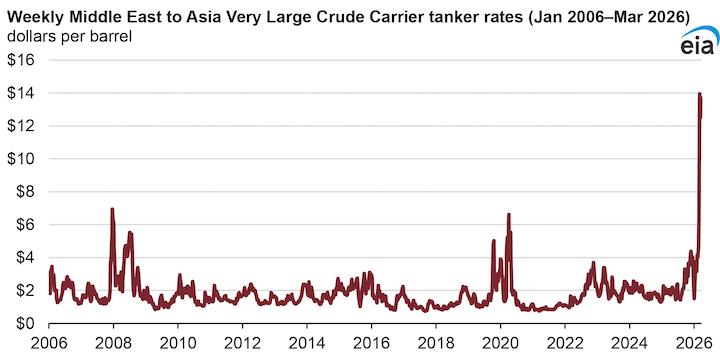
U.S. Energy Information Administration (EIA), Today in Energy, March 2026, tanker freight rates.
Refineries Face a Profit Squeeze
The freight shock is particularly damaging to refiners in Europe and Asia that depend on imported crude. Even when the market price of a refined fuel rises, the extra cost of obtaining feedstock can overwhelm the refinery’s potential profit.
The Financial Times reported that refining margins in northwestern Europe fell from about $54 a barrel in early September to as low as minus $11 on October 5 before recovering to around $3. Diesel and jet fuel prices have risen, but gasoline, naphtha and fuel oil have not kept pace with crude costs.
By contrast, U.S. refiners have benefited from access to comparatively discounted domestic feedstocks. The IEA said U.S. refining margins reached new highs while European and Asian margins were crushed.
The agency expects global refinery throughput to fall to a seasonal low of 81.3 million b/d in October. If margins deteriorate further, less competitive refineries could reduce runs, restricting fuel output precisely when importing regions need more supplies.
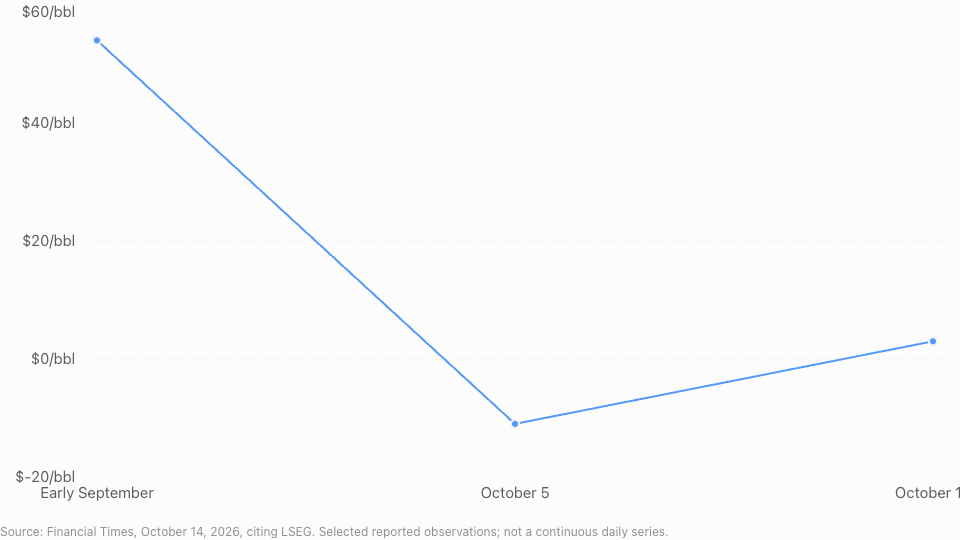
Financial Times, October 14, 2026, based on LSEG data on northwest European refinery margins.
Diesel Is the Most Acute Shortage
As Energi Media reported on the G7 response to the global diesel shortage, refinery constraints are central to the supply crisis. Diesel illustrates why recovering crude production is not enough to resolve the crisis. The fuel powers trucks, ships, construction machinery and industrial equipment, and its availability depends on refinery operations as well as international trade.
The IEA estimated global diesel and gasoil exports in September at 4.7 million b/d, almost 700,000 b/d below a year earlier. Combined net exports from the Middle East and Russia fell by 1.3 million b/d year over year to just 820,000 b/d, a decline of more than 60 per cent.
Middle Eastern refined-product exports remain below half their pre-war level, even as crude exports recover. The region shipped 1.9 million b/d of refined products in September, compared with 4.7 million b/d before the conflict. Russian refining disruptions have compounded the shortage.
Diesel prices retreated from record highs above $200 a barrel in September but remain exceptionally elevated. The IEA says benchmark diesel prices are still nearly double crude prices and pre-crisis levels.
Inventories offer little cushion. OECD gasoil stocks fell to 565 million barrels in July, five per cent below pre-conflict levels and their lowest since November 2023. Winter heating demand and seasonal refinery maintenance threaten to tighten supplies further.
Demand Is Falling, Yet Markets Remain Tight
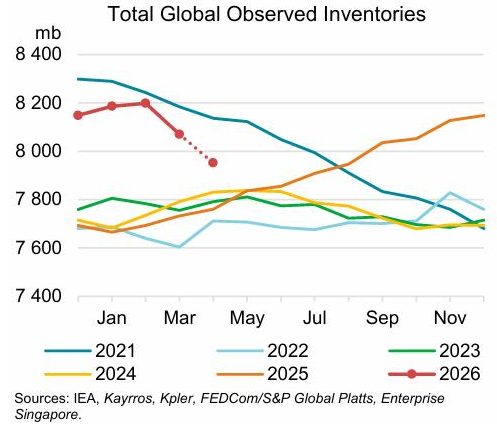 The shortage is unfolding during an unusually steep decline in global oil consumption. The IEA forecasts demand will fall by 2.6 million b/d on average in 2026, with a fourth-quarter contraction of 2.5 million b/d compared with a year earlier. Diesel accounts for roughly one-quarter of the projected annual decline.
Energi Media has also examined how electrification is changing global oil demand. Normally, weaker demand would relieve pressure on supply chains. This year, however, disruptions to refining and shipping have been severe enough to leave diesel markets tight despite reduced consumption.
Global observed oil inventories fell by another 10 million barrels in September, according to the IEA. Onshore stocks declined sharply, although a buildup of oil held aboard ships offset much of the reduction. Total observed stocks were 509 million barrels below their level at the end of February.
What It Means for Canada
For Canada, the changing economics of freight and refining complicate the outlook for oil exports.
Recent Canadian oil export data examined by Energi Media provide useful context for assessing the country’s exposure to overseas markets. Higher shipping costs for Middle Eastern crude could alter the competitive position of North American barrels in Asia, but Canadian shipments face their own transport charges and crude-quality considerations.
The IEA figures establish that the global trade system is being reorganized under pressure; they do not yet demonstrate that Canadian exporters are gaining market share or realizing higher netbacks as a result. That question requires route-specific freight rates, crude price differentials and trade data.
The immediate lesson is broader. Recovering production does not guarantee affordable fuel. As the IEA’s latest figures show, the capacity to move crude, refine it and deliver diesel has become as consequential to global energy security as the number of barrels coming out of the ground.
End Notes
- IEA, Oil Market Report, October 2026
- Bloomberg, Soaring Oil Freight Is Becoming a Risk to Fuel Supply (newsletter identified; full text not independently retrieved)
- Financial Times, European oil refineries’ margins collapse as input costs soar
- Business Insider, oil tanker transportation crisis