Tesla’s New Roadster Flies. Seriously
October 16, 2026 | Electrification, USA
Is it a bird? Is it a plane? It ain’t Superman, but it comes close. Tesla’s redesigned Roadster left the ground, twisted through the air and drove upside down during its October 15 unveiling in Texas.
The pricey electric supercar won’t be available to salivating drivers for some time. Buyers will have to wait: the company is targeting production in 2028, Reuters reported.
The spectacle raises a practical question for prospective owners: which parts of the demonstration belong to the car they can reserve, and which require a different configuration?
Tesla’s Canadian website describes three configurations with different capabilities. Its most dramatic version comes with an explicit restriction on public road use.
Three Versions, Different Capabilities
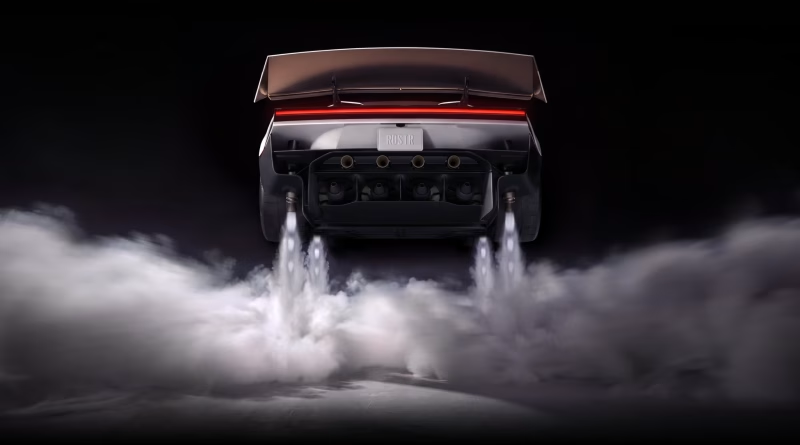
The Performance model seats two and combines active aerodynamics with a suction system. Thrust adds rear cold-gas thrusters; Tesla’s Canadian page claims acceleration from zero to 100 km/h in under one second.
The invitation-only Rocket configuration seats one. Thrusters around the vehicle enable upward, forward and rotational movement. Tesla says it can fly, but states it is not approved for public roads and is unavailable in some regions.
Tesla also cautions that the features and specifications displayed on its page reflect the optional Thrust upgrade. Readers should therefore check the configuration before treating a headline performance claim as standard equipment. The reservation decision starts with understanding exactly which vehicle is offered.
That leaves a clear dividing line for readers watching the launch footage. A demonstration of an airborne vehicle does not establish that the same capability will be available for an ordinary drive. The configuration and the conditions of use both matter.
Suction, Thrusters And Hidden Hardware
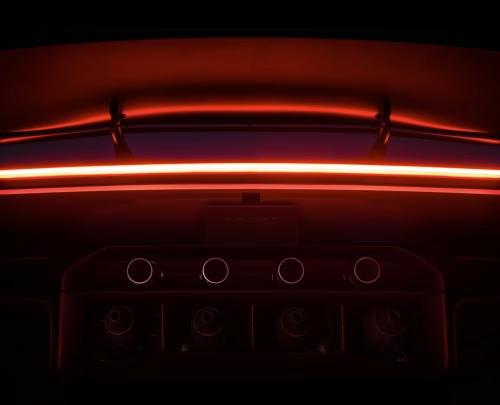
Tesla says fans extract air beneath the car, creating enough suction to hold it upside down while stationary. Active wings and selectable downforce or low-drag settings complement the system.
The design hides headlights and aerodynamic components behind a minimalist exterior. Inside, a steering yoke and multiple displays surround the driver. Tesla describes lightweight materials and a fixed seat position as ways to reduce mass.
The engineering presentation combines two different approaches to controlling movement: increasing the vehicle’s grip on a surface and using thrust to move beyond it. Those functions should be assessed separately when comparing the Roadster with other electric sports cars.
A Long Wait Continues
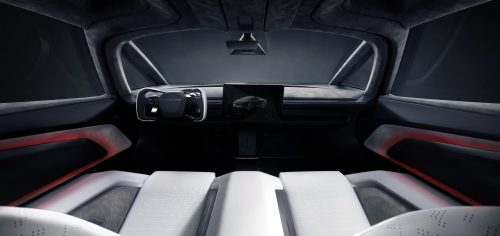
The Roadster interior features a steering yoke and multiple displays. Photo: Tesla.
Reuters reported that the SpaceX collaboration was demonstrated at the rocket company’s McGregor test site. Tesla executives cited a top speed above 370 km/h and driving range exceeding 480 kilometres.
No final prices were announced. Reuters reported US reservation deposits of $50,000 for Performance and $250,000 for Thrust. Those amounts are deposits, not confirmed purchase prices or Canadian pricing.
The timeline extends a project first unveiled in 2017, when deliveries were promised for 2020. The new production target arrives eight years after that original delivery date.
For buyers, the next meaningful milestones are a final specification, a final price and an actual production vehicle. Each answers a different question that a spectacular demonstration cannot settle on its own.
The Roadster gives Tesla a striking showcase for electric performance. Turning that showcase into a delivered product remains the test ahead. Until then, the launch establishes what Tesla has chosen to demonstrate and advertise, while customers await the car that ultimately reaches production.
Sources
- Tesla Canada, Roadster: configurations, technology and restrictions, accessed October 16, 2026. All photographs: Tesla.
- Reuters, “Tesla’s New Roadster Turns in Air With SpaceX Thrusters, Won’t Land Until 2028,” October 16, 2026, via Euronext.