Carney and Ford Unveil $8.7 Billion Plan to Defend Ontario Steel, Auto Jobs and EV Manufacturing
October 22, 2026 | Ontario, News
Prime Minister Mark Carney and Ontario Premier Doug Ford have announced an $8.7-billion industrial action plan aimed at protecting steel and automotive jobs from U.S. tariffs while positioning the province to manufacture electric vehicles and develop critical minerals.
The agreement, unveiled Wednesday in Ottawa, combines federal and provincial commitments for steel modernization, automotive investment and roads into Northern Ontario’s mineral-rich Ring of Fire. It marks a significant effort by both governments to reduce Canada’s dependence on the American market as trade relations deteriorate.
Steel Gets the Largest Share
The biggest component is a $5.22-billion Joint Steel Action Fund, including $3.55 billion from Ottawa and $1.67 billion from Ontario over five years. The money is intended to help steelmakers diversify production, modernize facilities, and find customers beyond the United States.
The governments also plan to prioritize Canadian steel in public procurement and strengthen enforcement against dumped or unfairly subsidized imports. Steel is also essential to electricity transmission, construction, vehicles and energy infrastructure, making domestic production strategically important beyond the immediate tariff dispute.
A joint task force will examine transportation costs and other obstacles to competitiveness.
The federal government puts direct employment in Canada’s broader steel industry at more than 23,000. Statistics Canada recorded 23,755 payroll jobs across two relevant categories in July 2026: iron and steel mills and ferro-alloy manufacturing (14,245), and steel product manufacturing from purchased steel (9,510).
The accompanying graph tracks only the first category.
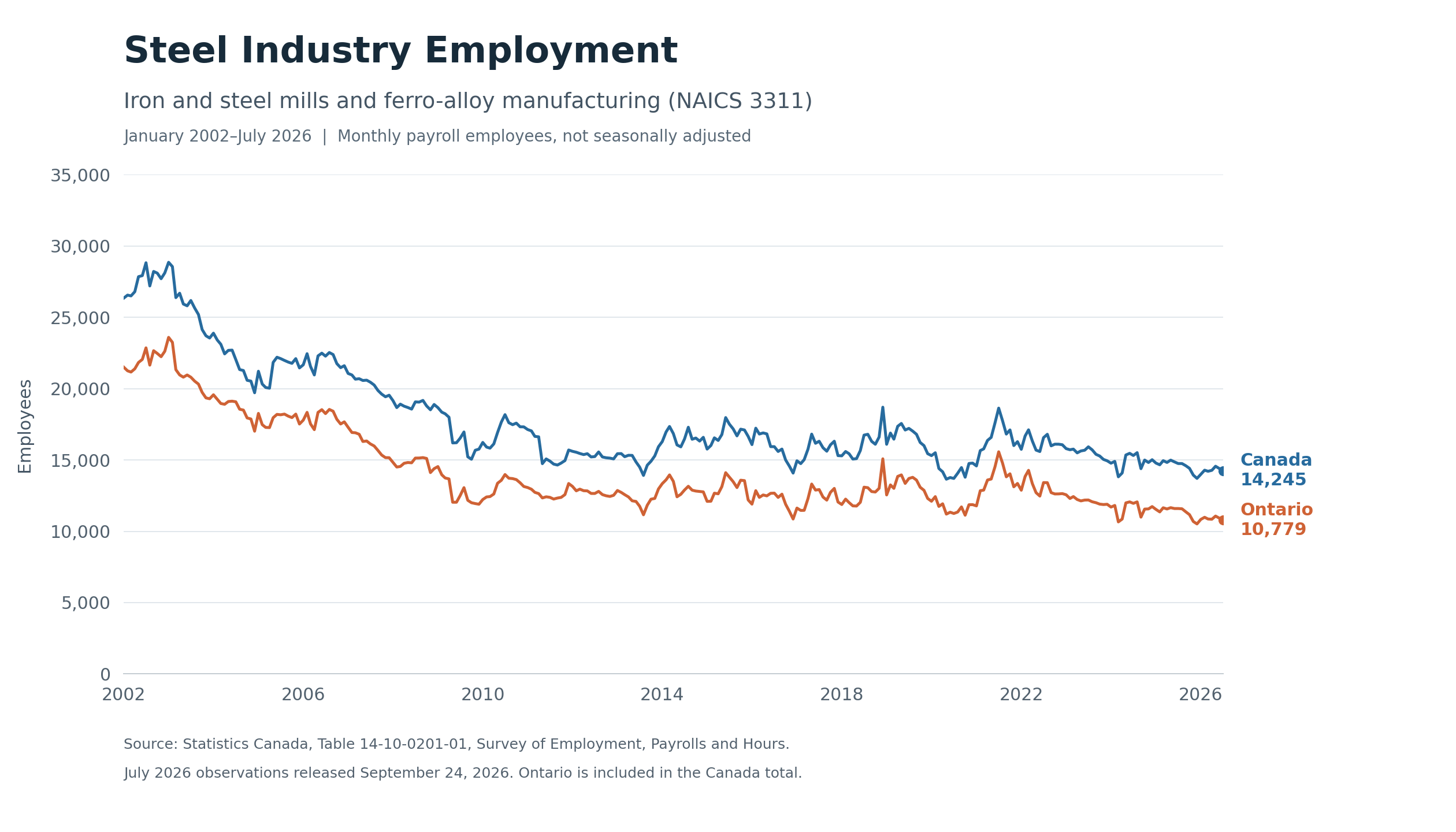
The graph shows a long decline in employment within iron and steel mills and ferro-alloy manufacturing. Ontario had 10,779 payroll employees in July 2026, down from 22,861 in July 2002, a drop of 52.8 per cent. Across Canada, employment in the same category fell from 28,828 to 14,245, a decline of 50.6 per cent.
Much of the decline occurred before 2010, followed by fluctuations at substantially lower employment levels. The long-term losses therefore predate the current tariff dispute. The graph uses monthly data that are not seasonally adjusted; the percentage changes compare July with July.
Automakers Face Twin Threats from Trump, Electric Vehicles
A further $2.5 billion over two years—$1.5 billion federal and $1 billion provincial—will support large automotive capital projects, including modern machinery and production lines for connected and electric vehicles.
The funding builds on previously announced federal auto-industry supports. Ottawa and Queen’s Park are trying to retain manufacturing investment while automakers confront U.S. trade barriers, shifting EV demand and growing competition from overseas manufacturers.
But the agreement also gives companies more time to meet vehicle emissions rules. Canada will hold its light-duty fleet emissions standard at the 2026 level through 2029, resuming annual tightening in 2030. The government says the change provides flexibility while retaining its target of 75 per cent EV sales by 2035.
That creates a policy tension: governments are subsidizing factories capable of producing electric vehicles while easing near-term regulatory pressure to sell cleaner vehicles. Whether the approach protects jobs without slowing electrification will depend on manufacturers’ investment decisions and future consumer demand.
Output Has Weakened, Especially in Vehicle Manufacturing
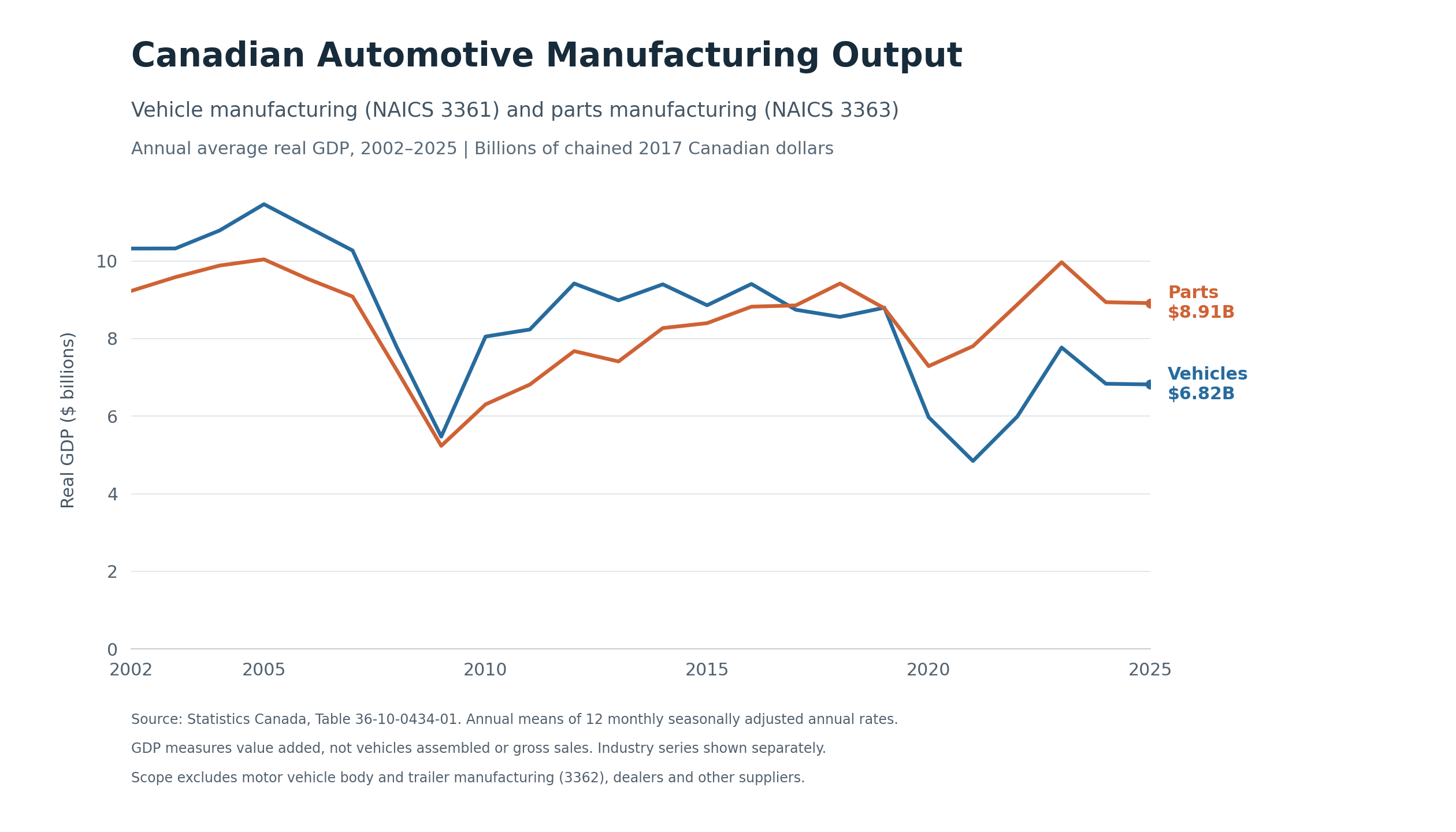
Statistics Canada’s inflation-adjusted GDP data show how the industry’s economic contribution has changed.
Vehicle manufacturing generated $6.82 billion in value added in 2025, down 33.9 per cent from $10.32 billion in 2002. Parts manufacturing proved more resilient: its real GDP fell 3.4 per cent, from $9.23 billion to $8.91 billion. Both industries suffered sharp declines around the 2008–2009 financial crisis and again in 2020. By 2025, vehicle manufacturing remained well below its earlier levels.
Employment Has Fallen in Both Industries
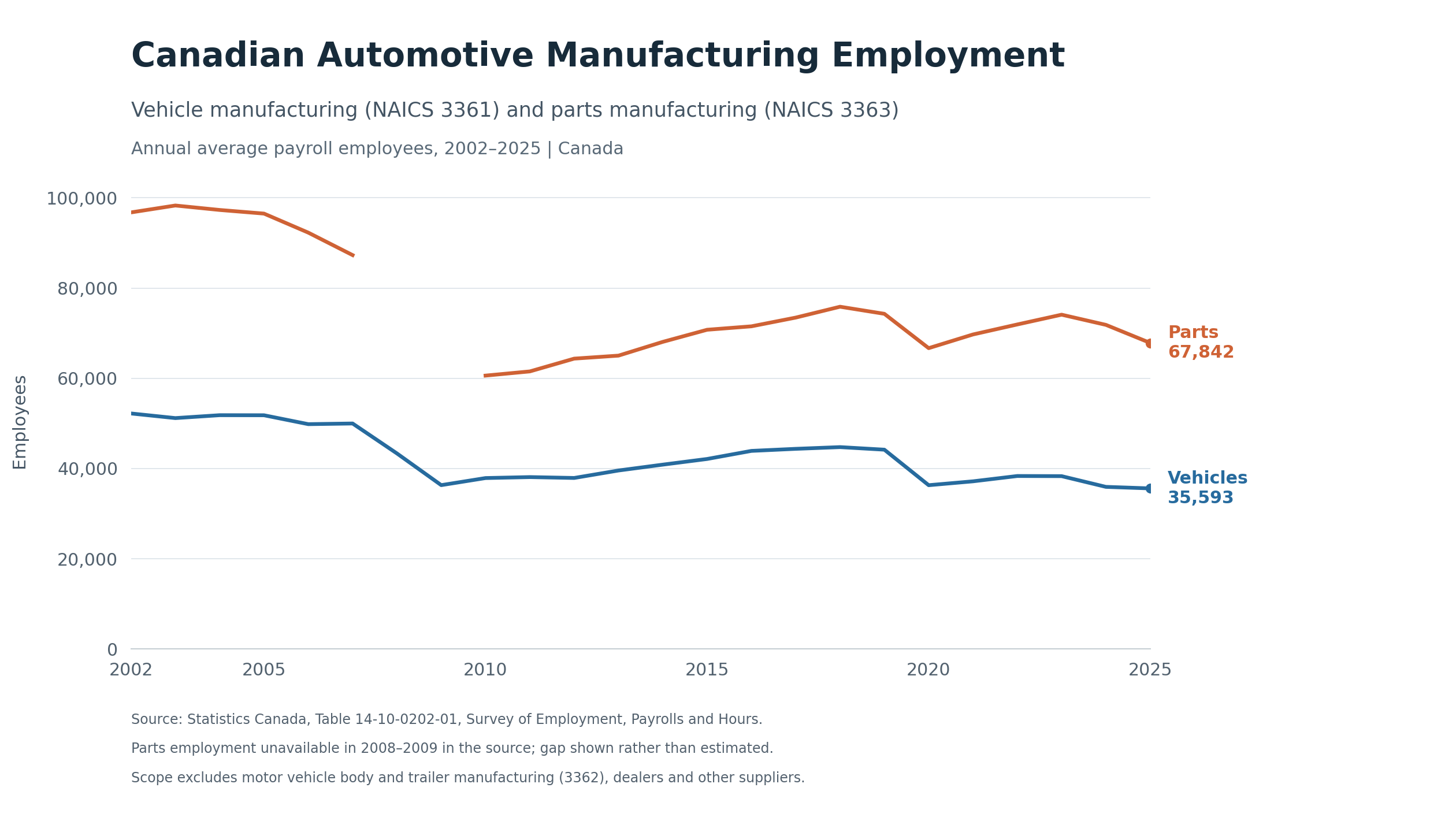
The employment figures show a broader loss of manufacturing jobs.
Annual average payroll employment in vehicle manufacturing fell from 52,205 in 2002 to 35,593 in 2025, a decline of 31.8 per cent. Parts manufacturing employment fell from 96,777 to 67,842, a drop of 29.9 per cent.
Together, the two industries employed 45,547 fewer people in 2025 than in 2002. The data show partial recoveries after the financial crisis, followed by renewed weakness around the pandemic.
Ring of Fire and the Missing Links
Ottawa will contribute up to $1 billion over three years toward road infrastructure in the Ring of Fire, matching Ontario’s existing commitment. The remote region contains deposits of minerals used in steelmaking and potentially clean-technology supply chains.
The governments will coordinate permitting and establish a working group on consultation with First Nations. Road construction, mine development and downstream processing still face substantial logistical, environmental and Indigenous-rights questions. Funding access roads does not itself guarantee commercially viable mines or local processing facilities.
Can Industrial Policy Reverse the Decline?
The announcement underscores a broader change in Canadian economic policy. Rather than relying principally on continental free trade, Ottawa and Ontario are using public investment, procurement rules and strategic infrastructure to preserve manufacturing capacity and build new supply chains.
Carney called the agreement “cooperative federalism in action,” while Ford emphasized protecting workers and securing future jobs. Both governments face a harder test than announcing funding: translating commitments into private investment, competitive factories and lasting employment.
The $8.7-billion headline includes commitments spread across multiple years and mechanisms that build on existing programs. It should not be confused with $8.7 billion in immediately disbursed new spending.
For Ontario’s industrial communities, the central question is whether this intervention can establish durable competitiveness in steel, electric vehicles and critical minerals or merely cushion the latest shock from Washington.
Related Energi Media Coverage
- Canada’s Manufacturing Decline Threatens Economic Sovereignty, Stanford Says
- Charlie Angus Calls for an Industrial Strategy to Escape Canada’s Staples Trap
- Battery Industrial Policy Offers Lessons for Canada as It Diversifies Beyond the U.S.
- Diversifying Canada’s EV Sector Key to Protecting Auto Jobs: Pembina Institute
- BYD Eyes Canadian Manufacturing, But Shuts the Door on Joint Venture
- Canada Needs Affordable Power and Practical Policies to Become an Electrostate