Cheap Batteries Break Solar Power’s Night Time Barrier
August 19, 2026 | Innovation
This news article is based on Ember’s new report, Batteries Have Unlocked the Era of Anytime Solar, published Aug. 12, 2026.
Battery storage is beginning to erase solar power’s long-standing daytime constraint, with new installations expected in 2026 theoretically capable of shifting more than one-third of new daily solar generation into non-sunny hours, according to a new Ember report.
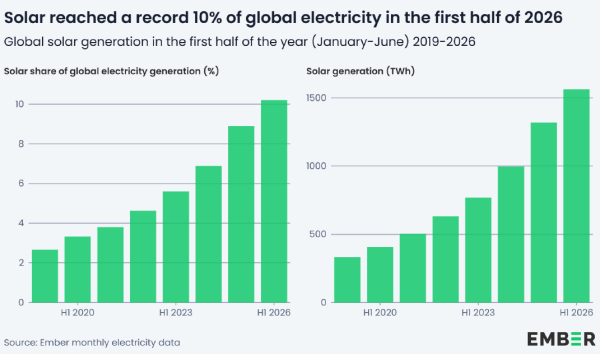
Solar supplied just over 10 per cent of global electricity in the first half of 2026, up from 8.9 per cent a year earlier and 5.6 per cent in the first half of 2023. Global solar generation doubled over those three years, reaching 1,564 TWh.
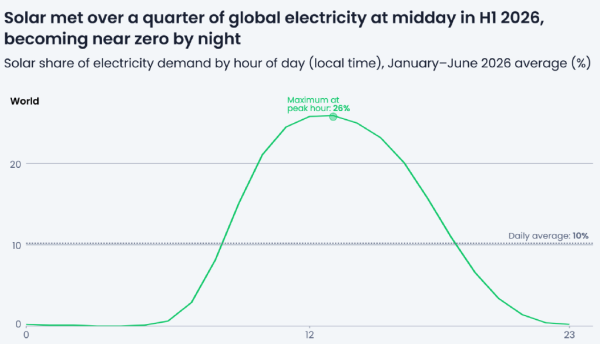
The rapid growth has created a pronounced daily imbalance. Ember estimates solar met more than 25 per cent of global electricity demand between 11 a.m. and 2 p.m. on the average day in the first half of 2026, before falling to near zero overnight.
In mature solar markets, midday shares are substantially higher. Solar supplied 71 per cent of Chile’s electricity demand at noon, 58 per cent in the Netherlands at 1 p.m. and 55 per cent in Germany at noon on the average day.
Fossil generation remains much more resilient after sunset. In India, average fossil output at 1 p.m. fell from about 135 GW in the first half of 2023 to 125 GW in the first half of 2026. Between 5 p.m. and 7 a.m., however, fossil generation rose by 22 GW to an average 168 GW.
The European Union experienced a similar split. Average midday fossil output fell by 16 GW between the first halves of 2023 and 2026, while the 7 p.m. to 9 p.m. evening peak declined by only 5 GW.
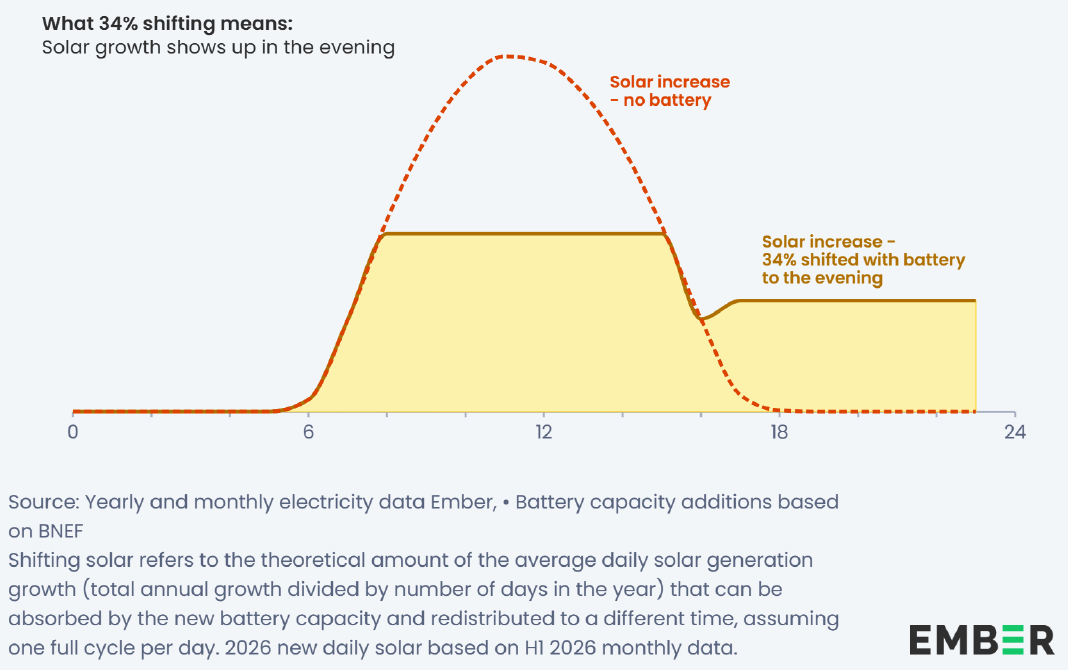
Battery deployment is beginning to change that pattern. Ember estimates 459 GWh of battery additions in 2026, up 50 per cent from 307 GWh in 2025, could theoretically shift 34 per cent of new daily solar generation into later hours. The figure is a technical ceiling because batteries also provide other grid services and many assets remain underutilized.
Several markets are already showing significant evening effects. Solar plus batteries met more than one-quarter of California electricity demand between 7 p.m. and 9 p.m. on the average day in the first half of 2026, up from 6.8 per cent three years earlier. The combination supplied 24 per cent of Bulgaria’s demand during the same evening period, while batteries helped solar supply more than 10 per cent of Chilean evening demand.
The shift has been enabled by collapsing battery costs. Ember says average installed storage costs fell 95 per cent from $2,634 per kWh in 2010 to $140 per kWh in 2025, alongside improvements in safety and cycle life.
Ember cautions that short-duration batteries primarily solve daily balancing. Longer periods of weak wind and solar will still require a broader mix of transmission, demand flexibility, hydro, nuclear, long-duration storage and other firm resources.
The report concludes that future solar growth will increasingly depend on battery deployment, market design and the ability of power systems to move cheap midday electricity into higher-value evening hours.