
This article was published by The Energy Mix on Dec. 17, 2025.
After adopting a series of rolling deadlines to phase out Russian gas imports by 2027, the European Union still won’t need new supplies—from Canada or anywhere else—to make up the difference, energy analysts say.
On Wednesday, the European Parliament voted to phase out imports of Russian liquefied natural gas (LNG) by the end of next year and pipeline gas by September, 2027, Reuters reported. The European Commission will also propose measures early next year to phase out Russian oil purchases.
Russia was once the continent’s biggest supplier of gas, the news agency writes. But since Vladimir Putin launched his invasion of Ukraine in 2022, his country has seen its market share in Europe fall from 45 per cent to 12 per cent.
One analyst put the value of those remaining cargos at €25 to €30 million each, with more than 200 tankers filled with Russian Arctic gas landing at European ports this year.
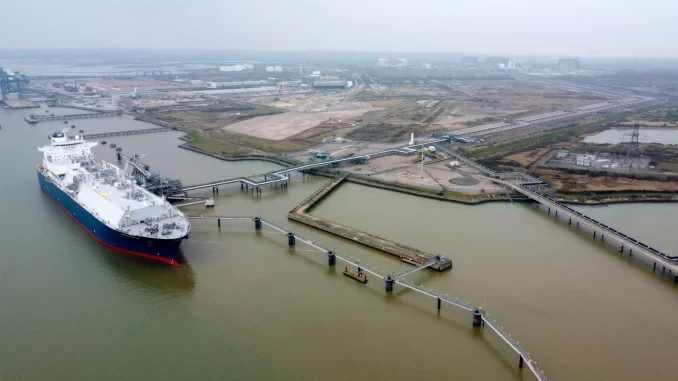
Over the past several months, the Canadian government has pushed hard to encourage LNG exports to Europe, with Energy and Natural Resources Minister Tim Hodgson maintaining in August that a first shipment might be possible in “as little as five years”. But analysts say Europe will have no need for new gas, even with Russia falling out of the supply mix.
“The big fear is always this question of how to find alternative supply,” said Sebastian Rötters, sanctions campaigner with Urgevald, a climate finance non-profit based in Sassenberg, Germany. But “from 2027 onwards, there will be an oversupply in the market, and this is something we can already start to see.”
With multiple experts predicting a gas glut, “I don’t really think the EU will replace these volumes, and I hope they won’t replace them with long-term contracts,” he told The Energy Mix. “If we see the need for alternative supply, but at the same we don’t want to throw our climate goals out the window, it’s difficult to sign a 20-year contract.”
In a market assessment released last March, the Ember energy policy think tank said Europe will see a 54 per cent increase in LNG import capacity between 2023 and 2030, even though the continent’s gas grid operators only foresee a 4 per cent increase in demand. That disconnect will lead to more than 100 billion cubic metres of “costly supply capacity potentially being unneeded and underutilized,” the report stated. “This scale of overinvestment is equal to the combined annual gas demand of Germany, France, and Poland.”
Throughout 2024, those gas supplies also drove up gas prices by 59 per cent, Ember added, leading to higher electricity costs for consumers.
Ana Maria Jaller-Makarewicz, lead energy analyst, Europe at the Institute for Energy Economics and Financial Analysis, said Russia supplied 16 per cent of the continent’s LNG and 13 per cent of its combined LNG and pipeline gas in the first half of 2025, even after the EU decreased its gas dependence by 20 per cent between 2021 and 2023.
But “if the EU continues with policies to reduce gas consumption and scale up renewables, the bloc could replace this supply without increasing gas imports from any source.,” Jaller-Makarewicz said.
Rötters said the real issue is whether EU members—including countries like Hungary and Slovakia that are more closely aligned with the Putin regime—would want to take those steps.
“Could we offset this? Of course we could,” he said. But “in Europe at the moment, renewable energy deployment and climate-related work are not really the number one priority. So of course energy efficiency is a priority, in the sense that the EU wants to be less dependent, but we could do a lot more if the political will were there.”
Beyond geopolitics, Rötters explained that Hungary and Slovakia worked to slow down the EU ban to protect their access to relatively inexpensive pipeline gas from Europe. That led countries to negotiate a phaseout in four stages: short-term LNG contracts in April, 2026, followed by short-term pipeline contracts in June and longer-term deals at the end of this year and the following September, respectively.
If the goal is to cut off financing for Putin’s war machine, one question is whether Russia will find other customers for the gas it can no longer sell to the EU.
“The market continues to be very volatile and dependent on geopolitical issues that could affect prices, supply, and demand,” Jaller-Makarewicz told The Mix. But already, “Russia has been selling gas and LNG at discounted prices to attract buyers,” and “it might be difficult to find a market that will import the same amount of Russian gas as Europe did before Russia’s full-scale invasion of Ukraine. Gas demand in different regions has been declining, and countries like China have been decreasing their LNG needs.”
That means it will serve the EU’s geopolitical agenda if imports can be shut down, Rötters said.
“Would it help to cut this money off? I would say yes, it would,” he said. “We are pushing for very strong and immediate sanctions because the Russian economy is really in trouble. This is something Putin can still hide, but… the existing sanctions do hurt.”
At the same time, Urgevald is stressing the urgency of stopping the flow of gas payments from the EU to Russia, with Rötters pointing out that Ukraine “is helping the EU” by “saving Europe from defending against a Russian attack on EU territory. Because I don’t think it’s a fairy tale to say the Baltic countries are in imminent danger of Russian aggression.”
After the deal was adopted, Denmark’s minister for climate, energy and utilities, Lars Aagaard, praised the EU agreement as “a big win for us and for all of Europe. We have to put an end to the EU’s dependence on Russian gas, and banning it in the EU permanently is a major step in the right direction.”
But in a release following Wednesday’s announcement, Urgevald said the continent is moving too slowly.
“While the EU congratulates itself on phasing out Russian gas by 2027, the Kremlin is still set to receive billions in the meantime,” Rötters said in the release. “At the current pace, the EU will pay over €4 billion for Russian-linked LNG in 2026 alone. That is not a phaseout. That is financing a war,” and “every delay weakens sanctions and strengthens the Kremlin.”
Be the first to comment