
This article was published by The Energy Mix on Dec. 16, 2025.
A new report suggests future exports of Canadian oil and liquefied natural gas (LNG) could deliver major emissions reductions, but its authors acknowledge they didn’t address some of the key sources of emissions in those fuels.
The report, produced by the Ottawa-based Public Policy Forum (PPF) for the Canadian Chamber of Commerce, asserts that future Canadian exports “are highly likely to substitute higher-emitting global alternatives and deliver significant climate benefits,” the organizations said in a release last week. They put the emissions savings as high as 40% if Canadian LNG displaced coal-fired power production in Japan, South Korea, China, or India, or 40% if it replaced LNG from the United States.
“This report reinforces what we’ve been saying for years: cleaner energy is Canadian energy,” said Chamber President and CEO Candace Laing. “When our LNG and oil displace higher-emitting alternatives abroad, global emissions go down, not up.”
“This analysis represents a win for the economy, Indigenous reconciliation, and the environment,” said PPF President and CEO Inez Jabalpurwala. “The report’s conclusions counter the simplistic narrative that more oil and gas equals more emissions.”
The Globe and Mail touted the release as “giving fresh support to Canada’s ambition to be an energy superpower as the federal and B.C. governments push for increased exports of liquefied natural gas.”
The report concludes that global emissions would “most likely” fall by 40 to 70 million tonnes per year of carbon dioxide or equivalent if all the LNG plants now under development in British Columbia were eventually built—thanks to low-emitting hydropower used in the liquefaction process, “tight” methane controls, high-quality gas with lower carbon dioxide concentrations, and shorter shipping distances to Asia.
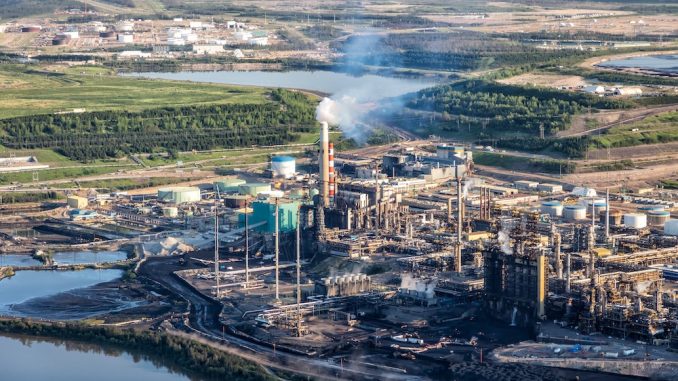
It concludes that heavy oil from Canada’s oil sands would generate an emissions saving of 18 to 51 kilograms per barrel, or more if the proposed Pathways Alliance carbon capture hub is ever built, compared to Venezuela, which (like Canada) produces one of the most emissions-intensive grades of oil anywhere.
The report says the emissions intensity of Canadian oil—the climate pollution released per barrel extracted—has fallen 30% since 2005. The Canadian Climate Institute reported this fall that the downward trend has been stabilizing since 2017.
‘Emissions Intensity’, Higher Emissions
Report co-author and Public Policy Forum Fellow Mark Cameron, a former VP, external relations with the Pathways Alliance, acknowledged in an interview that total emissions would rise if oil and gas production increased faster than emissions intensity fell.
“Obviously, if you simply lower emissions intensity slightly and dramatically increase production, you’re going to get higher emissions overall,” he said. “The question is, how fast will intensity improve and what will happen to global oil demand?”
The sweeping memorandum of understanding signed last month by Prime Minister Mark Carney and Alberta Premier Danielle Smith calls for up to 1.4 million barrels per day of new oil sands production, based on an expansion of the existing Trans Mountain Pipeline and construction of a new line to British Columbia’s environmentally hazardous northwest coast—although questions are beginning to swirl about where and whether there will be demand for those supplies. Cameron said long-term markets for oil sands bitumen might put more emphasis on non-combustion products like asphalt and carbon fibre.
As long as that bitumen is being burned as a fuel, Cameron acknowledged that emissions accounting leaves out the roughly 80% of the carbon in every barrel that fossil fuel producers can’t decarbonize—since it doesn’t go into the atmosphere until it reaches its end user.
“That’s going to be happening no matter where those barrels come from, right?” He said. “If we can produce a lower-emission barrel on the production side, it makes sense for Canada to maximize its share of whatever that market is. The emissions are the responsibility of the country that is the final end user, but from a Canadian economic point of view it’s better if that’s Canadian oil, and from a climate point of view it’s better if it’s as low-emission as possible.”
Other analyses have indicated that Canadian heavy oil is among the highest-polluting, as well as one of the most expensive and inconvenient to process.
Methane Uncertainties
The report cites LNG as “Canada’s largest new export opportunity, with potentially the greatest impact on emissions,” based on B.C.’s “stringent methane controls” and its methods for measuring, monitoring, reporting and verifying (MMRV) methane releases. Those numbers matter because methane is a climate super-pollutant with 84 times the global warming clout of carbon dioxide over the crucial 20-year span when humanity will be scrambling to get climate change under control.
Cameron noted that B.C. met its own deadline for reducing methane emissions 45% from 2012 levels in 2023, two years ahead of schedule, one of three provinces that beat their targets.
But the province is still falling far short of its 2030 emissions target, and the report bases its export and emissions projections on completion of several new LNG projects now under review in B.C. Late last month, an independent review commissioned by the B.C. government warned that those projects threaten to “set back progress” on the province’s emission reductions and “stand to all-but wipe out hard-fought gains in other sectors.”
Study co-author Arash Goishan, policy lead with PPF’s Energy Future Forum, said the emission advantages in the report were based on the (even) less stringent MMRV regime in the United States. Donald Trump’s administration moved to severely weaken those regulations after he returned to the White House earlier this year.
Cameron said Canada has some of the lowest methane emissions in the world based on the emissions companies are measuring. But “we can only look at what we can measure,” he told The Energy Mix.
As recently as June, McGill University researchers found that inactive oil and gas wells in five provinces, including B.C., were emitting seven times more methane than reported, and past research has suggested large quantities of unmeasured methane releases from natural gas fracking operations in the province’s northeast. Although replacing LNG with coal is one of the key strategies in the PPF analysis, a report last year concluded that LNG carries 2.7 times the climate impact because of its “significantly higher” methane emissions.
Decades of Fossil Demand
With a global LNG glut on the near horizon, oil prices headed for a “tailspin”, and fossil companies’ market behaviour signalling those risks, Goishan said the latest projections from the International Energy Agency paint “a more nuanced picture” of future demand.
“In the IEA’s Current Policies Scenario (CPS), which reflects only policies already firmly in place, global demand for both oil and natural gas continues to grow through 2050 and beyond,” he told The Mix in an email.
“Even under the IEA’s more ambitious Stated Policies Scenario (STEPS), incorporating announced policies and targets (which we’re seeing how easily are ditched in real time and in response to other economic and geostrategic priorities), oil demand peaks around 2030 at around 102 mb/d [million barrels per day] before a very gradual decline, while natural gas demand grows into the mid-2030s before leveling off into a prolonged plateau of high demand through 2050,” he added. “Importantly, post-peak, there is no sharp decline projected.”
The IEA’s net-zero scenario shows a more pronounced reduction in demand. But “even in those decline scenarios, we would expect the lowest-emission sources would be privileged, right?” Cameron told The Mix. “So if we do follow the net-zero scenario, that would assume there’s going to be some kind of benefit to being a low-emissions source.”
He said those calculations could translate into three to five decades of “pretty significant demand” for Canadian LNG.
The IEA scenarios were published after months of arm-twisting by U.S. Energy Secretary and former fracking CEO Chris Wright, who openly threatened to pull the U.S. and its funding out of the IEA if the Paris-based agency continued projecting a strong future for renewable energy. For years previously, the IEA had projected that demand for all three fossil fuels will plateau this decade before going into permanent decline, as an Age of Electricity begins to take hold.
A ’Pragmatic Approach’
The two authors recommend new accounting methods and bilateral agreements to maximize the emission savings they see in Canadian oil and gas. But they aren’t suggesting that anyone wait for the paperwork before pushing ahead with new exports.
“A pragmatic approach is essential,” they write. “Canada must not delay leveraging its oil and gas export potential by making such agreements a precondition or waiting for a fully-formed global framework, as this would voluntarily forfeit crucial economic, strategic, and environmental advantages that those products offer to Canada, its allies, and the global fight against climate change.”
Be the first to comment