Debunking Rebel News: Federal Export Tax Would Be Paid By American Consumers, Not Alberta Producers
September 5, 2026 | News
“Fact Check: What really threatens Alberta energy investment? A referendum or threat of a federally imposed excise tax in a trade war?” – Sheila Gunn Reid, Sept. 4, 2026
Rebel News is to journalism what professional wrestling is to a real sport. Exhibit A is this flimsy — I’m being kind — “fact check” that contains no data, no expert opinion, and not much in the way of facts.
Gunn Reid’s argument moves directly from assumption to conclusion: “An export tax would immediately raise costs, reduce returns for producers and tell investors that Alberta’s largest industry could be sacrificed during Ottawa’s next political fight.” Read it for yourself. Thirty seconds should do it.
Energy economist Ed Hirs of the University of Houston provides a very different picture. The oil industry veteran argues that the cost of a tax on Canadian crude would not simply fall on Alberta producers. It would be distributed through a tightly integrated North American oil market among Canadian producers, American refiners, and American consumers.
“The tariffs are paid at the import point,” Hirs told Energi Media in February 2025. That means the refinery importing Canadian crude initially pays the tax.
What happens next depends upon market conditions.
A refinery could absorb some of the cost through lower margins. It could demand a discount from the Canadian producer. Or it could pass some or all of the additional cost through to consumers in the form of higher gasoline and diesel prices.
Hirs said the ultimate distribution depends heavily on the price elasticity of demand. Because demand for gasoline and diesel is relatively inelastic, consumers could bear a significant share of the cost.
That bargaining power matters because some American refineries have no alternatives to Canadian crude.
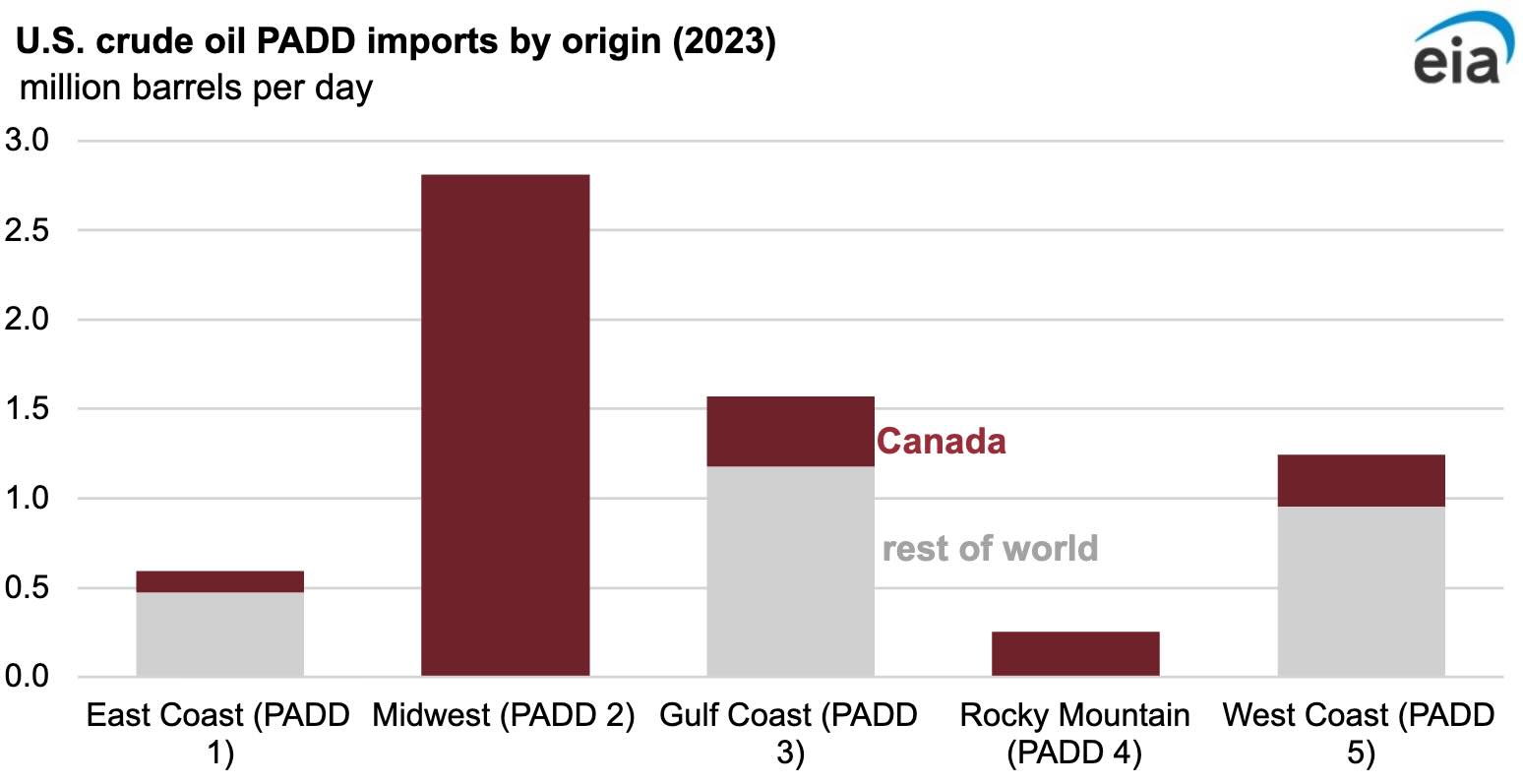
A U.S. Energy Information Administration graphic using 2023 data makes the point dramatically: 100 per cent of imported crude going into the Midwest, known as PADD 2, came from Canada. The same was true for the Rocky Mountain region, PADD 4.
Screenshot
Those refineries were built and configured in large part to process the heavy crude produced in Western Canada.
“They don’t have any alternatives other than the Canadian crude they’re configured to process,” Hirs said of Midwest refineries.
Geography makes the problem worse for the Americans.
North American crude pipelines were largely built to move Western Canadian oil south into U.S. refining centres. They do not provide an easy way to land replacement oil by tanker on the Gulf Coast or East Coast and move millions of barrels north into Midwest and Rocky Mountain refineries.
Finding another barrel somewhere in the world is not enough. The barrel has to reach the refinery that needs it.
That is why an export tax cannot simply be treated as a tax on Alberta producers.
The actual cost would be negotiated and absorbed throughout the supply chain. Some of it may fall on Canadian producers. Some could reduce refinery margins. But most of it would likely appear at American gas pumps, according to Hirs.
Gunn Reid may believe an export tax would discourage investment more than Alberta separation. But belief is not analysis. Before reaching that conclusion, she would first have to explain who actually pays the tax. She didn’t.
Hirs certainly did.