
This article was published by The Energy Mix on Oct. 20, 2025.
By Mitchell Beer
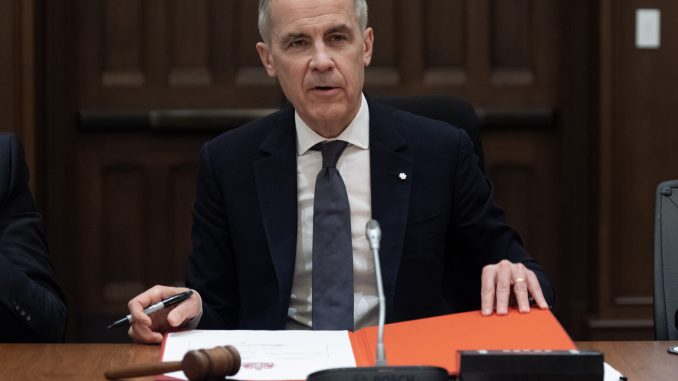
Prime Minister Mark Carney is preparing to release a new carbon competitiveness strategy that promises real-world outcomes over aspirational goals, but relies heavily on still-evolving carbon capture and storage (CCS) technologies to deliver those results, the PM’s recent media statements suggest.
The strategy is expected to be released this month, and possibly in the next few days. The latest speculation on timing follows a sudden flurry of anticipation late last week, with climate policy groups sending reporters their contact information for responses over the weekend.
The strategy will be released as questions swirl about whether Carney is abandoning the climate priorities he famously emphasized as a central banker, high-profile author, United Nations special envoy for climate action and finance, and vice-chair of a major renewable energy investment firm.
“I’m the same me. I’m focused on the same issues,” Carney told the Bloomberg Weekend podcast with Mishal Husain. “The question is: how do you make progress toward those issues? And particularly, how do you make progress in a way that is most effective?”
All signs points to a strategy that will “deprioritize Canada’s commitments to reduce domestic greenhouse gas emissions, in favour of focusing on ways to reap economic advantage from the global transition toward low-carbon energy,” writes Globe and Mail policy columnist Adam Radwanski.
“By all accounts, Ottawa is unlikely to officially change national emissions targets—which currently involve a reduction of at least 40% from 2005 levels by 2030—because it’s too difficult legislatively and as a matter of international process,” Radwanski reports, citing interviews with nearly a dozen sources familiar with the emerging policy. “Instead, the strategy is expected to play them down and perhaps tacitly acknowledge they won’t be reached. To the extent that it mentions those sorts of goals, it will likely be through an emphasis on net-zero emissions by 2050, not nearer-term landmarks.”
But “a subtext will be that despite the United States retreating from climate action, the energy transition is continuing apace globally, and Canada needs to embrace related economic opportunity,” he adds. That will lead into a strategy of decarbonizing existing industries and bolstering the country’s ability “to compete in growing low-carbon sectors, such as the electric vehicle battery supply chain, non-emitting electricity, mass timber, and early-stage clean technologies.”
Ottawa will attempt that manoeuvre while navigating a global trade war, seeking to “appease” Alberta and other fossil-dependent provinces, and “reassuring people—including Liberal caucus members—disconcerted by his deprioritization of climate policy since taking office despite championing it before,” the columnist writes.
Radwanski lists industrial carbon pricing, support for clean electricity, EV battery supply chains, and a focus on early-stage cleantech innovation as likely pillars of the strategy, while citing affordability as a priority the PM should connect to his climate strategy at every opportunity. “It’s in Mr. Carney’s interest to draw the connection wherever possible, if he wants to bring people along,” he writes.
Radwanski echoed continuing signals that Carney might trade away the federal government’s hard-fought, watered-down cap on oil and gas emissions, which will not take effect until 2030-32, in exchange for a stronger industrial carbon pricing system with enough heft to have an impact on emissions—a goal the Alberta government was undercutting as recently as last month. Carney didn’t dispel concerns about the fate of the emissions cap, telling Bloomberg Weekend that “a desired outcome is not a policy.”
Instead, “what makes those emissions go down will be carbon capture and storage,” he declared, while specifically name-checking the Pathways Alliance project, a $16.5-billion carbon capture hub and pipeline network that six major oil sands companies have been promoting for years, but refusing to launch without massive taxpayer support. Independent analysts have warned the project could be “scuppered” without permanent subsidies and won’t break even without efficiency gains and steadier revenue.
After multiple high-profile failures, the technology’s biggest boosters admit it won’t be ready for prime time before 2035—long after global climate agreements, and the urgency of the climate crisis itself, will dictate steep reductions in the oil sands’ massive climate footprint. Last month, a peer-reviewed paper in the journal Nature concluded that global carbon storage capacity is 10 times less than previous estimates after ruling out geological formations where the gas could leak, trigger earthquakes, contaminate groundwater, or had other limitations.
Carney previously suggested a “grand bargain” in which the massive Pathways project would enable the new oil pipeline the Alberta government has been demanding, despite a “flashing red warning light” that such a project would also need massive taxpayer subsidies in an era of low oil prices.
“All of the indicators are that he’s doubling down on fossil fuels, which is bad for the climate, it’s bad for the Canadian economy, and he should know better because he knows the climate science,” University of Toronto political scientist Jessica Green told Bloomberg. While acknowledging that Donald Trump’s trade wars have put Canada in a difficult position, she said Carney would gain credibility by showing how the country can decarbonize over the longer term.
Be the first to comment