
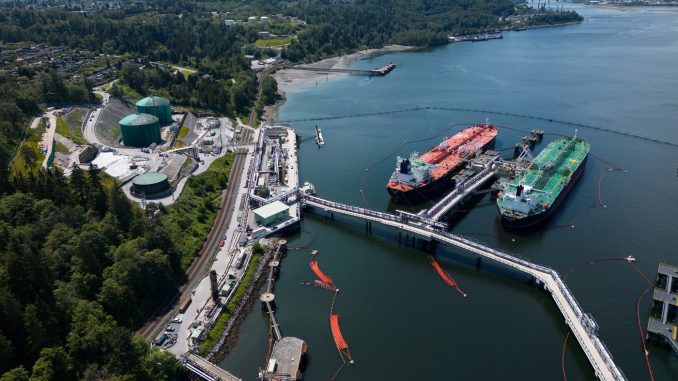
Canada hit a new high for crude-oil output in 2024 and maintained elevated production through the first half of 2025, according to a recent market snapshot from the Canada Energy Regulator (CER).
The gains reflect strong bitumen and synthetic-crude performance in the oil sands, improved pipeline access, and steady conventional crude production.
In 2024, Canadian crude oil, including bitumen, synthetic crude, light and medium crude, rose 4.3 per cent compared with 2023, reaching an estimated 298.8 million cubic metres, according to national production data from Statistics Canada, as cited by CER’s summary.
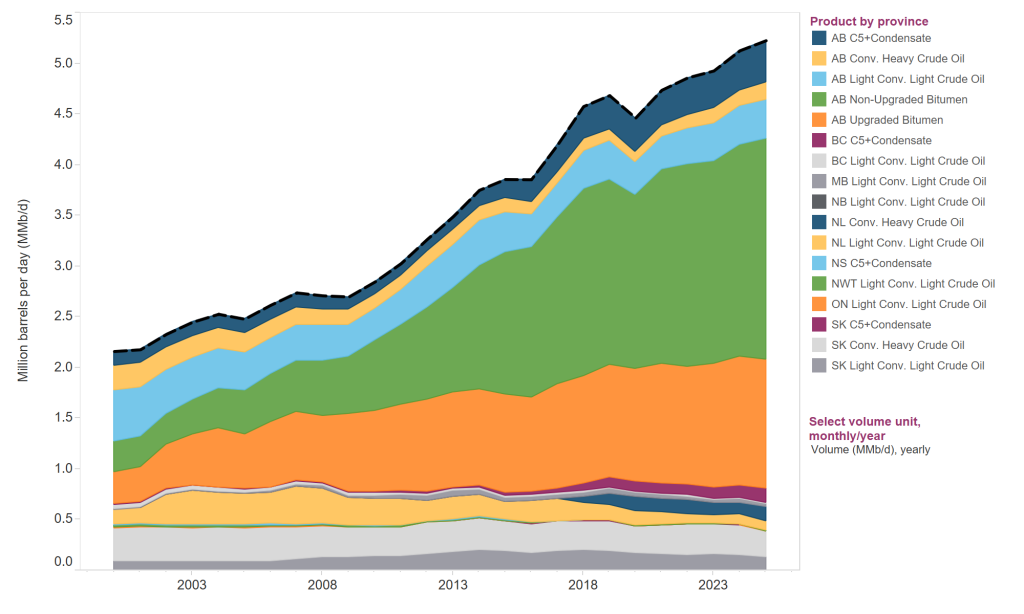
Text Alternative: This stacked area chart shows monthly crude oil and equivalent production from January 2000 to June 2025 for Canadian provinces and territories. Alberta’s production grew by 172,000 barrels per day in 2024, while British Columbia’s production increased by 25,000 barrels per day.
Within that total, oil-sands production delivered the bulk of the increase. In situ bitumen extraction and mined bitumen both grew by about 4.3 per cent, while synthetic crude output also rose 4.3 per cent year-on-year. Light and medium conventional crude also rebounded, increasing 2.1 per cent in 2024 after a modest decline the previous year. Heavy crude — a grade favoured by many U.S. refineries — saw a 2.7 per cent increase to a new series high of 26.3 million cubic metres.
These gains mark the fourth consecutive year of rising crude oil production in Canada. Analysts attribute the trend to sustained investment, operational efficiencies in the oil sands and improved logistics, including expanded capacity on key pipelines such as the recently upgraded Trans Mountain Expansion Project (TMX).
Data released by CER show that elevated production levels have carried into 2025. While the full-year figures are still being compiled, early estimates suggest that Canadian output remains near or above last year’s record pace.
The sustained output through mid-2025 reflects continued strength in oil-sands operations as many producers ramp up post-maintenance and maintain high upgrader utilization. At the same time, favourable access to export infrastructure helps move crude efficiently to market, reducing bottlenecks that had previously limited growth.
Even as global crude prices have faced volatility, Canada’s crude oil exports remained robust. According to CER’s 2024 trade summary, total crude exports were valued at US$100.7 billion, a 5.7 per cent increase over the previous year.
While a growing share of Canadian oil continues to flow to the United States via established pipeline corridors, expanded export capacity, such as that provided by TMX, has opened access to new markets, helping maintain export volumes despite price headwinds.
The shift has also contributed to a reduction in reliance on rail exports, which fell to their lowest volumes in eight years even as overall export records were set.
The gains also raise ongoing questions about how Canada balances fossil-fuel production with climate-policy goals. As oil-sands output rises, so too does the challenge of reducing greenhouse-gas emissions — a core tension in Canada’s long-term energy and environmental transition strategy.
Be the first to comment