U.S. natural gas production hits record in 2025, EIA says
March 13, 2026 | News
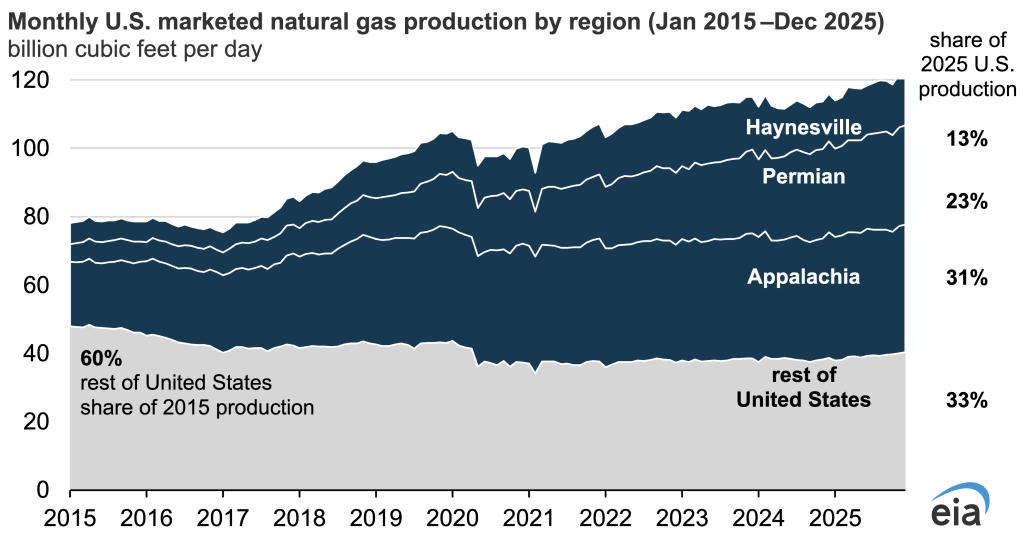
U.S. natural gas production reached a new record in 2025, averaging 118.5 billion cubic feet per day (Bcf/d), according to the U.S. Energy Information Administration (EIA). The increase highlights the continued dominance of major shale basins in driving U.S. supply growth.
Production increased by 5.3 Bcf/d compared with 2024, according to the EIA’s latest Natural Gas Monthly. Three regions — Appalachia, Permian and Haynesville — accounted for 67 per cent of total U.S. marketed gas production and 81 per cent of the growth last year.
 Higher natural gas prices helped support drilling activity. The Henry Hub benchmark price rose about 60 per cent in 2025 to US$3.52 per million British thermal units (MMBtu), improving the economics of production across multiple basins.
The Appalachian Basin in the northeastern United States remained the country’s largest natural gas producing region, accounting for 36.6 Bcf/d, or roughly 31 per cent of total U.S. marketed production.
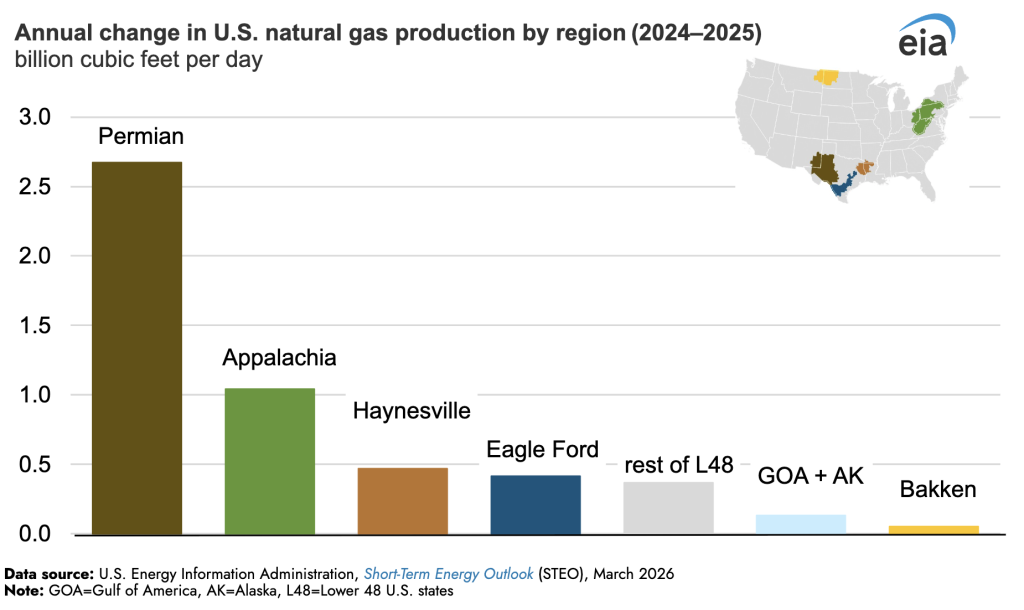
Production growth there has slowed in recent years because of limited pipeline capacity to move gas to markets. However, additional capacity began coming online in 2024 when the Mountain Valley Pipeline was authorized to start operating. Combined with higher gas prices, that helped push Appalachian production up by 1.1 Bcf/d in 2025, compared with only modest growth in 2024.
The Permian Basin in Texas and New Mexico continued to play a major role in U.S. gas growth. Production in the region rose 11 per cent, or 2.7 Bcf/d, reaching an average of 27.7 Bcf/d in 2025.
Much of the natural gas produced in the Permian is associated gas, meaning it is generated as a by-product of oil production. Even though benchmark West Texas Intermediate crude prices declined from US$77 per barrel in 2024 to about US$65 in 2025, prices remained high enough to support oil-directed drilling.
Industry surveys suggest the basin remains economically viable at those levels, with breakeven prices estimated around US$61 per barrel in the Midland Basin and US$62 in the Delaware Basin.
Another factor contributing to higher gas production in the Permian is the region’s rising gas-to-oil ratio, meaning wells are producing more natural gas relative to oil over time.
The Haynesville shale, which spans Louisiana and Texas, also contributed to production growth. Output there averaged 14.9 Bcf/d in 2025, about four per cent higher than in 2024.
Haynesville wells are typically much deeper — between 10,500 and 13,500 feet — than wells in the Appalachian Basin, which generally range from 4,000 to 8,500 feet. The greater depth increases drilling costs, but the basin’s location provides an important advantage.
Haynesville sits close to liquefied natural gas export terminals and large industrial natural gas consumers along the U.S. Gulf Coast, making it an attractive supply source for both domestic and export markets.
The EIA expects U.S. natural gas production to continue growing in the coming years as additional infrastructure and export demand support drilling activity. Expansion of LNG export capacity along the Gulf Coast is expected to play a key role in shaping future natural gas markets.
The United States has been the world’s largest producer of natural gas for more than a decade, largely because of the expansion of shale gas production since the mid-2000s.