Ukrainian Drone Barrage Sets Russian Oil Facilities Ablaze
October 18, 2026 | News
Ukrainian President Volodymyr Zelenskyy and U.S. President Donald Trump are at odds over attacks on Russian oil infrastructure
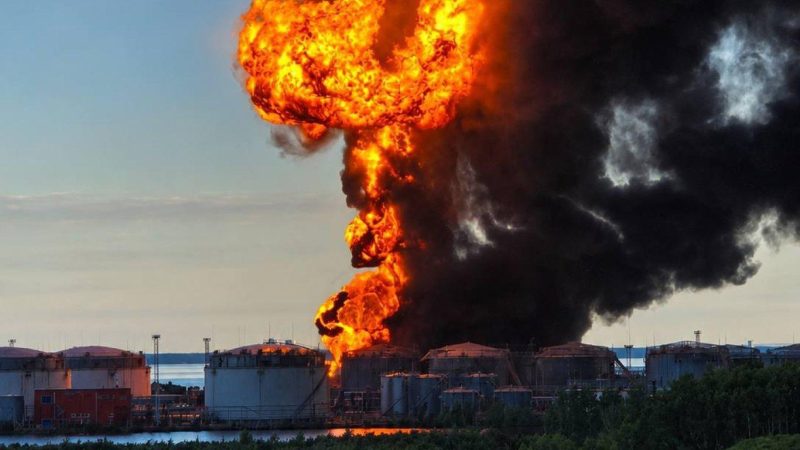
Ukraine launched one of its largest drone assaults of the war against Russia on Sunday. Large fires at oil facilities lit up the St. Petersburg night sky.Russian authorities reported one person killed and 15 injured across the city and the surrounding Leningrad region, according to Reuters.
Moscow’s defence ministry claimed its forces intercepted 1,015 Ukrainian drones overnight. That figure has not been independently verified and does not establish how many drones reached their targets.
The strikes on commercial infrastructure come during a dispute over energy attacks that deepens between Kyiv and Washington.
Oil Exports Become a Battlefield
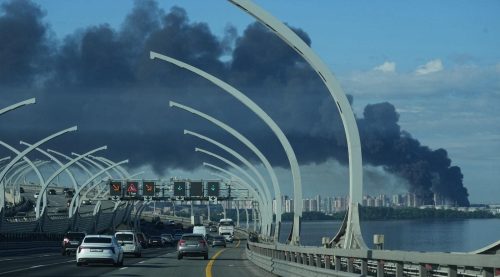 Fires broke out at the Petersburg Oil Terminal, the Ruchi oil depot, and industrial warehouses, according to St. Petersburg governor Alexander Beglov. Images distributed by international news agencies showed smoke rising over the city. The scale of damage to oil-storage tanks, loading equipment and export operations remained unclear Sunday.
The assault also reached beyond petroleum.
St. Petersburg is an important Baltic Sea industrial and shipping hub. Oil terminals connect Russian producers to international markets, making storage tanks, pumping equipment and loading berths valuable targets.
A spectacular fire does not necessarily mean a sustained export shutdown: the commercial impact depends on which equipment was damaged, available alternative capacity and how quickly operators restore service.
Russian retailer Ozon reported a fire at a logistics centre, while internet company VK said a data centre in the Leningrad region had been attacked. Ukrainian drone producer Fire Point said Ukrainian forces struck the VK facility. Regional officials reported electricity outages affecting about 20,000 people, according to Al Jazeera.
A New Front in the Energy War
Ukraine has increasingly used long-range drones to hit Russian refining and fuel infrastructure, seeking to disrupt supplies and reduce the revenue that helps finance Moscow’s invasion. The latest attack followed a strike on a refinery in Russia’s Ryazan region earlier in the week.+
Russia, meanwhile, has continued attacking Ukraine’s electricity system. Ukrainian President Volodymyr Zelenskyy said Russian strikes overnight killed two people and injured 12, including children.
He also accused Moscow of repeatedly violating the proposed energy ceasefire, citing dozens of attacks on Ukrainian energy infrastructure over the preceding week.
“Since the American President announced the energy ceasefire a week ago, Russia has deliberately attacked Ukraine’s energy and oil and gas sectors 76 times,” Zelensky said, according to Reuters.
Both governments frame attacks on energy infrastructure as military pressure. For civilians, the consequences can include blackouts, disrupted heating, damaged homes and casualties. For energy markets, repeated strikes introduce uncertainty even when immediate losses of production or exports cannot be measured.
Trump’s “Ceasefire” Faces a Test

Ukrainian President Volodymyr Zelenskyy. Photo: Office of the President of Ukraine / Wikimedia Commons.
The drone barrage comes amid worsening relations between Kyiv and U.S. President Donald Trump. The White House has criticized Ukrainian strikes on Russian oil infrastructure. Washington has pursued an energy ceasefire while easing some restrictions on Russian petroleum trade, moves Zelenskyy argues could strengthen Moscow’s war effort.
The dispute exposes a central contradiction in energy diplomacy: Russia wants its export infrastructure protected, while Ukraine argues that Russian attacks on its power grid have not stopped. Kremlin spokesman Dmitry Peskov said Russia would continue responding to Ukrainian strikes, Reuters reported.
For global oil markets, the question is no longer simply how many drones Ukraine can launch. It is whether repeated attacks can materially restrict Russian petroleum exports, raise operating costs and change the economic calculation of the war. Sunday’s fires are dramatic evidence of Ukraine’s reach; their lasting effect on supply remains to be established.