Ottawa Invests $193 Million in Quebec Aluminum Upgrades
October 26, 2026 | Economy, Quebec, Canada
Ottawa is putting $193.3 million into Quebec aluminum operations as it seeks to protect industrial jobs, improve energy efficiency and strengthen a processing industry facing pressure from tariffs and shifting global trade.
Industry Minister Mélanie Joly announced the funding October 23 in La Baie, Quebec. Rio Tinto will receive $164.8 million, while Aluminerie Alouette will receive $28.5 million through the federal Strategic Response Fund.
The government expects the projects to maintain approximately 6,000 full-time jobs across Quebec and Canada and support 65 co-op student placements. That is a commitment to sustaining employment, rather than a forecast of 6,000 additional jobs.
Although Ottawa presented the announcement as support for critical minerals, the spending is directed at existing aluminum facilities. It targets the processing capacity that turns mineral resources into industrial materials used by manufacturers.
In an earlier Energi Media interview about industrial policy, development economist Aaron Cosbey emphasized the importance of building on existing industrial strengths.
“You need to build on what you’ve got,” he said, discussing how countries can use established skills, resources and manufacturing capabilities to develop new industries,” he said.
Modernizing Quebec’s Aluminum Industry
Rio Tinto’s federal contribution will support projects valued at $818.5 million in the Saguenay–Lac-Saint-Jean region. They include a new billet casting centre at its Alma smelter, intended to expand production of value-added aluminum products.
The company will also modernize anode-baking furnaces at its Grande-Baie smelter. Infrastructure upgrades and equipment refurbishment are intended to improve reliability, productivity and competitiveness over the longer term.
Together, those investments address different stages of aluminum production, from preparing the anodes used in smelting to casting products for further manufacturing. Ottawa says the projects will increase regional production capacity and efficiency while helping decarbonize Rio Tinto’s operations.
Aluminerie Alouette’s federal contribution will go toward a $135 million project to modernize and optimize electrolysis operations. The government says the improvements will target energy performance and greenhouse gas emissions alongside industrial competitiveness.
Alouette produces approximately 633,000 tonnes of primary aluminum annually and employs more than 1,000 people, according to the federal announcement. Its scale makes improvements in operating efficiency significant for the company and the communities supplying its workforce and services.
The combined project values total $953.5 million. Federal funding therefore represents about one-fifth of the announced investment, rather than the full cost of the work.
The projects are also expected to strengthen collaboration with Canadian research institutions, colleges and universities, and smaller businesses. Those relationships could help connect upgrades at major industrial facilities with expertise and suppliers elsewhere in the economy.
Cosbey also identified clean electricity as infrastructure that can attract investment across multiple industries.
“If you build a nice low carbon power grid in your country, you’re going to attract all kinds of different businesses to use that power,” he said in the same interview.
Emissions From Aluminum Production
Quebec’s aluminum industry has reduced its process emissions substantially since 2000, although progress has been uneven. As the graph shows, emissions fell from 6.52 million tonnes of CO₂ equivalent in 2000 to 5.20 million tonnes in 2024, a decline of 20.3 per cent. Emissions reached a low of 4.49 million tonnes in 2019 before rebounding, leaving further reductions to be achieved through improvements in smelting technology and operating efficiency.
These figures cover production-process emissions; fuel combustion and purchased electricity are accounted for separately. Official figures for 2025 are not yet available.
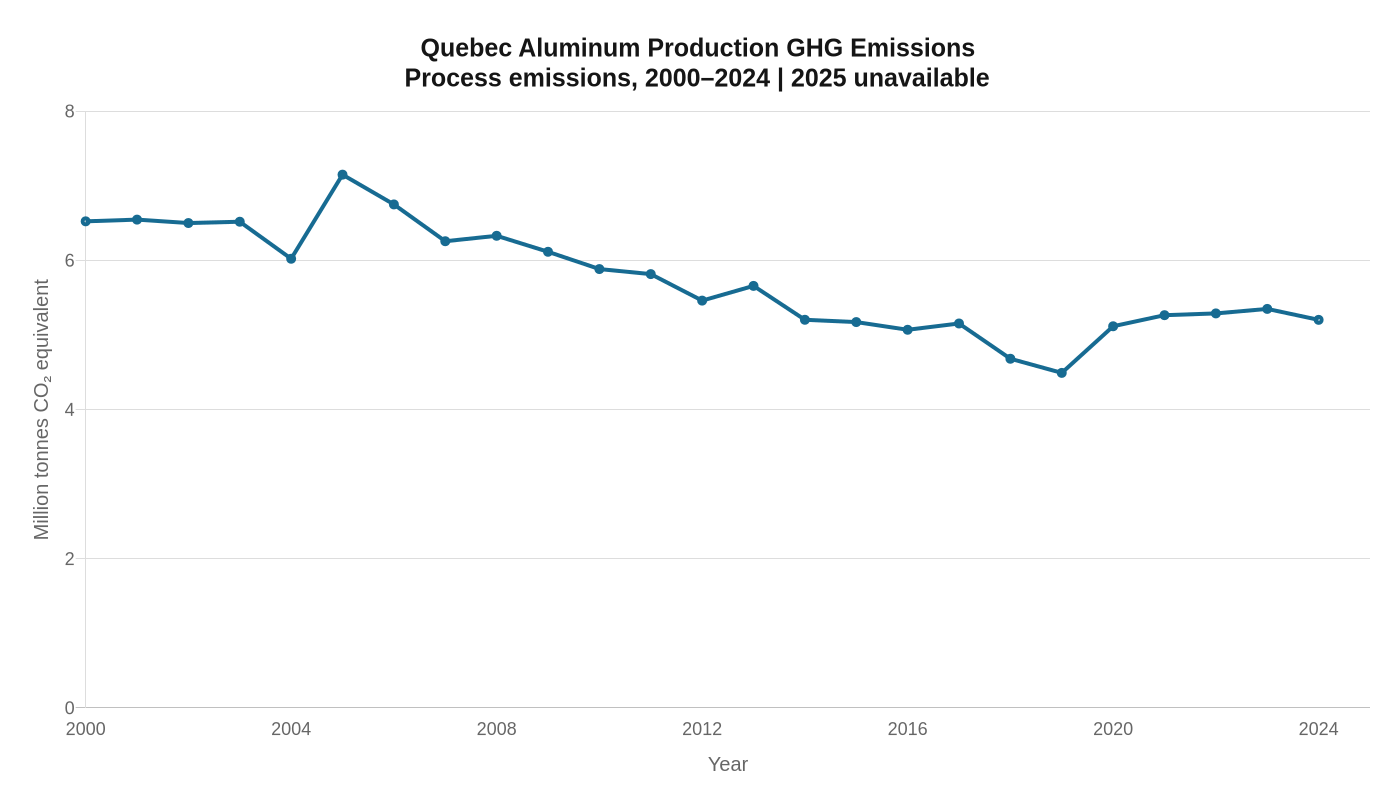
Quebec aluminum-production process emissions, 2000–2024. Source: Environment and Climate Change Canada, 2026 National Inventory. Excludes fuel combustion and purchased electricity. Figures for 2025 are unavailable.
Aluminum smelting produces greenhouse gases through the chemical reactions that separate aluminum from alumina, or aluminum oxide. During electrolysis, oxygen from the alumina reacts with carbon anodes, consuming them and releasing carbon dioxide. Disruptions in the process, known as anode effects, can also generate perfluorocarbons, powerful greenhouse gases. Quebec’s hydroelectricity limits emissions from powering its smelters, but it does not eliminate these chemical emissions. Reducing them requires better process controls and technologies that replace carbon anodes with alternatives that release oxygen instead of carbon dioxide.
Protecting Jobs and Processing Capacity
The announcement links industrial modernization with Ottawa’s response to tariffs. Aluminum supports industries including automotive manufacturing, aerospace, defence and infrastructure, giving the investment implications beyond the smelters themselves.
Joly framed the spending as a way to reinforce Canada’s industrial base and support growth in downstream aluminum activities, including extrusion. That process shapes aluminum into products used by other industries.
Cosbey’s broader assessment of industrial policy also offers a caution about relying on funding alone.
“You can’t just pump money into a sector and expect that to work,” he said. In his discussion of battery-sector policies, he argued that investment support needs complementary measures, including demand, infrastructure, research and development, and workforce skills.
Statements included in the announcement reflect the companies’ interest in continued investment during a period of uncertainty. Rio Tinto emphasized modernization and decarbonization, while Alouette pointed to energy efficiency and investor confidence.
The public announcement leaves several measures of success unspecified. It does not provide quantified emissions-reduction targets, projected energy savings or completion dates for the funded work.
Those details will be needed to assess how much the investment reduces the industry’s environmental footprint and improves competitiveness. The employment figures also remain government expectations, rather than independently demonstrated outcomes.
For now, the spending commits federal support to upgrading Canada’s existing aluminum processing base. Its longer-term value will depend on whether those upgrades deliver the promised improvements in productivity, emissions and employment.
End Notes
- Innovation, Science and Economic Development Canada, Government of Canada invests over $190 million to advance Canada’s critical minerals sector and strengthen aluminum processing, October 23, 2026. Project costs, funding allocations, employment expectations and company statements.
- Environment and Climate Change Canada, 2026 National Inventory, 1990–2024. Chart uses the IPCC-sector dataset, Quebec, Aluminium Production (category 432), CO₂-equivalent emissions in kilotonnes converted to million tonnes.
- Environment and Climate Change Canada, Canada’s greenhouse gas quantification requirements; Natural Resources Canada, Aluminum facts; Government of Canada, Environmental benefits of inert-anode technology. Background on carbon-anode consumption, perfluorocarbons, hydroelectricity and inert anodes.
- Aaron Cosbey, earlier Energi Media interview, Industrial Policy, transcript: 01:15–01:50 (investment support and demand); 02:00–03:29 (clean electricity, infrastructure and complementary policies); 06:12–07:00 (building on existing industrial strengths). Quotations describe his broader industrial-policy analysis, rather than a response to the October 23 aluminum funding announcement. Related Energi Media coverage: Battery industrial policy offers lessons for Canada as it diversifies beyond the U.S., August 20, 2026.