New Canada-EU Partnership a Good Start With One Big Question Mark
November 1, 2026 | Economy, Electrification, Canada, Markham on Energy
“Because the path to affordability is electrification. The path to competitiveness is electrification. The path to net-zero is electrification.” – Mark Carney, May 14, 2026
Friday’s Canada–European Union announcement of a stronger alliance is an important step toward diversifying away from the United States. Building bridges to a significant bloc with similar values is smart. “Ours is an Alliance that delivers now and for the future,” is how Prime Minister Mark Carney described the “new partnership of nations.” A more accurate take might be that the new partnership has delivered some small successes and laid the groundwork for bigger ones down the road.
And that’s about as much as could be asked for in the 19 months since Carney became PM. He has done a great deal during his short tenure, but the proof of the pudding really is in the tasting. For Carney, that proof is closely tied to electrification.
Yet, the new alliance with Europe says little about electrification, which in turn is linked with Ottawa’s efforts to stem a quarter century of de-industrialization.
Make Electrification the Organizing Principle
Canada should approach this alliance with a clear idea of the economy it wants to build. Start with the work businesses and households need done: moving goods, heating and cooling buildings, running factories. Then identify where electric technologies can do that work more cheaply and efficiently, what Canadian companies could manufacture, and how European partners could help with technology, investment and customers.
That would give the partnership an industrial purpose that would advance electrification of the Canadian economy. Last spring’s national electricity strategy promised to double the supply of electricity by 2050 while growing demand.
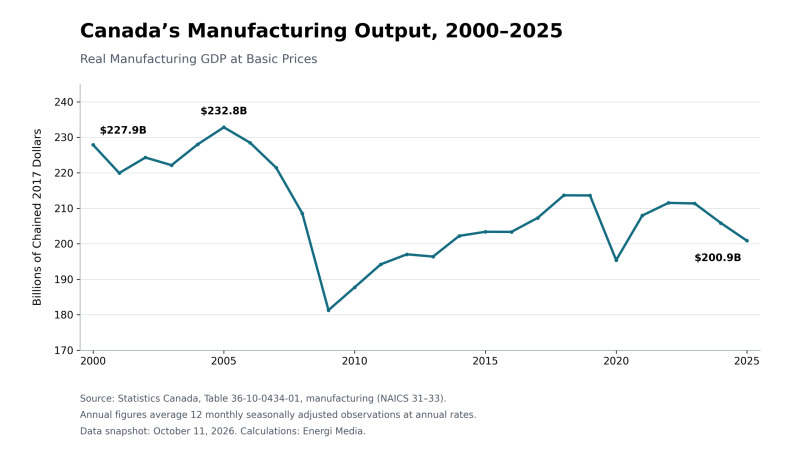
Canada has spent the past 25 years undoing much of its industrial progress. As economist Jim Stanford explained in a recent Energi Media interview, decades of deliberate industrial policy helped build Canadian capabilities in autos, aerospace, telecommunications and other industries.
“But since the turn of the century, we’ve been going backwards,” he said. Manufacturing has retreated (down 19% in Ontario, with 250,000 jobs lost) while extracting and exporting resources, particularly oil and gas, has become more central to our economy. Stanford’s warning should guide the European partnership: “It’s important to also diversify what we sell, not just where we sell it.”
Clean Energy Canada spotted a big hole in Friday’s announcement. Joanna Kyriazis, its director of policy and strategy, called the lack of focus on electrification “a major shortcoming of this agreement.”
She welcomed progress on critical minerals and investment, but argued that electrifying transportation, buildings and industry should guide the partnership.
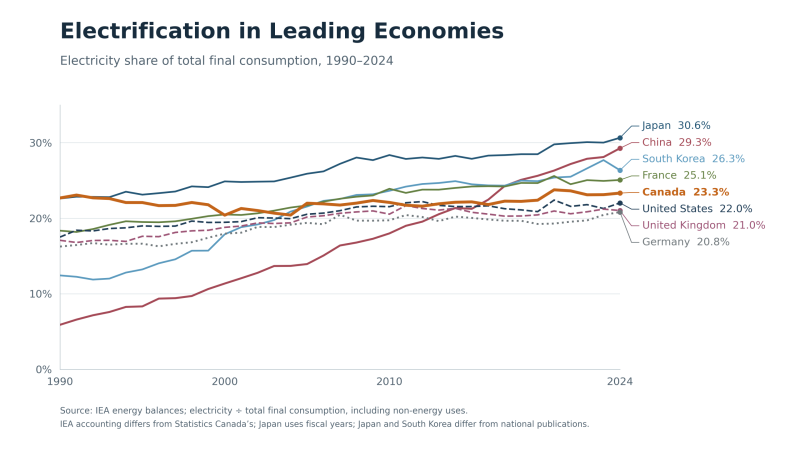
Exactly. And the reason shows up in the electrification rates of Canada’s competitors, as illustrated in the graph below. Based on the rate alone (23% in 2024), Canada is in the middle of the pack. The problem is that its rate has stagnated for 35 years while rates in other economies have risen.
Asian economies have electrified to a greater degree than Europe or North America. China has become the world’s first electro-state by developing, deploying, and manufacturing electric technologies on a massive scale. Its electrification rate is rising by one per cent a year while Canada’s rate is falling slightly; other Western economies are stagnating.
This is the reason for Kyriazis’ pointed criticism of the Canada-EU pact:
“[T]he lack of focus on electrification is surprising given both jurisdictions’ domestic emphasis on building out their electricity systems—and is thus a major shortcoming of this agreement. As the EU and Canada seek to advance a partnership anchored in ensuring mutual security and navigating an uncertain world, it is essential that electrification remains a north star. The electrification of vehicles, buildings, and industries is one of the greatest ways we can advance both short- and long-term affordability, competitiveness, and energy security. It underpins the build-out of critical mineral and electricity supply chains. And it needs a greater focus at this stage of discussions.”
Turn European Financing Into Canadian Industry
The European Investment Bank agreement opens a financing door. Now comes the harder work of getting Canadian projects through it. A mineral refinery needs customers willing to sign long-term purchase agreements, electricity at a competitive price, skilled workers and infrastructure. Governments have to help put those pieces together.
European financing could be particularly useful if it comes alongside commitments from European manufacturers to buy the output. That would give Canadian projects both capital to build and customers to serve, the beginnings of an industrial strategy with something concrete to show for it.
There is substance to work with here.
The agreement allows the EIB to consider loans, guarantees, equity investments, and technical assistance for Canadian projects, with critical minerals an early priority. Processing, refining and recycling are explicitly included, and the bank plans to establish a presence in Ottawa.
These tools could help Canadian companies finance the expensive steps between a mineral deposit and a product manufacturers can use. Friday established the financing framework; the test now is which projects get funded, where they are built and how much industrial capability Canada gains.
Economist Aaron Cosbey laid out the ingredients in an Energi Media interview before the summit. “Canada has plenty of those minerals. We don’t have the refining capacity,” he said.
His proposal would combine Canadian and European equity investment with long-term purchase commitments and either stockpiling or minimum prices to protect projects against market volatility. That package could support Canadian refineries supplying manufacturers on both sides of the Atlantic. “There’s a beautiful possibility for a partnership here,” he said.
The EIB agreement gives governments one tool to pursue it.
Make LNG Pass the Commercial Test
Friday’s announcement commits Canada and the EU to studying whether increased LNG exports are viable. Good. Let’s see the numbers.
Energy analyst Seb Kennedy told Energi Media that his modelling strongly favours shipping Western Canadian LNG to Asia, where shorter voyages and avoided Panama Canal fees improve returns. European companies buying Canadian LNG therefore does not mean those cargoes will reach Europe.
Additional Pacific supply could ease global gas markets, he acknowledged, while leaving Europe dependent on American LNG. The study needs to establish what Canadian projects can realistically deliver for European energy security and whether the commercial returns justify building them.
Beyond Energy, Plenty Worth Building On
The alliance reaches well beyond energy, with several initiatives that could strengthen Canadian research, manufacturing and technological independence.
- Supercomputing: Canada’s membership in the European High Performance Computing Joint Undertaking opens access to powerful computers, including JUPITER, for research and AI development.
- Digital trade: Negotiations have concluded on an agreement to simplify online trade, including electronic contracts and cross-border transactions for Canadian businesses serving European customers.
- Skills and research: Planned negotiations on expanded Erasmus+ participation and the next Horizon Europe program could give Canadians more opportunities for study, skills exchanges and joint research.
- Defence manufacturing: Montréal’s Galvion secured a five-year framework contract worth up to €27.8 million to supply military helmets to Latvia, following Marconi’s earlier contract to build radios for Poland.
- Waterbombers: Up to $2.5 billion in financing would help De Havilland expand Canadian aircraft production, serving Canadian and European firefighting needs while supporting manufacturing jobs in Alberta.
- Satellite services: Cooperation on Europe’s IRIS² communications network and Galileo navigation system could strengthen secure connectivity, emergency response and navigation, including in the Arctic. MDA Space also announced an initial agreement worth more than $100 million with Thales Alenia Space for antenna systems for 66 IRIS² satellites, manufactured in Montréal.
- Digital infrastructure: Canada and Europe will examine a direct transatlantic data cable to strengthen the security and independence of their digital connections.
A Good Start. Now Build on It.
Carney deserves credit for opening doors while Donald Trump tries to slam them in our face. The Prime Minister inherited a Canadian economy that has been shedding industries and manufacturing jobs for 25 years, and is now under attack from the United States. His stated goal is to reverse those trends by doubling the country’s exports to countries other than the United States by 2035.
Viewed through that lens, the fortified alliance with Europe is significant progress. The aircraft, satellite equipment and defence contracts show what closer ties with Europe can deliver: Canadian expertise turned into products that customers need and will pay for.
Ottawa should apply that same discipline to the electric economy. The minimal progress on this front is a red flag. That said, the federal budget will be tabled Thursday and it will provide more details about how the more robust economic relationship with the EU will proceed.