Ontario and Quebec Have Legitimate Grievances, Not Alberta
October 19, 2026 | Economy, Ontario, Quebec, Alberta, Canada, Opinion
To make matters worse, Donald Trump is trying to “de-industrialize” Eastern Canada by brute-forcing factories to move to the U.S.
Alberta’s “grievances” have become such a staple of Canadian politics that no one questions them. They should. According to Statistics Canada data, Alberta is doing wonderfully well, thank you, while manufacturing in Ontario and Quebec has fallen off a cliff over the past 25 years. Now Donald Trump is circling for the death blow to Eastern Canadian industry. The East, not the West, deserves immediate attention to its economic woes.
This is not a popular argument, especially today of all days, as Albertans vote in their hair-brained referendum to have a referendum. There is little support for Alberta to leave Confederation. What there was has steadily fallen, according to public opinion polls.
The diehard “seppies” are former Yellow Vesters, Freedom Convoy supporters, anti-science and anti-vax conspiracy theorists. Unfortunately, they now infest the governing United Conservative Party. So much so that it is widely considered to be a separatist party.
Premier Danielle Smith simply doesn’t have the guts to stand down the many separatists in her caucus. She saw how in 2022, that crew turned on her predecessor, Jason Kenney, and turfed him after a leadership review. Smith was the beneficiary. She has sold her political soul to ensure she is not the next victim.
Part of her strategy has been to excoriate Ottawa at every turn. Justin Trudeau tried to kill Alberta’s oil and gas industry, she wails in response to every question – regardless of what the question was actually about – put to her by a credulous news media. No one questions her narrative. Alberta’s victimhood is fact, and God help those, like me, who suggest otherwise.
The claims of Smith and the separatists – not to mention those of the oil industry and its legions of proxies – should be challenged. They are not supported by the data. Compare the fortunes of Alberta and its oil and gas sector with the manufacturing sectors of Ontario and Quebec, and the conclusion is stark.
The West is already in and the East is now out in the cold. Industrially speaking, anyway.
Between 2000 and 2025, Ontario’s inflation-adjusted manufacturing output fell 18.8 per cent. Quebec’s fell 16.3 per cent. Over those same years, their provincial economies grew by 59.8 per cent and 55.2 per cent, respectively. These are Energi Media calculations using Statistics Canada’s provincial GDP dataset in our research library.
Meanwhile, Alberta’s oil output expanded dramatically, from 1.35 million barrels per day (b/d) in 2000 to 4.4 million b/d in 2025. This year’s production is even higher.
Those trajectories should change the national conversation. Canadians have spent years hearing why Alberta feels mistreated. We should also listen to the provinces whose industrial production actually shrank.
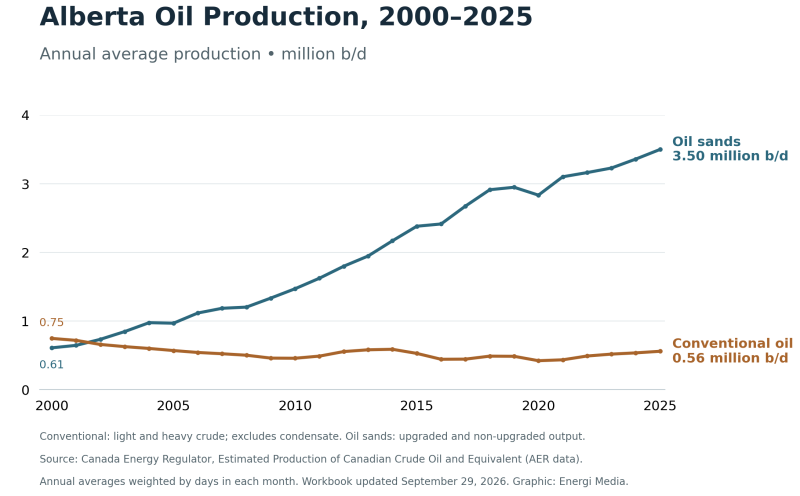
Eastern Industrial Losses Are Huge
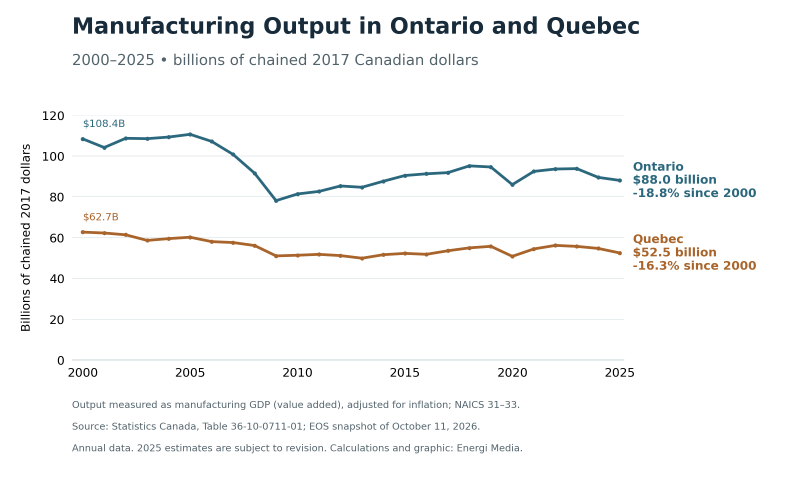
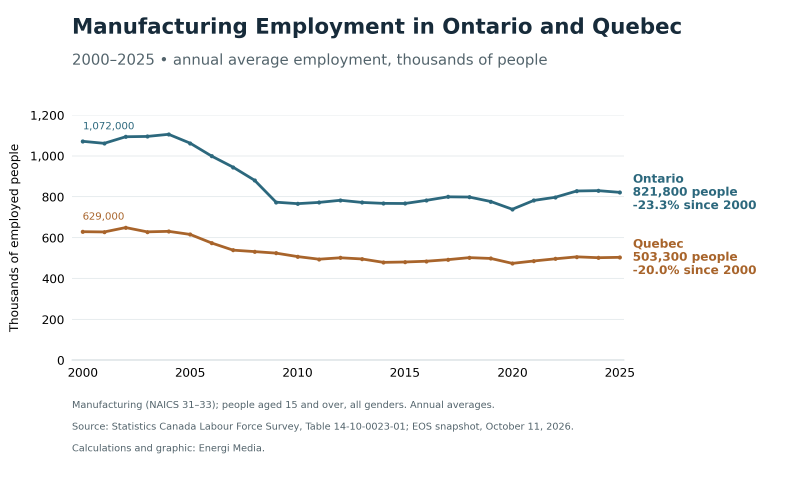
Manufacturing decline is often explained as the inevitable result of productivity improvements. Factories automate, workers produce more, and employment falls. That explanation cannot, by itself, explain the record in Ontario and Quebec.
Ontario’s real manufacturing GDP fell from $108.4 billion in 2000 to $88.0 billion in 2025. Quebec’s fell from $62.7 billion to $52.5 billion. These figures measure value added in chained 2017 dollars, stripping out inflation. They describe manufacturing’s contribution to the economy rather than gross sales or a count of products.
The decline was uneven. Ontario’s manufacturing output stood at $110.6 billion in 2005 before falling to $78.1 billion in 2009. By 2019 it had recovered to $94.6 billion, still below its 2000 level. Quebec also suffered a sharp contraction and never regained its starting position.
Both provinces weakened again in 2025. Manufacturing output fell 1.6 per cent in Ontario and 4.0 per cent in Quebec from the previous year. The industrial retreat is therefore more than an old wound left by the financial crisis.
An aggregate GDP series cannot tell us everything about individual communities or workers. It does tell us that the employment losses we have examined occurred alongside an absolute contraction in real manufacturing output.
That gives Ontario and Quebec a legitimate grievance.
A country should take seriously the erosion of industries that support skilled work, supplier networks, technical capabilities, and the ability to turn knowledge into products.
And let’s not forget the US trade war against Canada, which is focused almost exclusively on Eastern manufacturing. Energi Media examined the targets for Trump’s tariffs on Canada. Three-quarters are aimed at autos, advanced manufacturing, and electronics manufacturing.
Tariffs on Alberta oil and gas exports to the U.S.? Zero. And Smith has refused to consider applying an export tax or restricting exports as part of Canada’s response to Trump.
As economist Jim Stanford said during a recent Energi Media interview, Trump is very clearly trying to de-industrialize Eastern Canada. He thinks Canada “stole” factories and jobs from Americans. The plundered assets should be returned to their rightful place in the United States and Canada should be nothing more than a supplier of cheap raw materials (like oil and gas) to the industrial metropolis south of the border.
It bears noting that Premier Smith is a great admirer of Trump.
Alberta’s Gains Are Bigger Thank Eastern Canada’s Losses
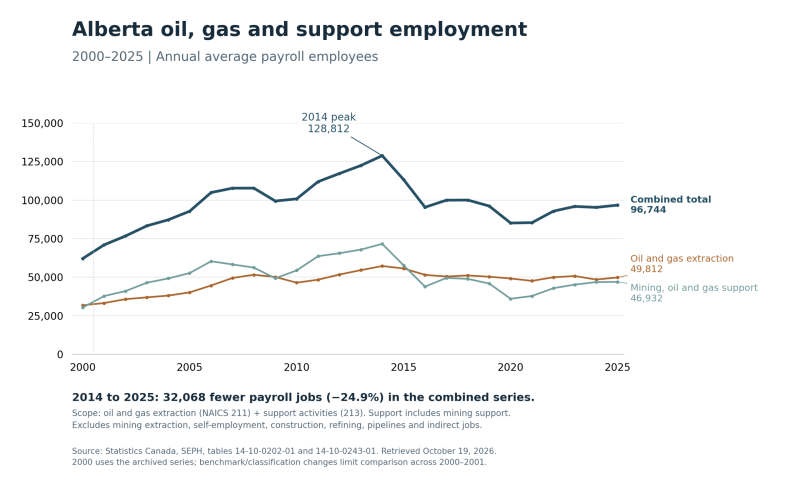
Let’s start with the anomaly that jumps out of the data: oil and gas production rose, but employment declined over the past quarter-century. Evidence of an Ottawa plot against Alberta? Not even close.
Extracting and transporting hydrocarbons is technology-intensive. Like many industries, oil and gas has invested heavily in advanced technologies that significantly increased worker productivity. Pumpers, for example, no longer have to drive around oil fields physically checking wells. Sensors and cameras on-site monitor operations, sending reams of data to the cloud, where it is retrieved by technicians in head office and analyzed.
For workers, however, greater productivity can mean fewer opportunities. Companies can increase production and profits without restoring the jobs eliminated during a downturn. Alberta’s extraction and support industries employed about 32,000 fewer payroll workers in 2025 than at their 2014 peak, even as oil production climbed. That is a legitimate concern for workers and their communities.
“And it is not the result of Ottawa having its foot on the neck of the Alberta economy,” says Stanford. “It is a result of decisions made by petroleum companies finding ways to produce more oil and gas with less workers.”
Blaming Ottawa lets corporate decisions and technological change escape scrutiny.
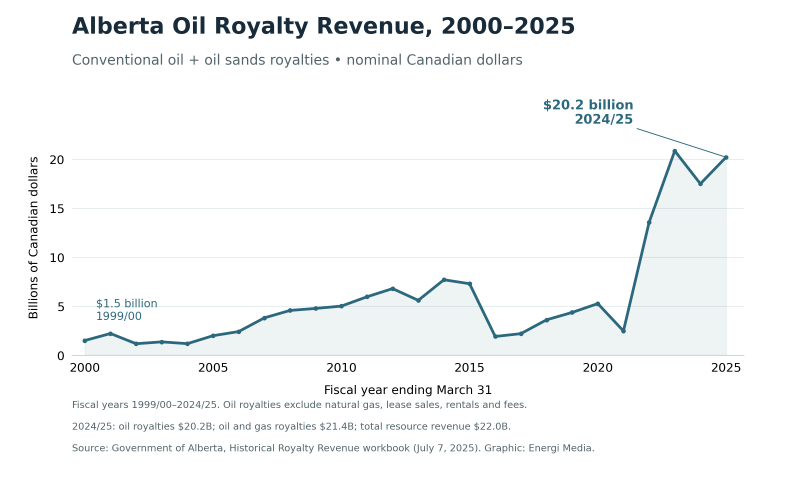
Then there is the money flowing into Alberta’s treasury. Conventional oil and oil sands royalties rose from $1.5 billion in fiscal 1999/2000 to $20.2 billion in 2024/25, more than thirteen times as much in nominal dollars.
The oil sands drove that transformation: their royalty contribution climbed from $426 million to $17.2 billion, accounting for about 85 per cent of oil royalties by the end of the period. The ride was volatile, with oil-price crashes repeatedly hammering provincial revenues, but the long-term expansion delivered an enormous fiscal dividend.
Add natural gas and by-product royalties, and Alberta collected $21.4 billion in 2024/25.
That resource wealth helps pay for hospitals, schools and public services while allowing Albertans to remain the only Canadians living in a province without a provincial sales tax.
Ontario and Quebec have no comparable petroleum windfall to cushion the loss of manufacturing jobs and the taxes those workers and employers paid. Albertans have legitimate concerns about who benefits from their resource wealth, but the province’s own royalty accounts hardly describe an industry strangled by Ottawa.
Canada Needs a New Economic Bargain, Not More Grievance Mongering
Ontario and Quebec need more than sympathy. They need a national economic strategy that treats manufacturing capabilities as essential to prosperity and sovereignty. The ability to design, engineer and manufacture sophisticated products deserves sustained attention alongside the extraction and export of resources.
That means judging industrial policy by results: productive investment, stronger domestic supply chains, commercially successful innovation, and durable employment. Public support should come with clear expectations and scrutiny. Announcements and subsidy totals are poor substitutes for industries that become competitive.
It also means connecting energy policy to industrial development. Reliable electricity, efficient equipment, and the adoption of electric technologies belong in a discussion about manufacturing costs and competitiveness. Canada should be asking how its energy advantages help firms produce more value here.
Alberta belongs in that strategy. Its workers, engineering expertise and industrial capabilities are national assets. Expanding opportunities for them is compatible with rebuilding manufacturing elsewhere. Canada needs ambitions large enough to include several kinds of economic success.
Today’s referendum should prompt Canadians to widen the frame. Grievance cannot be assessed solely by the intensity with which political leaders repeat it.
Ontario and Quebec experienced real industrial losses while Alberta’s oil sands multiplied their output. Their workers and communities deserve a hearing as serious as the one Alberta demands. Canada’s emerging economic bargain under Prime Minister Mark Carney should begin by acknowledging all three provinces’ experience.
Sources
- Government of Alberta: Premier’s address and the October 19 referendum question.
- Statistics Canada Table 36-10-0711-01: Provincial GDP by industry. Energi Media calculations from the October 11, 2026 EOS snapshot, using Manufacturing [31–33] and All industries [T001], chained 2017 dollars. Percentage change = (2025 / 2000 − 1) × 100. The 2025 estimates are subject to revision.
- Statistics Canada: Provincial and territorial GDP by industry, 2025.
- Alberta Energy Annual Report 2001–2002: Oil sands production of 605,000 b/d in 2000.
- Statistics Canada: Canadian crude oil reaches new heights in 2025. Oil sands production: 203,052,524 cubic metres, converted at approximately 6.2898 barrels per cubic metre over 365 days to 3.50 million b/d. Approximately 5.78 times the cited 2000 volume. This measures oil sands output, not the size or GDP of the entire oil industry.
- Canada Energy Regulator: Record crude oil production in 2025. Alberta volume estimated from rounded published figures: 5.35 million b/d × 83.8 per cent = 4.48 million b/d.
- Government of Canada: Trans Mountain Expansion Project and federal acquisition in 2018.