Is the Age of Electricity Skipping Canada?
November 16, 2026 | Electrification, Canada, Opinion
Canada’s electrification rate of 18% is lowest in the G7, 34 out of 37 in OECD
“The path to affordability is electrification. The path to competitiveness is electrification. The path to net-zero is electrification.” – Mark Carney, May 14, 2026
The answer to the headline’s question is a resounding “no” if Canada’s 2026 budget is your guide. Mark Carney’s government described an ambitious 25-year plan to electrify the Canadian economy. The strategy is very good, as are most of the Prime Minister’s many strategies. Implementation, however, promises to be difficult. Perhaps even impossible. And that’s bad news for Canada.
The reason it’s bad news is rooted in new electric technologies like EVs and heat pumps. “Electrotech” is now, or very soon will be, the lowest cost and highest value means of performing a unit of work. That might be driving a delivery van or heating and cooling a commercial building. Given the rate of electrotech innovation, costs will continue to fall and value to rise for the foreseeable future.
Electrotech is the real revolution of the energy transition, not renewables like solar panels and wind turbines. Humans have generated electricity at scale for 150 years. Generating more if it is hardly revolutionary. Electric devices that are better and cheaper than combustion devices like the gasoline-fuelled engine in your car, however, are both new and transformative.
Now consider that electrotech is part of a much broader industrial revolution that includes AI, robotics, and advanced materials. Entirely new use cases are possible, like the driverless robo-taxi, which is sweeping China and the United States. Mobility as a service, as it is called, will enable people to travel at a fraction of the cost per kilometer compared to a private auto.
PM Carney is absolutely correct: “The path to competitiveness is electrification.” Unfortunately, Canada is not very electrified. And the evidence suggests that likely won’t change without a lot more ambition on the part of Canadians and their governments.
Canada’s Electrification Rate
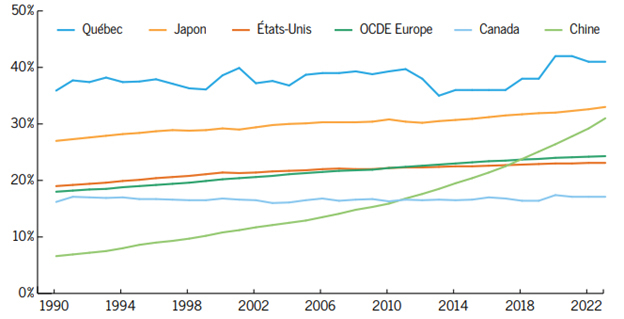
What percentage of energy consumed by the Canadian economy is electricity? Using the Canadian Energy Regulator’s methodology and data gives us 18 per cent. This is a problem for a number of reasons.
One, it’s low compared to other industrialized countries, as the graph above demonstrates. China, Japan, and South Korea, for example, are over 30 per cent. Two, the rate has been stagnant for 35 years. China, by comparison, is growing one per cent per year. Three, current provincial plans are much less ambitious than the Prime Minister’s stated goals of doubling electricity supply by 2050 and significantly growing demand. Since energy is provincial jurisdiction, nothing improves unless provincial governments are solidly on board the federal plan.
To make matters worse, Ottawa’s ambitious strategy isn’t matched by its own policies. At least, not yet.
Unambitious Federal Policies
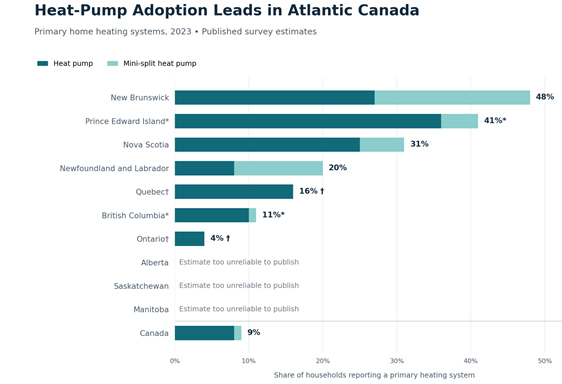
The recently announced heat pump program illustrates the point. $2 billion has been budgeted over eight years to replace 820,000 residential heating systems with the much more (two to four times more) efficient heat pumps. Environment and climate activists cheered. They should have paid closer attention to Ottawa’s math.
There are 14.4 million residential units in the country. Every year, one million replace their gas furnaces. The government’s goal is for 100,000 of those to be heat pumps. But by 2035, only 5.7 per cent of Canadian homes will be affected. Replacing all of them would take over 100 years. Since nine per cent of homes already have heat pumps, we may be able to shave a few years off our estimate, but not many.
Conclusion
Heat pumps illustrate a troubling Canadian habit: We talk a good game, but our play on the ice is lacking. When we do score, our boasting is out of proportion to the play. We kid ourselves that we’re world class, when the evidence shows otherwise. Climate policy and greenhouse gas emissions reductions since 2015, for example.
Electrifying the national economy could easily suffer the same fate.
Last year, Canada consumed 600 terawatt hours (TWh) of electricity. Doubling that by mid-century would give us 1,200 TWh. I made some modest assumptions about how much new industry – LNG facilities, oil sands expansion, new mines, data centres, factories, etc. – could be built if the Carney Liberals succeed. Then I applied more modest assumptions about how much extra electricity might be consumed by that new industry.
The number is in the ball park of 600 TWh. Therefore, we can imagine a scenario where new industry and population growth combine to consume all new power generation by 2050. There is none left to electrify existing transportation, buildings, and industry. Canada is left with the same electrification rate of 18 per cent as the last four decades. Meanwhile, China and other advanced economies are two to three times as electrified.
If electrification truly is the path to affordability, lower emissions, and greater competitiveness, then Canada is in serious danger of watching the Age of Electricity pass us by.
Originally published in National Newswatch on November 16, 2026.