Trump Threatens Canada With Tariffs As American Oil Floods North
August 17, 2026 | Markham on Energy
Donald Trump is threatening to slap 50% tariffs on billions of dollars of Canadian exports to the United States. At the same time, American oil producers are shipping near-record volumes of crude north into Canada.
There is a lesson here that the US president’s zero-sum view of trade cannot accommodate. Canada and the United States do not simply sell things to each other. After decades of integration, we increasingly make things together, supply each other and depend upon the same continental markets. Crude oil may be the clearest example of all.
Trump’s tariffs are almost certainly illegal. To understand why, watch my interview with Professor Jennifer Hillman, co-director of the Institute of International Economic Law, Georgetown University Law Center.
The United States Has Taken Over Canada’s Import Market
The transformation has been extraordinary. In 2000, the United States supplied just two per cent of Canada’s imported crude oil. Its share remained below 10 per cent as late as 2012.
Then something changed. The US share jumped to almost 20 per cent in 2013 and 53 per cent in 2014, when the United States became Canada’s largest foreign supplier. By 2025, three out of every four imported barrels came from south of the border.
This was a fundamental restructuring of Canada’s oil supply.
American crude did not simply capture a little more market share. It displaced overseas barrels that had supplied Canadian refineries for decades. By 2025, the United States supplied 75.6 per cent of Canadian crude imports, while Saudi Arabia supplied 11.2 per cent and Nigeria 10.9 per cent.
Together, those three countries accounted for almost 98 per cent of the market. The first half of 2026 has pushed the American share (77%) higher still.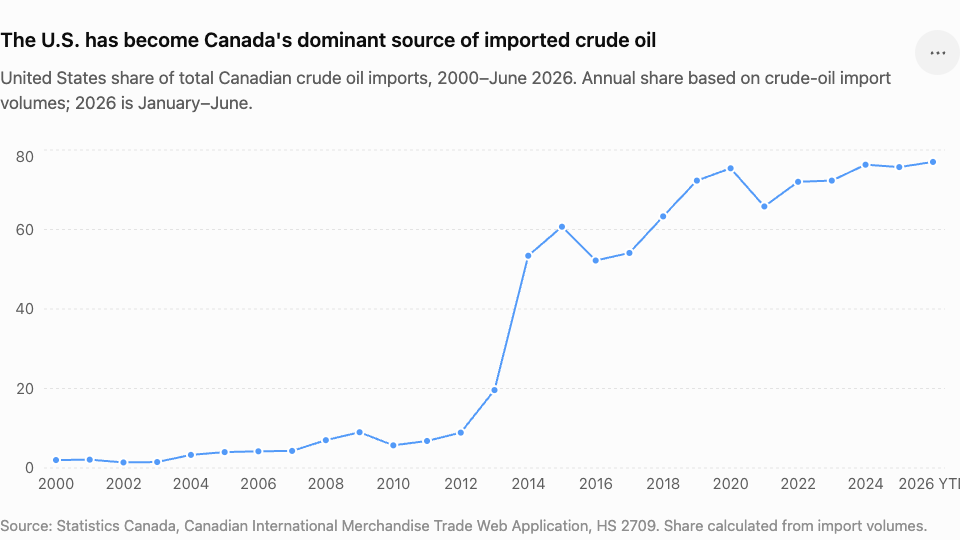 American Crude Replaced Overseas Crude
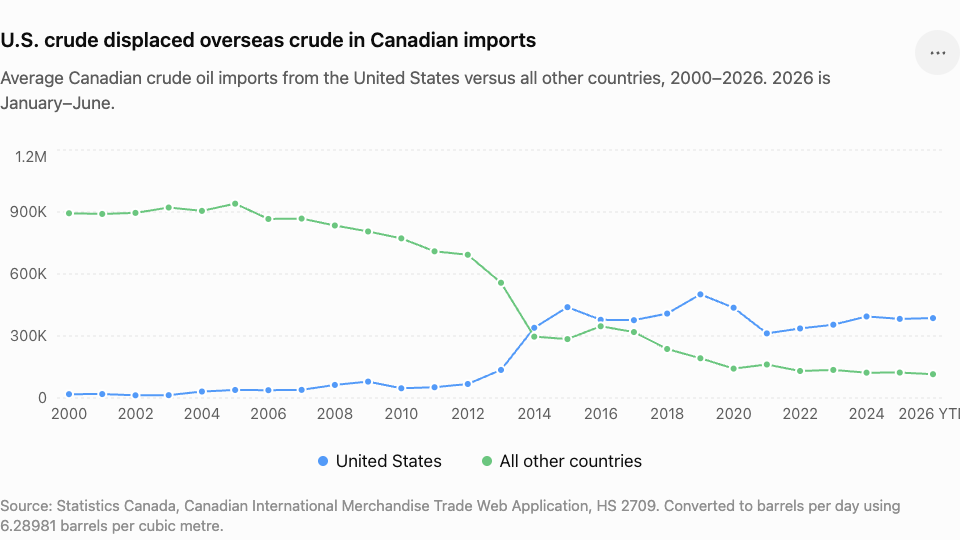
Here’s the important part: Canada did not suddenly develop an enormous new appetite for imported oil, it changed suppliers.
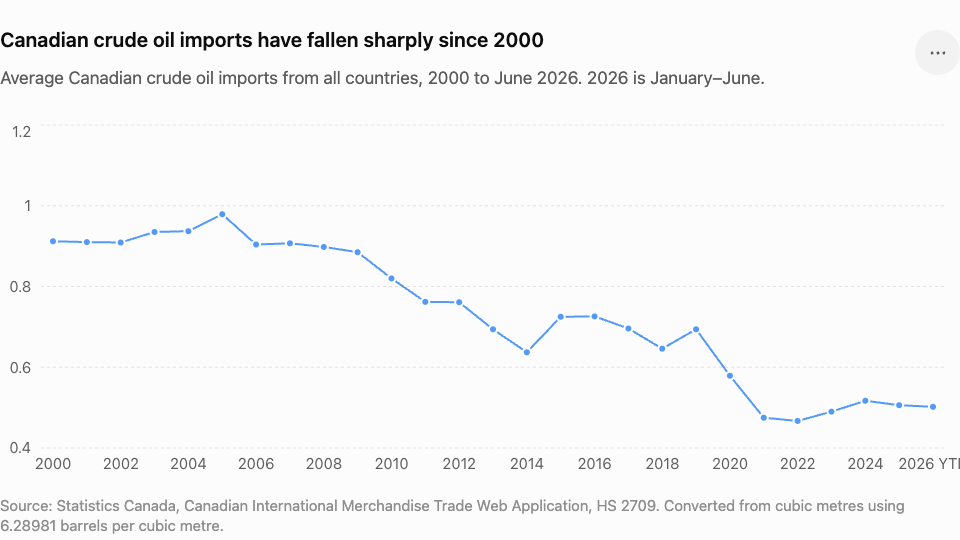
In 2000, Canada imported roughly 894,000 barrels per day from a variety of countries, with the US supplying 20,000 barrels per da(y b/d). By 2025, imports had fallen to just over 500,000 b/d, with the Americans providing roughly 383,000 b/d.
That is an astonishing reversal.
Overseas suppliers once dominated the Canadian import market. Today, most have virtually disappeared. Saudi Arabia supplied 11.2 per cent of Canadian imports in 2025 and Nigeria another 10.9 per cent, leaving barely two per cent for everyone else.
Over 25 years, Canada replaced most of its overseas crude supply with American barrels. The continental oil market became far more integrated just as the politics of the Canada-US relationship began moving in the opposite direction.
This Is What Energy Integration Actually Looks Like
Canada and the United States have spent decades building a continental oil market. Canadian producers ship millions of barrels south every day to American refineries, while US producers ship hundreds of thousands of barrels north to Canadian refineries. Those flows are shaped by geography, pipeline connections, refinery configurations and the economics of moving different grades of crude to the facilities designed to process them.
Trump’s tariffs collide directly with that reality.
The border may divide two countries politically, but it does not neatly divide their energy systems. Canadian and American companies have built supply chains around the assumption that oil, natural gas, electricity, equipment and investment can move relatively freely across it. A trade war introduces costs and uncertainty into a system whose greatest economic advantage has been integration.
Canada Is An Oil Superpower That Imports 500,000 Barrels A Day
Canada is the fourth-largest oil producer in the world. In 2025, Canada exported 4.3 million barrels per day of crude oil, including 3.9 million to the United States, while Canadian refineries imported about 506,000 barrels per day.
That sounds absurd until you look at a map.
Most Canadian production is in Western Canada. Much of the refining capacity that relies on imported crude is thousands of kilometres away in Ontario, Quebec, and Atlantic Canada. Refineries also cannot simply swap one barrel for another. They are designed around particular grades of crude, connected to particular pipelines and ports, and supplied according to transportation costs and market prices.
The result is a continental system in which Canadian crude flows south while American crude flows north. Canada’s half-million barrels per day of imports are evidence of how deeply integrated the North American oil market has become.
Trump Is Attacking The System American Oil Producers Depend On
The irony is difficult to miss. Washington is threatening punitive tariffs of 50 per cent, due to be imposed in two days, to extract concessions from Canada while American oil producers are benefiting from the very economic integration Trump is attacking.
Canada has become an increasingly important customer for US crude precisely because companies on both sides of the border spent decades building a continental energy market. Disrupt that market and some of the costs inevitably flow south.
Trump sees the Canada-US economic relationship as leverage Washington can wield against Ottawa. The crude oil trade tells a different story. After decades of integration, Americans are deeply embedded in the Canadian economy, just as Canadians are deeply embedded in theirs.
A 50 per cent tariff may punish Canadian exporters, but there is no economic wall at the border to contain the damage. American producers, workers, and consumers live on the other side of the same integrated system.
Markham, here’s a clean endnote set for the essay as we’ve built it. I’d keep the notes lean and let a few authoritative sources support multiple claims.
Endnotes
-
- Canada Energy Regulator, “Market Snapshot: Overview of 2025 Canada-U.S. Energy Trade,” June 2026. Canada exported 4.3 million barrels per day of crude oil in 2025, of which 3.9 million barrels per day, or 90.1 per cent, went to the United States. Canada simultaneously imported approximately 500,000 barrels per day, with roughly 400,000 barrels per day coming from the United States. https://www.cer-rec.gc.ca/en/data-analysis/energy-markets/market-snapshots/2026/market-snapshot-overview-of-2025-canada-us-energy-trade.html
- Canada Energy Regulator, “Market Snapshot: Canadian crude oil imports dipped slightly in 2025, with most still coming from the U.S.,” July 15, 2026. Canada imported 506,000 barrels per day of crude oil in 2025, down from 517,000 barrels per day in 2024. The CER notes that refinery operators choose crude according to factors including quality, price, availability, transportation costs and logistics. https://www.cer-rec.gc.ca/en/data-analysis/energy-markets/market-snapshots/2026/market-snapshot-canadian-crude-oil-imports-dipped-slightly-in-2025-with-most-still-coming-from-the-us.html
- Statistics Canada, Canadian International Merchandise Trade Web Application, and Energi Media analysis. Monthly HS 2709 data through June 2026 provide the underlying data for the Energi Media charts showing total Canadian crude imports, U.S. versus non-U.S. imports, the U.S. share of Canadian crude imports and monthly imports from the United States.
- Canada Energy Regulator, “Canadian crude oil imports dipped slightly in 2025.” The CER independently identifies 2014 as the year the United States became Canada’s largest source of imported crude. In 2025, the United States supplied 75.6 per cent of Canadian crude imports, Saudi Arabia supplied 11.2 per cent and Nigeria supplied 10.9 per cent. Together, the three countries accounted for 97.7 per cent of Canadian crude imports.
- Canada Energy Regulator, “Canadian crude oil imports dipped slightly in 2025.” Of Canadian crude imported from the United States in 2025, 70.5 per cent originated on the U.S. Gulf Coast and 29.5 per cent in the Midwest. Saudi Arabia and Nigeria have each supplied approximately one-tenth of Canadian crude imports during the past three years