Oil, Gas and Electricity Give Canada Enormous Leverage Over the US
August 12, 2026 | News
Donald Trump says the United States does not need anything Canada produces. Energy data tell a very different story. Decades of cross-border investment have created an integrated North American energy system in which Canadian electricity, natural gas and heavy crude are embedded in major US markets.
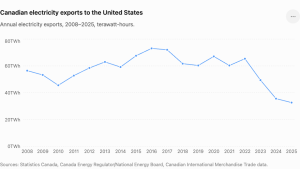 The leverage begins with electricity. Canadian hydroelectric output fell sharply after 2022 as drought reduced generation in Quebec, British Columbia and Manitoba. Exports to the United States fell with it, from about 65 terawatt-hours in 2022 to 36 TWh in 2024. But the decline reflected weaker Canadian supply, not weaker American need.
US electricity demand is now accelerating after nearly two decades of stagnation. The US Energy Information Administration expects national demand growth of 1.9 per cent in 2026 and 2.5 per cent in 2027, driven largely by data centres and industrial electrification. New England is an especially important market. ISO New England projects winter peak demand could reach 57 gigawatts by 2050, roughly 2.5 times the region’s historical record. During the January 2025 winter peak, Canadian imports supplied 14 per cent of New England electricity demand.
Natural gas creates another layer of dependence. Canadian pipelines delivered an average 8.6 billion cubic feet per day to the United States in 2025. At the same time, US LNG exports are rising rapidly as new Gulf Coast plants come online. The EIA forecasts LNG exports of 18.5 Bcf/d in 2027 and more than 30 Bcf/d by 2050 in most scenarios. Canadian gas helps backfill US markets as more American production is pulled toward export terminals.
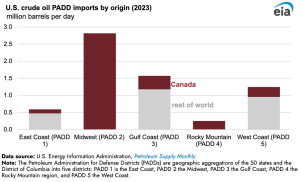 Oil provides Canada’s strongest physical leverage. The United States imports roughly 3.5 million barrels per day of Canadian heavy crude. In 2025, the Midwest imported about 2.75 million barrels per day from Canada and the Rocky Mountain region another 268,000 barrels per day. Canada supplied 100 per cent of crude oil imports into both regions. Many of those inland refineries are configured to process Canadian heavy crude and are connected to Western Canada by north-south pipelines.
The system also carries little room for a prolonged disruption. Commercial crude inventories in the Midwest amount to roughly 17 days of refinery throughput. Storage can absorb a short interruption, but it cannot replace millions of barrels per day if Canadian pipelines stop flowing.
Whether Ottawa should threaten or use that leverage in trade negotiations is a separate strategic question. The underlying energy reality is clearer: significant parts of the US economy cannot quickly replace Canadian oil, natural gas and electricity. Canada enters any energy-related negotiation with far more leverage than Trump’s rhetoric suggests.