Oil boom widens economic gap between Prairies and rest of Canada: Bank survey
August 11, 2026 | News
Canada’s latest oil upswing is widening the economic gap between the Prairies and the rest of the country, according to the Bank of Canada’s second-quarter Business Outlook Survey.
Businesses in the Prairies reported much stronger expectations for future sales, investment and hiring than firms elsewhere in Canada. The Prairie indicator for future sales stood at 38, compared with 9 in the rest of Canada. Investment intentions were 45 versus 26, while hiring intentions were 48 versus 21.
The regional divergence has intensified since the first quarter. Prairie investment intentions jumped from 5 to 45 and hiring intentions increased from 26 to 48. Outside the Prairies, future-sales expectations fell from 23 to 9, investment intentions declined from 35 to 26 and hiring intentions dropped from 40 to 21.
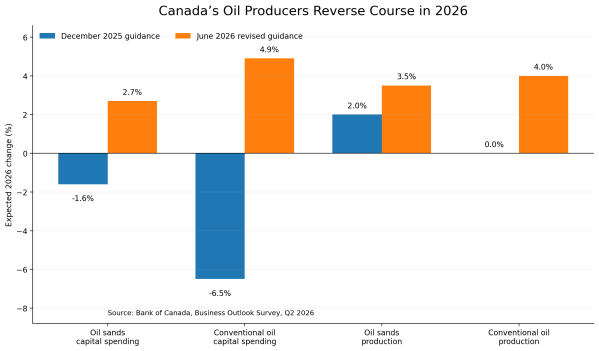
The survey also shows a major reversal in oil-producer plans for 2026. In December 2025, conventional oil producers expected capital spending to decline 6.5 per cent. By June, they expected spending to increase 4.9 per cent. Their production outlook moved from no growth to a 4 per cent increase.
Oil sands producers also revised their plans upward. Expected capital spending shifted from a 1.6 per cent decline to 2.7 per cent growth, while the production outlook rose from 2 per cent to 3.5 per cent.
Natural gas producers are following a different path. Their expected production growth remains strong at 5 per cent, but capital-spending guidance moved from 1.9 per cent growth in December to a 0.9 per cent decline in June.
The survey suggests stronger commodity activity is also supporting Canada’s export outlook. The Bank’s indicator of future export sales rose from 24 in the first quarter to 50 in the second, compared with a historical average of 30. The improvement provides a source of demand for Canadian producers at a time when businesses serving the domestic economy are becoming more cautious. It also increases the importance of commodities in the near-term national outlook, even though the survey does not identify where those additional exports are going.
The regional figures are especially notable because the Prairie economy had already been outperforming on several measures before the latest revision to producer plans. The second-quarter results suggest that higher oil-sector spending is reinforcing that advantage while conditions elsewhere deteriorate.
At the same time, national business conditions weakened. The Bank’s business activity indicator fell from 0.13 in the first quarter to -0.11 in the second. Its price indicator rose from -0.05 to 0.96. Selling-price expectations increased from 58 to 90, while input-price expectations rose from 82 to 111.
The combination points to an increasingly uneven Canadian economy. Higher oil prices are encouraging producers to spend and expand, strengthening the Prairie outlook. Businesses elsewhere are reporting weaker sales, investment and hiring expectations while also facing stronger price pressures.
Stronger commodity exports can cushion the national economy, but they do not by themselves reduce Canada’s dependence on the United States, which remains the dominant market for Canadian oil and gas. The emerging policy challenge is to convert resource-sector strength into broader investment and greater access to non-US markets while managing the regional and inflationary pressures created by another oil upswing.