Battery Storage Beats Gas Peakers. Is Canada Backing the Wrong Horse?
October 10, 2026 | Markham on Energy
According to a new report from consulting giant Wood Mackenzie, battery storage is now cheaper than gas peaker plants in almost every market. Analysts are hailing the milestone as a seminal moment for the electrification of the global economy – or, as we like to call it, the energy transition. Granted, this is an important moment. But it’s also just one data point in a process of technological change that will end many decades in the future.
And, in that change, there is a critical lesson for Canada at this point in our country’s economic evolution. I’ve been writing about technological change for four decades. My model is based on the transition from horses and steam to tractors and modern industrial farming from 1900 to 1950. In that process are all the components of most technology adoptions.
The slow initial development of the technology (1900 to 1920, when the first modern “small tractors” appeared in the market). The adoption inflection point (1920, with the introduction of the Fordson, cheap and built on automotive manufacturing). The mid- to late-1920s, when ancillary machines (the combined harvester-thresher, the three-point hitch, rubber tires) became available. Then, from 1930 to 1950, the now-superior economics of mechanical agriculture displaced horses from every field in North America.
The story over the past 75 years has been about ever-improving technology and changing farm economics. But the war between the technologies – animals and steam versus the internal combustion engine – was fought in the first half of the 20th century.
Pegging the date for the start of the modern technology competition – combustion vs electrotech, molecules vs electrons – is inexact, but let’s choose 2010. Comparatively speaking, then, we’re 16 years into a 50-year transition. In 2060, we’ll look back on that process and the triumph of electric over combustion will appear inevitable. Just as the triumph of the tractor seems inevitable from today’s vantage.
That’s why the Wood Mackenzie analysis is interesting, but not cause for popping the champagne. The triumph of battery storage is one data point among many in a long, complex process. A decade from now we might have enough data to declare electrons the victory, just not quite yet.
But one thing we can say for certain: if present trends hold, electrons will win. And that any country that wants to have an advanced, prosperous economy in 2060 has to bet on the tractor, not the horse. This is the lesson for Canada.
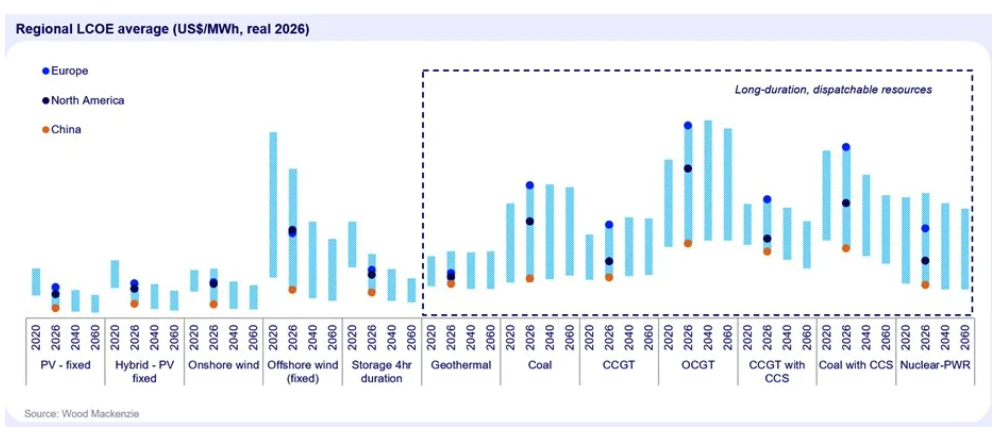
Four-Hour Batteries Are Beating Gas Peakers on Cost
Gas peaker plants fire up when electricity demand surges, supplying power for those relatively short periods when the grid needs extra help. Batteries that can deliver electricity for four hours increasingly compete for that job. Wood Mackenzie now finds their lifetime cost per unit of electricity is lower than that of open-cycle gas turbines in all 43 markets where it compared the technologies.
The competitive gap is widening: turbine shortages and volatile fuel prices push up gas costs, while expanding battery manufacturing pushes storage costs down. The significance extends beyond batteries taking business from gas plants.
Storage makes solar and wind more useful by saving electricity for when customers need it. Cheaper batteries therefore expand the market for other electric technologies, just as better implements expanded what farmers could accomplish with a tractor.
This is the technological convergence at the heart of our theory of change: advances in one technology create opportunities for others, strengthening the economics of the emerging system.
The Same Competition, Different Regional Advantages
China shows what manufacturing scale can accomplish: its grid-scale storage costs are more than 55 per cent below the average for the rest of Asia Pacific, according to Wood Mackenzie. In the Middle East and Africa, abundant sunshine makes the combination of solar and batteries especially attractive.
Four-hour storage already undercuts gas peaking across the region’s modelled gas markets, and WoodMac forecasts its cost will fall another 33 per cent by 2035. Different regional advantages are pushing the competition in the same direction.
Across the rest of Asia Pacific, China’s manufacturing strength is helping drive storage costs lower.
Wood Mackenzie expects competitive Chinese supply to help bring the regional average, excluding China, down from US$134 per megawatt-hour to US$92 by 2036. Japan, Australia, and the Philippines are expected to remain more expensive because of import duties, installation costs, and domestic manufacturing policies.
The broader significance is that China’s investment in scaling electric technologies is changing the economics of energy well beyond its borders.
North America illustrates how messy that competition can become. Tax credits help battery storage compete, while trade restrictions and supply-chain constraints push in the opposite direction. Meanwhile, data-centre demand is straining gas-generation supply chains, keeping capital costs elevated and strengthening the investment case for renewables and storage, according to WoodMac. The technologies compete within markets shaped by government decisions, industrial capacity, and changing demand.
The direction of technological change can be clear even while the path remains uneven.
Another lesson for Canada: whether 4-hour batteries are more competitive than gas peakers in Canada is the wrong question. The right one is the effect on electrification promoted by falling battery storage costs in the Global South where Canada hopes to sell Alberta oil and British Columbia LNG. More EVs mean falling demand for gasoline and diesel. More heat pumps and grid-storage batteries mean less demand for gas.
Heat Pumps Illustrate Canada’s Dilemma
Ottawa’s new heat-pump program illustrates Canada’s tentative embrace of the electric future.
Over eight years, it is expected to help roughly 100,000 households annually switch to heat pumps. That sounds impressive until we consider that approximately one million Canadian homes replace their heating systems each year. The program would support conversions equivalent to just 10 per cent of those replacements.
Every replacement is an opportunity to put more efficient electric technology to work, but our policy ambition remains modest compared with the opportunity. Canada is behaving like a late-majority adopter, stubbornly sticking with horses while its neighbours buy the new-fangled tractor everyone is talking about.
Canada’s national adoption of heat pumps remains modest: in 2023, roughly nine per cent of households used heat pumps as their primary heating system, including mini-splits, according to Statistics Canada.
Nordic economies demonstrate how much further cold countries can go: the International Energy Agency reported in 2022 that heat pumps equipped 60 per cent of buildings in Norway and more than 40 per cent in Sweden and Finland. The measures differ—Canadian households versus Nordic buildings—but the contrast is striking. Cold weather plainly does not condemn Canada to tentative adoption. Other advanced economies have already made the technology commonplace.
The shift extends beyond Scandinavia.
More than 20 per cent of American households now rely on heat pumps for space heating, according to the IEA’s Heat Pump Monitor 2026. In Japan, reversible air conditioners—which are heat pumps capable of both heating and cooling—are the most popular space-heating technology. Europe’s heat-pump sales returned to double-digit growth in 2025, continuing into early 2026. These economies are following different paths, but each demonstrates that electric heating and cooling can move well beyond a niche market.
Canada has ample examples to learn from.
Canada Is Still Betting on the Horse
Wood Mackenzie’s finding that four-hour battery storage now beats gas peakers on cost is one milestone in a much larger technological competition. Look beyond electricity generation and the same contest is playing out in home heating, transportation, and industry. Canada’s problem is that we recognize the tractor’s advantages but remain reluctant to put it to work.
Battery-electric and plug-in hybrid vehicles accounted for only 9.5 per cent of Canada’s new vehicle registrations in 2025, down from 14.6 per cent in 2024. The United States is just as dreary: just under 10 per cent of new car sales in 2025, according to the IEA.
Meanwhile, electric vehicles captured 28 per cent of new car sales in Europe, nearly 55 per cent in China, and almost 20 per cent in Southeast Asia. In Latin America, electric car sales grew 75 per cent in 2025, led by Brazil and Mexico.
Light-duty passenger vehicles are only one transportation category. China’s electrification push extends to two- and three-wheelers, heavy-duty freight trucks, autonomous robotaxis, high-speed rail, and delivery vans. Improving batteries, electric motors, and digital technologies are carrying electrification into more markets that once belonged almost exclusively to combustion.
This brings us back to four-hour storage. Better, cheaper batteries strengthen the economics of renewable electricity, just as they strengthen the economics of electric transportation. These technologies advance together, expanding each other’s markets. The tractor became more useful as farmers acquired better implements. Electrotech is following a similar path.
While other economies put these technologies to work at scale, Canada remains tentative about adopting the machines that will shape our future prosperity. The ambition of federal and provincial governments is tepid, not bold. Too often, their priorities reflect those of incumbent oil and gas companies and political promoters—including Alberta Premier Danielle Smith and B.C. Premier David Eby—whose interests are served by prolonging the combustion economy.
As we stand in 2026, the race is not yet lost. But another five to 10 years of hesitation could leave us dangerously far behind. Wood Mackenzie’s analysis is another signal that the economics are shifting. It should prompt Canada to accelerate adoption, not wait for the next study to confirm what the last one told us.
The tractor keeps getting better and cheaper. How much longer will Canada keep betting on the horse?
Endnote: Sources and Further Reading
This column places Wood Mackenzie’s battery-storage findings within Energi Media’s continuing analysis of technological change, electrification, and Canadian competitiveness. The following reporting and research provide additional context.
- Wood Mackenzie — Four-hour battery storage now beats gas peaking on cost globally. The cost comparison that prompted this column, including regional differences in the competition between batteries and gas peakers.
- Energi Media — How the 1920s help us understand the energy transition of the 2020s. The historical perspective behind the tractor analogy and our interpretation of today’s technological competition.
- Energi Media — Cheap Batteries Break Solar Power’s Night Time Barrier. How falling storage costs extend solar power’s usefulness beyond daylight hours.
- Energi Media — Future of EVs: GM’s “Ultium” platform and radical new battery arrive just as electric is cost-competitive with gasoline. Reporting from 2020 documenting an earlier milestone in the competition between electric and combustion technologies.
- Energi Media — Battery industrial policy offers lessons for Canada as it diversifies beyond the U.S.. The connection between battery supply chains, industrial strategy, and Canada’s economic opportunities.
- Energi Media — Chinese EVs and Grid Technology Are Reshaping Global Energy Demand, Says Reuters Columnist. China’s role in the changing relationship between transportation, electricity, and fossil-fuel demand.
- Energi Media — Canada’s Low Electrification Rate Threatens Its Future Prosperity. Why the pace of electrification matters to Canada’s long-term economic competitiveness.
- Ember — The Electrotech Revolution. A framework connecting renewable electricity, electric vehicles, heat pumps, batteries, and digital technologies through their improving economics and expanding deployment.
- Ember — The Age of Power. Research placing the growth of electricity within the broader transformation of the global energy system.
- Adair Turner, Transition Accelerator and Institut de l’énergie Trottier — The Future Is Electric: Trends and Implications for the World. The efficiency and economic advantages driving electrification, alongside the regional differences and constraints shaping its progress.
- International Energy Agency — Electrification. International analysis of the shift toward electricity across energy-consuming sectors.
- Ember — Global Electricity Review 2025. Comparative evidence on electricity demand and generation, providing a foundation for assessing how the transition differs across countries.
- Lux Research — The Next Era of Energy Innovation. Research on innovation priorities and the commercial pressures shaping investment decisions across the energy sector.