California power problems a potential migraine for BC?
August 18, 2020 | Markham on Energy
British Columbia intends to import a lot of low-cost Western US renewable electricity over the coming years. California solar power is “very, very cheap because they produce so much of it,” says Bruce Ralston, BC energy minister. But with the California power grid on the verge of collapse this week, is boosting imports still a good idea?

Source: ABC7 News.
Rolling blackouts across the state this weekend were caused by a record-setting heatwave exacerbated by the coronavirus pandemic. Temperatures in Death Valley reached 130 Fahrenheit. Thousands of dry lightning strikes have started fires across the state, fanned by winds up to 119 km per hour.
The state power grid is under so much stress from air conditioners that millions of Californians could lose access to electricity for days. At a press conference Monday, Governor Gavin Newsome said the state was short 4,400 megawatts of generating capacity, which is 40 per cent of BC Hydro’s entire power generation capability.
According to energy economist Ed Hirs of the University of Houston, the cause of California’s problems will be familiar to British Columbians: governments promising low electricity rates. As a consequence, utilities don’t have enough revenue to properly maintain the power grid and carry sufficient generating capacity. Not that long ago, the state’s three big investor-owned utilities all sought bankruptcy protection.
“The question for California consumers is how much they want to pay for safe and reliable electricity,” he told Energi Media. The answer to date, he says, is very little. Californians seem to think that the promise of low-cost wind and solar power magically translates into teensy electricity bills. Deprived of sufficient revenue, when disaster strikes, as it does regularly on the West Coast, utilities and the state power grid haven’t the resources to properly respond.
The problem is exacerbated by California’s aggressive push to replace coal and natural gas generators with renewable energy, according to Reuters energy columnist John Kemp.
“In the long term, California has ambitious plans for a grid dominated by wind and solar generation, backed up by variable pricing, load-shifting and lots of grid-scale and customer-scale storage,” he wrote in his August 18 column. “But the state has failed to sequence the transition properly, phasing in wind and solar generation and phasing out other sources too quickly, before consumption has been reshaped and storage has been scaled up sufficiently.”
Implications for BC
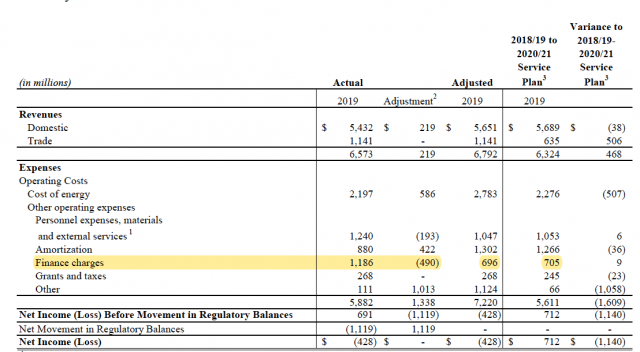
Source: BC Hydro Annual Service Plan Report 2018-2019.
What does the California crisis have to do with British Columbia? In a word, everything, because the NDP government of John Horgan finds itself in a not dissimilar dilemma.
BC governments of all political stripes have promised lower prices and now the utility’s finances are a mess.
The BC Liberals under Gordon Campbell and Christy Clark loaded up BC Hydro with debt, hiding $5.5 billion in deferral accounts. The utility’s total debt has ballooned to $21 billion; it now has the worst debt-equity ratio of North American utilities. Not surprisingly, BC Hydro’s most recent annual report lists “finance charges” on that debt of $1.2 billion for 2019, about 18 per cent of the crown corporation’s revenue.
Imagine spending almost one-fifth of your family income to pay just the interest on credit cards.
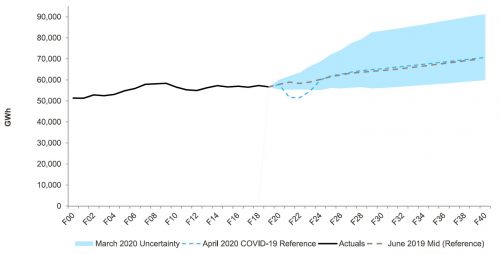
Forecasts prior to 2007 showed BC Hydro needing more power generation around 2010 because of 2% annual growth in electricity consumption. As this graph shows, demand instead stayed flat for the past decade. Source: BC Hydro.
Also under the Liberals, BC Hydro contracted with independent power producers because its forecasts showed an electricity shortage after 2010. Unfortunately, provincial consumption plummeted after the 2007 financial collapse and subsequent Great Recession, then plateaued instead of rising again, leaving BC Hydro with surplus power it sold at a loss on spot markets.
To make the BC situation even more interesting, the Horgan government’s CleanBC climate plan calls for extensive electrification of the provincial economy. Estimates of how much extra electricity that would require vary, but they range from 7,000 to 30,000-gigawatt hours per year by 2030. That’s the equivalent of one-and-a-half to six Site C dams.
Fixing BC Hydro while implementing CleanBC is going to be tricky – and we haven’t even mentioned the disaster that is Site C.
Part of the NDP’s strategy to bandaid BC Hydro’s finances is to lower its “cost of energy” by importing more American power from the well developed Western electricity markets where its subsidiary Powerex has been trading for decades.
The government expects US imports to cost $25 to $40 per megawatt-hour (compare to Site C’s more than $100 per MWh). Those prices are so low because states like California are in the midst of a wind and solar building boom, helped by a 30 per cent federal tax credit that enables renewable energy generators to make money even when market prices are negative, which happens occasionally in California.
Issue for BC is risk management
A California power shortage caused by heat and wildfires isn’t the only risk that comes with higher BC electricity imports.
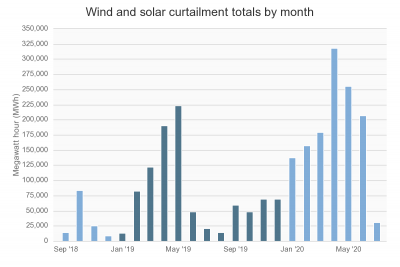
Source: California ISO.
Energi Media has identified four other risks after interviewing experts including economists Severin Borenstein and Lucas Davis of the Energy Institute at Haas School of Business, University of California Berkely; Ron Monk, a consulting engineer who worked in BC Hydro’s energy planning department for years before leaving in 2007; Ricardo Rodriguez, San Francisco-based battery storage analyst for Guidehouse Insights; and BC-based engineer Richard Harper. Several American experts provided information on background because they are not authorized to speak on the record.
One, transmission congestion is a major issue in California precisely because of all of that solar. The state system operator CASIO often has to curtail production or pay nearby states like Arizona to take excess electricity off its hands. Expanding regional transmission is difficult because of opposition from communities and environmentalists.
“If there’s a risk to BC Hydro, it doesn’t come from electrification, it doesn’t come from batteries,” says Davis. “But it would come from congested regional transmission systems and also investment by industry in ways to use that surplus power locally.”
There are also congestion problems on transmission lines following the I-5 freeway corridor that has led BC Hydro in the past to restrict imports to 300 to 500 megawatts.
Two, investors are already eyeing up that cheap excess electricity for power-intensive industries like “green” hydrogen, which is created using electrolysis. Davis says the it’s still early days, but as the mad race to build ever more solar farms continues, he expects to see companies taking advantage of the opportunity.
Three, California is also increasingly requiring utilities to invest heavily in battery storage.
“I think that there is a risk with [British Columbia] relying on solar imports given the rate of storage that’s being that’s being deployed to limit solar curtailment,” says Rodriguez.
Four, BC isn’t the only jurisdiction planning to electrify its economy to combat climate change, including many of the states that make up the Western electricity market. For example, California recently mandated the switch from diesel and gasoline-powered heavy-duty trucks to electric beginning in 2024. By 2045 every commercial vehicle sold in California must be electric or hydrogen-electric.
Consequences for BC
Importing more power from California or other Western states carries risk, probably much more than British Columbians are aware of.
Harper says he’s not a fan of boosting imports because BC will be exposed to too much risk from American markets: “I don’t think imports are the solution to BC’s long-term issues.”
Hirs says that if California wants to sell electricity to BC, it will sell electricity to BC, but asks what BC is going to do in a situation like the current one when California consumers say, “That’s my power, I want it.”
“BC Hydro and the BC government relying upon somebody that is already in a bind to fix their own self-inflicted problems is simply asinine,” he says.
If the Horgan government insists upon being asinine, the least it can do is be honest with British Columbians about the degree of risk BC Hydro will be assuming on their behalf.
Disclosure notice: Energi Media provides video production and communications consulting to Clean Energy BC, the trade association of the BC independent power producers.