Suncor, Alberta Innovates op-ed a game-changer as oil and gas industry finally embraces energy transition
June 2, 2020 | Markham on Energy
Faced with potentially significant market disruption from COVID-19 pandemic and energy transition, oil sands giant signals that materials, clean fuels are the future
The CEOs of Suncor and Alberta Innovates published an extraordinary op-ed in the Corporate Knights magazine on Monday. Titled, “Canada’s oil sands are best positioned to lead the energy transformation,” Mark Little and Laura Kilcrease chart a new direction for the Alberta oil sands and its role in Canada’s pivot to a low-carbon economy. The most significant aspect of the op-ed? This is the leadership Alberta has been waiting for.
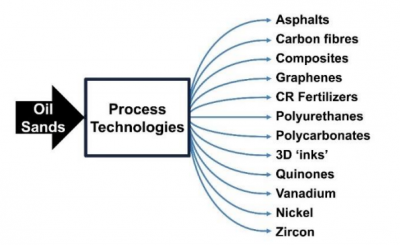
Source: Alberta Innovates.
Don’t look for new initiatives in the op-ed. The innovations used to buttress their argument have been in the pipeline for a while now.
For example, Alberta Innovates’ Bitumen Beyond Combustion program that is working to commercialize bitumen as a feedstock for carbon fibre manufacturing has been around for years. The same is true for the hydrocarbon industry’s support for Canada’s cleantech companies. “The oil and gas industry is one of the largest markets for, and potentially investors in, clean technology in Canada,” the executives write. “Canada needs to ensure these opportunities aren’t ignored.”
But here’s the real eye-opener from the op-ed: “The temporary economic lockdown triggered by the 2020 pandemic is giving us a glimpse into a not-too-distant future where the transformation of our energy system could disrupt demand on a similar scale.”
There’s a lot to unpack in that solitary sentence.
The most significant is the recognition that hydrocarbon consumption could decline much sooner and faster than expected. Only a few years ago, Suncor’s own sustainability reports suggested peak oil by 2040. The management team at Canada’s largest integrated oil and gas company appears to have had a change of heart. It has certainly diverged from the dominant Alberta narrative, promulgated at every opportunity by Premier Jason Kenney and the energy war room (aka the Canadian Energy Centre), which holds that oil consumption will keep growing for a long time.
Also interesting is the linked document. Wells, Wires, and Wheels…EROCI and the Tough Road Ahead for Oil was written by Mark Lewis of BNP Paribis Asset Management. His argument is that renewable energy and electric vehicles are already much cheaper than gasoline and diesel-powered vehicles. “That will mean that the economics of conventional road transportation, as we have known it for the last 60 to 80 years, is going to be disrupted very dramatically,” he told Energi Media last year.
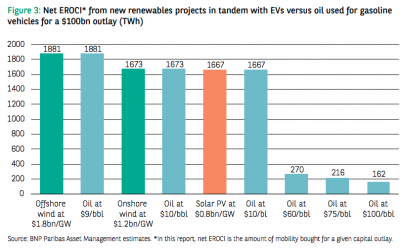
Source: Wells, Wires, and Wheels…EROCI and the Tough Road Ahead for Oil.
Publicly referencing Lewis is a significant acknowledgment that at least some Canadian oil and gas leaders understand the existential threat posed by the energy transition. And, it appears, they are ready to act.
“Now is the time to take a big step forward,” the op-ed argues. “As the history of the oil sands reveals, disruption and transformation are nothing new for Albertans and we’re optimistic that the Canadian energy industry is up to the challenge and best positioned to invest in and lead energy transformation.”
Lead the energy transformation. Those are powerful words, especially since the Alberta oil patch has been driving by the rearview mirror the past few years. What might leadership look like? Three ideas from the op-ed stand out.
One, a new approach should be about seizing opportunities as much as it is about mitigating risk: “While Canadian oil and gas will remain a significant part of the global energy mix for some time, we have to take advantage of new opportunities that offer attractive growth prospects.” The authors single out cleantech as an opportunity and illustrate the potential with Suncor’s partnership with technology startup Enerkem, which turns household garbage into biofuels.
“In addition to an equity investment, Suncor seconded a dozen operations experts,” Little and Kilcrease write.
This is a terrific model for fostering innovation. For example, Suncor alone earned $20 billion of revenue last year and has the financial clout to bridge the difficult gap between demonstration and scaling up for the market. And the big oil sands companies (Cenovus, CNRL, Imperial, Husky) have a depth of technical expertise that may be unrivaled in the country.
Source: Woodside.
Two, Alberta needs to transition away from producing feedstock for fuel markets. It is telling that the innovation examples used in the op-ed are either clean fuels (biogas) or materials (carbon fibre manufactured from bitumen). Bitumen, in particular, is an excellent feedstock for materials, where its high carbon content is an asset instead of a liability.
“If we can figure out how to do this affordably at scale, it has the potential to quadruple the revenue from Alberta’s current bitumen output,” the op-ed says. “Alberta Innovates estimates the added economic potential of carbon fibre, activated carbon and asphalt binder alone could be in the range of $84 billion annually.”
In an interview with Energi Media earlier this year, Alberta Innovates estimated that commercial-scale production of carbon fibre from bitumen could begin in five to seven years.
Three, now “is the time for the federal government to support disruptive innovation,” Little and Kilcrease write. They give a nod toward Prime Minister Pierre Trudeau’s support for Premier Peter Lougheed’s Alberta Oil Sands Technology and Research Authority, created in 1974, that “made technological breakthroughs that unlocked hundreds of billions of dollars of value from the oil sands in subsequent decades benefitting all Canadians.”
Another great idea, one that aligns the oil sands’ future with global concerns about climate change and the current Liberal government of Justin Trudeau’s climate policies. One can only imagine how contentious this is in the Calgary Petroleum Club, where hatred of the Trudeaus runs deep and support for the CPC is part and parcel of the tribal affiliation.

Prime Minister Justin Trudeau, left, and Alberta Premier Jason Kenney.
In a similar vein, Alberta Innovates is a provincial agency. Given the historic animosity between Premier Kenney and Prime Minister Trudeau, at first glance it might appear that the agency is out on a political limb. But it cannot be a coincidence that the same day the op-ed was published, Alberta finance minister Travis Toews told Postmedia that the Alberta government is preparing an economic recovery plan that will focus on diversifying “various industry sectors that we know have a great future in the province, certainly energy and agriculture as you would expect.”
Have the planets re-aligned in the wake of the economic carnage wrought by the COVID-19 pandemic? It would appear they have.
Now we wait for the next steps to see just how serious the Alberta government and the oil and gas industry are about this new approach to hydrocarbon development.