Carney’s Electrification Budget Is a Breakthrough. Now Triple the Ambition
November 5, 2026 | Electrification, Canada, Markham on Energy
Prime Minister Mark Carney has delivered the budget I’ve been waiting for. Budget 2026 puts electricity and electrification at the centre of Canada’s economic strategy. The government understands that cheap, abundant, clean electricity is the foundation of industrial competitiveness, energy security and household affordability. It understands that electric cars, heat pumps, and factories are part of one economic transformation. And it’s prepared to put serious federal money behind that vision.
For someone who’s spent years arguing that Canada should electrify its economy, this is a terrific budget.
But I’ve got one big complaint: The ambition isn’t nearly big enough.
Canada gets about 18 per cent of its end-use energy from electricity. That’s the starting line. But the math doesn’t match Carney’s ambition.
Canada consumes 600 TWh of electricity per year. I’ve done a rough calculation about how much new industry – pipelines, LNG< oil sands, mines, smelting and refining, manufacturing, to name the big ones – could be added by 2050, and the new load could easily be another 600 TWh. That would leave Canada using the same percentage of electricity it does today.
Meanwhile, other advanced economies are advancing at a rapid pace. The electrification rate for China, for example, 30 per cent and it’s rising by one percentage point per year. China could arrive at mid-century with a rate of 55 to 60 per cent.
The Prime Minister is correct that electrification is more efficient, lower cost, and that electric technologies make Canada more competitive. It follows, then, that Canada should be shooting for a much, much higher degree of electrification than this budget suggests.
An advanced economy that wants to compete in an increasingly electric world should be far more ambitious. The budget finally gets the direction right. Now the federal government needs a plan that matches the scale of the opportunity.
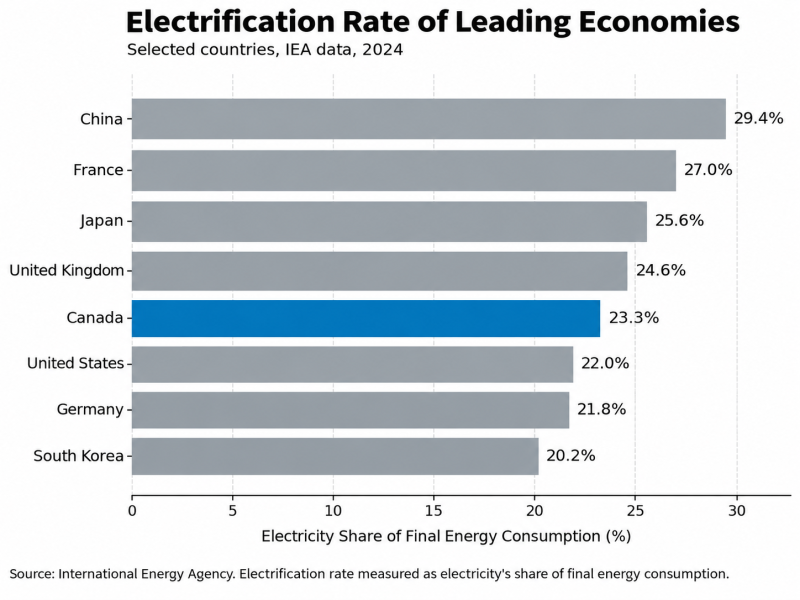
There are several methods of calculating electrification rates. This graph uses International Energy Agency data, which gives Canada a higher rate. The 18% referred to in this article uses Canadian Energy Regulator methodology and data.
The Great Electricity Build-Out
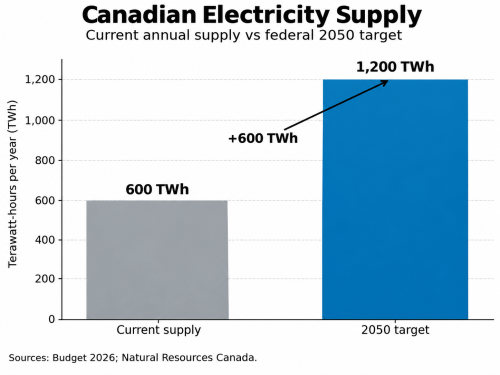 Ottawa’s National Electricity Strategy, first released last spring, aims to double the country’s electricity system by 2050. Natural Resources Canada says federal support for electrification totals $115 billion through 2041–42, including $52 billion in new Budget 2026 commitments.
Those aren’t all cheques for new power plants: a large share consists of tax incentives spread over many years.
Still, the program is substantial. The government proposes extending the 30 per cent Clean Technology and 15 per cent Clean Electricity investment tax credits to 2040, at an estimated cost of $38.5 billion. High-voltage transmission lines within provinces would become eligible for the electricity credit. Another $4 billion would support electricity infrastructure, renewable energy and priority grid projects.
Nuclear power, hydroelectricity, offshore wind, northern energy systems, and interprovincial transmission are all in the mix. Projects already receiving federal backing include Darlington nuclear in Ontario, the North Coast Transmission Line in British Columbia, and Churchill Falls and Gull Island in Labrador.
And here’s where the arithmetic becomes uncomfortable.
Canada produces roughly 600 terawatt-hours of electricity annually. Doubling that would take us to about 1,200 TWh by mid-century, an additional 600 TWh. But expanding industries—everything from critical minerals processing and steel to hydrogen and data centres—could claim a staggering share of that new supply.
Consider a plausible scenario in which new industrial demand alone adds 600 TWh a year. The entire increase in generation would be spoken for before we dramatically electrified the rest of the economy. That’s a stress test, not a verified federal demand forecast, and we must avoid counting industrial demand twice.
But it exposes a crucial question: is doubling supply sufficient for both industrial expansion and mass electrification?
Ottawa needs to publish an integrated electricity-demand plan, sector by sector, that shows how much power its economic ambitions actually require. If the answer is more than twice today’s supply, the national target should rise.
Connecting the Country—and Making the Equipment
The budget recognizes that generation is only half the battle. Electricity has to get from dams, reactors, and wind farms to the communities and industries that need it.
Canada’s provincial grids are fragmented
Transmission links could allow provinces to share clean electricity, reduce the need for duplicate capacity and protect customers against disruptions. Ottawa proposes additional transmission support, planning work and new financing arrangements to avoid loading the entire cost of long-lived infrastructure onto today’s ratepayers.
The most encouraging part might be the industrial logic. Federal tax-credit bonuses of up to 10 percentage points for clean technology and five points for clean electricity are being considered for projects using Canadian-made components. Transformers, cables, batteries, turbines and digital controls could become major Canadian manufacturing opportunities.
That’s economic sovereignty in concrete form: building the infrastructure and building the industries that supply it. But these domestic-content bonuses are still subject to consultation. Ottawa will have to translate its intentions into orders, factories and jobs.
Heat Pumps: A Good Start, Not a Mass Transition
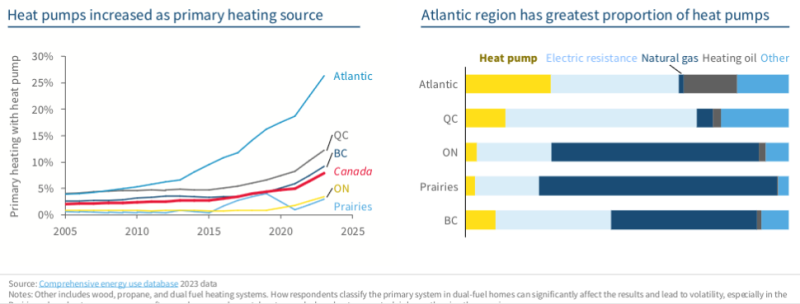
The government is also spending more than $2 billion on one million home retrofits. Its National Heat Pump Rebate is intended to support up to 820,000 households, helping them replace costly heating systems and lower energy bills. The government estimates annual savings exceeding $1 billion across its retrofit effort.
Excellent policy. Modest scale.
Using a working estimate of 17.4 million homes, 820,000 installations would represent about 5.7 per cent of the housing stock over eight years. And not every supported installation necessarily replaces a fossil-fuel heating system. The actual additional electrification would be smaller.
We replace furnaces and other heating equipment every year. That’s the opportunity: make the electric option easy and affordable whenever a household needs a new system. A serious national electrification program would move beyond a limited rebate pool toward sustained, mass-market adoption, supported by provincial utilities and installers.
Electric Vehicles Need the Same Ambition
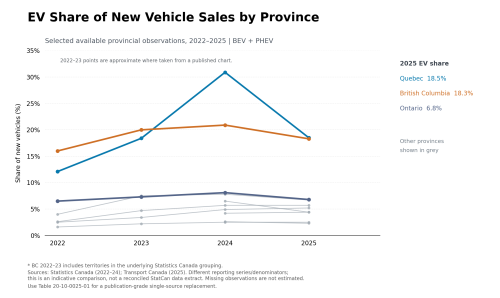 Budget 2026 promises more charging infrastructure: over 55,000 additional federally supported chargers, backed by $587 million over five years, alongside support for EV affordability and Canadian automotive manufacturing.
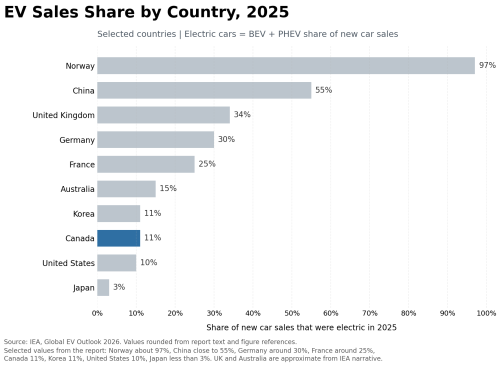 Good. Range anxiety is real, especially in rural Canada, and dependable public charging matters. But chargers are only one part of the transition. Canadians also need affordable vehicles, straightforward home and workplace charging, and electricity prices that make switching attractive.
The government’s own action plan sees electric vehicles and heat pumps as the means of shrinking the household ‘energy wallet’—the combined bill for gasoline, natural gas, heating oil, propane and electricity.
As electricity takes a larger share, overall energy spending can fall because electric technologies use energy more efficiently.
That’s a compelling affordability argument. Ottawa should make it much more central to public policy.
Make the Vision Bigger
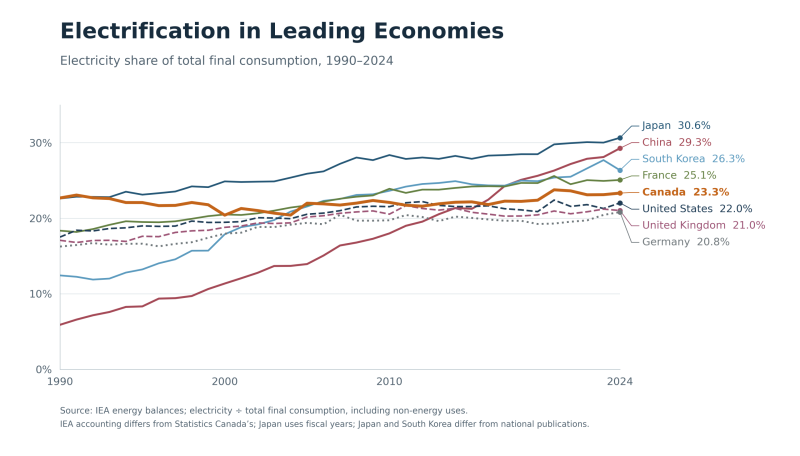
This graph sums up a big problem for Canada: The electrification of the national economy hasn’t changed for 35 years. Sure, we have a clean power supply, but the majority of Canada’s energy comes from gasoline and diesel for transportation and natural gas for heating.
Mark Carney’s electricity budget is unlikely to significantly change the country’s trajectory.
The Canadian Climate Institute is right to welcome this budget’s direction. Electricity investment can drive growth, lower emissions, and improve competitiveness. The federal government has finally connected those dots in a way that reaches far beyond climate policy.
But we shouldn’t confuse a breakthrough in thinking with a complete plan. Doubling electricity generation by 2050 is a major undertaking. It may also be too conservative. Electrifying a relatively small fraction of homes over eight years won’t transform the residential sector. And charging stations won’t electrify transportation by themselves.
Carney has given Canada a convincing economic destination. Now he needs to show the country what it will take to get there—and raise the ambition if the math demands it.
That’s my verdict on Budget 2026: a remarkable start, and a challenge to think much bigger.
Related Energi Media Journalism
- Canada Must Electrify Its Economy Faster or Risk Falling Further and Further Behind
- Canada Needs Affordable Power and Practical Policies to Become an Electrostate
- Electrifying Canada’s Economy Requires Provincial Coordination and Utility Reform
- Canada Heat Pump Strategy Needs Stronger Standards
- Battery Storage Beats Gas Peakers. Is Canada Backing the Wrong Horse?
- Carney and Ford Unveil $8.7 Billion Plan to Defend Ontario Steel, Auto Jobs and EV Manufacturing
- China’s Rooftop Solar Boom Offers Lessons for Canada
- China’s Electric Truck Boom Challenges Long-Haul Assumptions
- Ontario Local Electricity Grid Report Misses Innovation Opportunity, Says Winfield
- New Canada-EU Partnership a Good Start With One Big Question Mark
End Notes
- Budget 2026, Masters of Our Destiny (November 5, 2026).
- Natural Resources Canada, Powering Canada Strong: From Strategy to Action (November 2026).
- Canada Energy Regulator, Canada’s Energy Future 2026, Executive Summary.
- Canadian Climate Institute, Budget 2026 maps new milestones for clean power, electrification and climate competitiveness.